
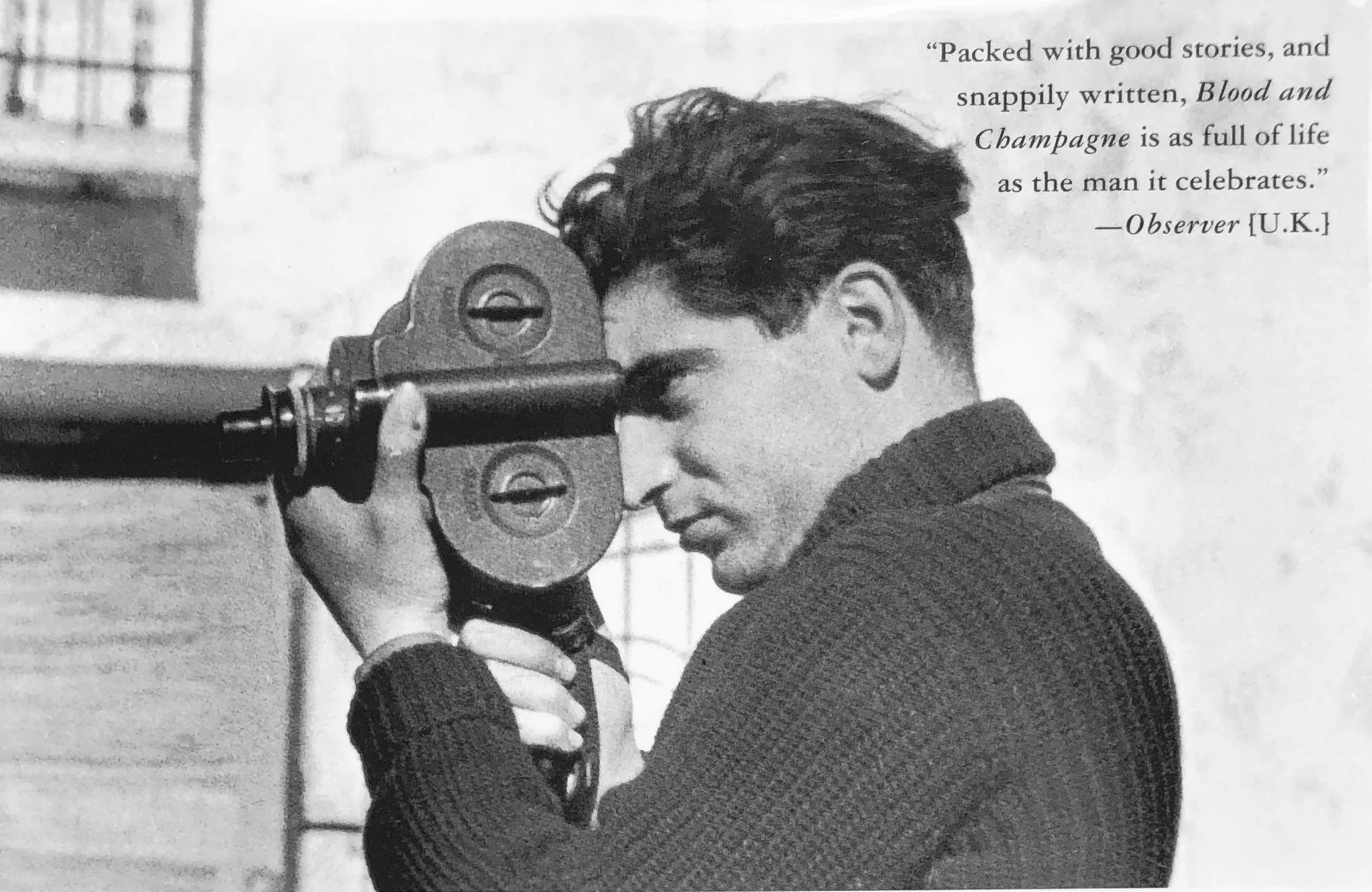
Book Review: Blood and Champagne, by Alex Kershaw
An Unauthorized Biography of Robert Capa
The author provides the background story to Capa's work and insight into the photographers' community from the 1930s to the 1950s. Reading Capa's story made me realize how much happened in the relatively…

An Unauthorized Biography of Robert Capa
INTRODUCTION
Having spent my childhood in the 60s through 80s of the last century in the southeast of the Netherlands near the German border, I remember playing in the demolished remnants of the bunkers of the Westwall (Siegried Line) and seeing the dragon's teeth anti-tank devices just over the border near Aachen, Germany.
And with parents and other family members who lived through the Second World War, that period in history always has had my interest—specifically concerning what happened in the so-called European Theather of Operations (ETO).
Combine this interest with my passion for photography, and it will not be a surprise that I loved reading this unauthorized biography of probably the most famous photographer of World War 2 and the decades immediately before and after that terrible period in history.
The author, Alex Kershaw (England, 1966), is a journalist, public speaker and the author of several best-selling books. His journalism includes investigative pieces, reportages, and interviews with a broad range of subjects. He also has led many battlefield tours of Europe.
Technical data:
Published: 2003 (first US edition)
Publisher: Thomas Dunne Books
ISBN: 0-312-31564-3
Size: 6 3/8” x 9 1/2” x 1”
The book has 23 chapters, each based on an important stage of Capa's life.
Furthermore, it contains:
a List of Illustrations;
Acknowledgements;
a foreword/introduction by the author
an Epilogue
Notes
Bibliography
Index
It also includes a section with 26 images: 18 are images of Capa, and 8 are images of his friends or acquaintances (the book does not have any pictures made by Capa).
REVIEW
Kershaw's narrative provides a unique insight into the life and background of the man André Friedman, who became the famous war photojournalist Robert Capa.
The author provides the background story to Capa's work and insight into the photographers' community from the 1930s to the 1950s. Reading Capa's story made me realize how much happened in the relatively short period of 3 decades that he was active: the Spanish Civil War, the Chinese-Japanese wars, World War 2, Korea, and Indo-China.
It, therefore, should not be a surprise that Capa's lifestyle and restlessness show symptoms of what we currently probably would associate with PTSD.
Capa was a photojournalist. But he was also a passionate photographer. One of the gems I found in the book was a quote from John Steinbeck ('Popular Photography' September 1954): "It does seem to me that Capa has proved beyond all doubt that the camera need not be a cold mechanical device. Like the pen, it is as good as the man who uses it. It can be the extension of mind and heart." [p. 1]
While he tried his hands at other trades, fortunately for the world Capa "decided to become a photographer, which was the nearest thing to journalism for anyone who found himself without a language." [p. 16]
Whether this was because his German - and later English - seemed not to have been the best or for other reasons, it shows that photography is a universal language.
As the author observes, "like nothing else, a still photography conjures up vivid memories." [p. 4]. Eva Besnyö, a friend of Capa and a great photographer in her own right, already realized that "Photographs could be a socially conscious artist's means of showing truth to the world, thereby helping to change it." [p. 14]
Capa embraced this notion, as Pierre Gassman noted: "He wanted to show people things they had never seen. He wanted to shock and surprise." [p. 24]
Capa achieved this with his unique style of getting as close as possible to his subjects, which he developed early in his career. Already during his first assignment, photographing Trotsky, "he had got within a few feet of his subject" [p. 19]
Capa later explained his "trademark intimacy and intensity." [p. 19] with his famous words, "If your pictures aren't good enough, you're not close enough." [p. 164]
CONCLUSION AND RECOMMENDATION
This book is an impressive biography of one of the great, if not the greatest, photojournalists of the 20th century.
It provides a unique, intimate insight into Robert Capa's life, the 'how' and 'when' of some of the most famous images of that era, and the photographer's community during the heydays of photojournalism.
A 'must read' for anyone interested in photojournalism, the era from the Spanis Civil War until the origins of the Vietnam War, or the photographers' community from the 1930s to the late 1950s.
Book Review: Lost London 1870-1945 by Philip Davies
How A Photo Book With Old Images Impacted My Photography
I was lucky enough to stumble upon this book while browsing the bargains area of Barnes & Noble. It is a photo book with old images from London, United Kingdom, taken between 1870 and 1945, providing a unique insight into how the city and its inhabitants looked during those years.

How A Photo Book With Old Images Impacted My Photography
Introduction
I was lucky enough to stumble upon this book while browsing the bargains area of Barnes & Noble.
It is a photo book with old images from London, United Kingdom, taken between 1870 and 1945, providing a unique insight into how the city and its inhabitants looked during those years.
Philip Davies has curated the images in the book, an architectural historian who - from 2005 to 2011 was the Planning and Development Director for London and South-East England at English Heritage.
From the dust jacket: "Lost London 1870-1945 is a spectacular collection of more than 500 of the best images from the formor London County Council archive of photographs... Most have been never published before. Taken to rovide a unique recored of whole districts of London as they were vanisching, each of the photographs is a full-plate image, a stunning work of art in its own right."
Published: 2009
Publisher: Transatlantic Press
ISBN: 978-0-9557949-8-8
Size: 11 6/8" x 9 7/8" x 1 1/2"
Review
The book has 14 sections, with the photo sections arranged according to period and city areas:
Foreword by HRH The Duke of Gloucester
Author's Note
Introduction - The Lost City - Images of London 1870-1945
Chapter One - Urban Penumbra - The City fringe
Chapter Two - Engine of Commerce - The City of London
Chapter Three - Between Two Cities - Holborn and Strand
Chapter Four - Imperial Capital - Westminster and the West End
Chapter Five - City Of Dreadful Night - The East End
Chapter Six - London-Over-The-Water - South London
Chapter Seven - Urban Villages - Villas and leafy gardens
Chapter Eight - Zenith 1918-39 - Sovereign of cities
Chapter Nine - Catastrophe 1940-1945 - A city in ruins
Index
Acknowledgements
The first thing that struck me was that the quality of the images is remarkable. They have great detail and excellent tonality. We only wish future generations can view our currently mainly electronically created images with the same quality after one or two hundred years.

Lost London 1870-1945, page 71
The book also provides a great history of photography in London in its Introduction. Not only its 'why' but also its 'how.'
"Photography was not easy in London. Henry Dixon recorded how he had to obtain a photograph in a crowded street by removing a wheel from a wagon, and while his assistant pretended to mend it, he photographed his subject from under the canvas." [pp. 24-25]
The images also show how the photographers had to work the light to create their photos: look at how buildings in the background are over-exposed due to the exposure time needed for foreground objects.

Lost London 1870-1945, page 23
The book's main objective is to create a sense of urgency with the viewers of the importance of preserving architectural gems. To paraphrase from the Foreword: This kind of photography emphasizes the task of English Heritage (and similar organizations in other countries!) to preserve the best of historic buildings, help the general public understand why they should be kept, and increase the understanding of the significance of these buildings for our history.
For me, however, the value and importance of the book and the photographs go far further than this. The images of the streets, buildings, and people provide us with a unique insight into how people lived during the period covered by the book. It is a true social documentary trove and "Spanning a period of 75 years from the mid 1870s to 1945, [the photographs] depict a world in transition." [p. 9]
"Some of the physical impacts of these profound changes can be seen in these photographs - the arrival of tramlines, the progressive replacement of horse-drawn vehicles by motor cars,..." [p. 27]

Lost London 1870-1945, pages 202-203
While Davies, in his Introduction, does a great job to explain the importance of the images from an architectural history perspective and while he provides us with a socio-economic reference frame for the period covered, it is the images themselves that tell that story best.
"As primary sources of historical evidence, [the photographs] are by their very nature impartial, and bear witness to past places or events, undistorted by the interpretation of their creator." [p. 9]
One of my first reactions was Eugene Atget coming to mind when first browsing through the images: the streets, sometimes with and sometimes without people. Important in that context is that "[The images] have been selected to show the commonplace rather than the great-set pieces,....which conveys so vividly the actual feel of London as it then was..." [p. 9] and they are "important documents of social and topographical history,..." [p. 9]

Lost London 1870-1945, page 69
Consequently, I dare say that Davies did for the multiple photographers whose images he used in the book what Berenice Abbott did for Eugène Atget.
Other images reminded me of Lewis Hine with their harsh directness and focus.

Lost London 1870-1945, page 14
Conclusion and Recommendation
This book is a monumental document about one of the world's great cities and about the photographers who documented the changes in London over 75 years.
It provides a unique, intimate insight into the status of London's buildings and streets and the lives of its inhabitants.
In conclusion, this is a remarkable document, and it has very much influenced my view about street and social documentary photography. Creating images of the places I visit, I also try as much as possible to have my photographs as impartial and undistorted by my interpretation of the scenes I observe as possible.
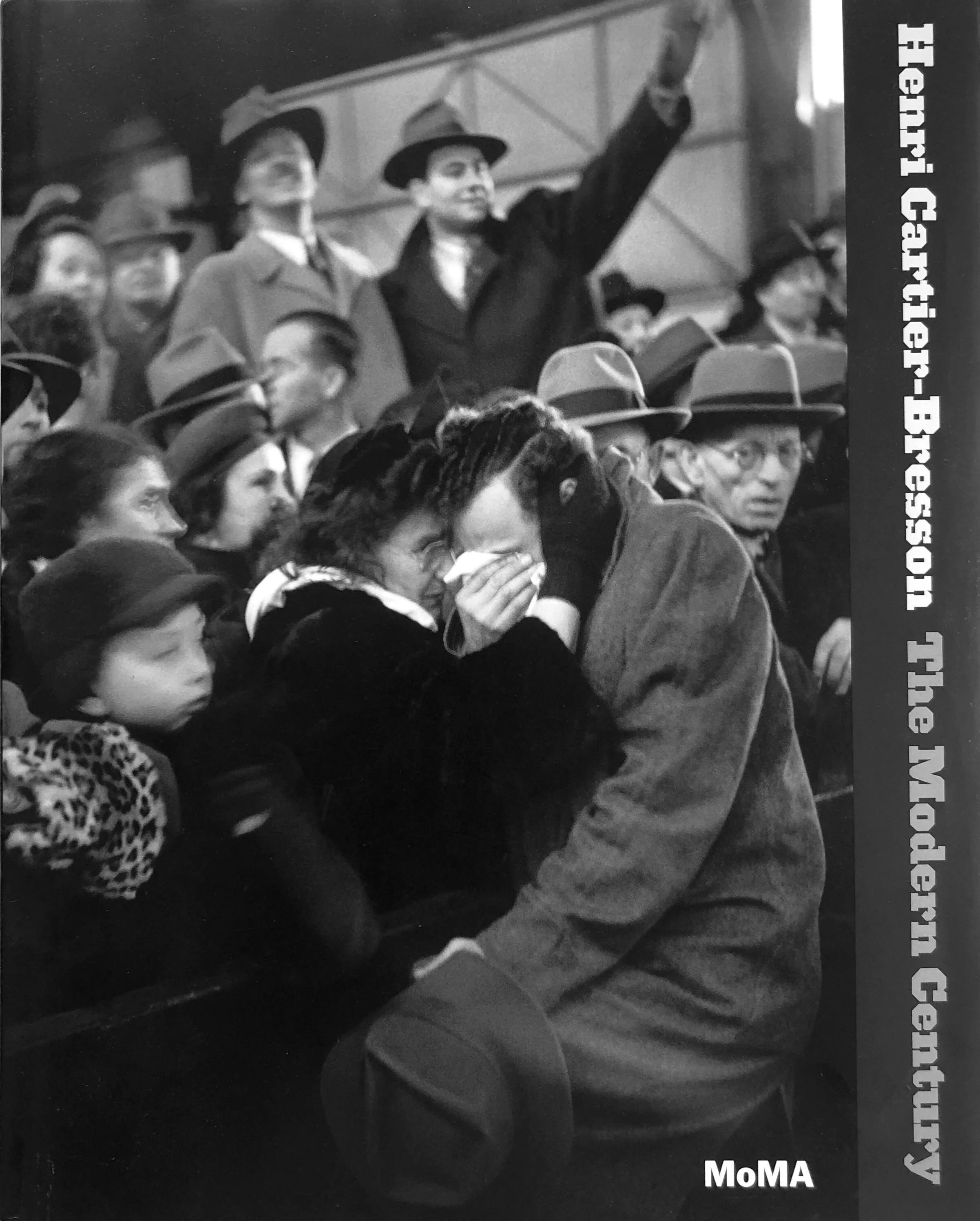
Book Review: Henri Cartier-Bresson - The Modern Century, by Peter Galassi
Eight Lessons I Learned From MoMA's Henri Cartier-Bresson Retrospective The Modern Century
Henri Cartier-Bresson. Admiringly called HCB by his followers, almost no documentary photography documentary does not mention him. Loved, imitated, copied: the photographer who defined documentary and street photography.

Eight Lessons I Learned From MoMA's Henri Cartier-Bresson Retrospective The Modern Century
Introduction
Henri Cartier-Bresson.
Admiringly called HCB by his followers, almost no documentary photography documentary does not mention him.
Loved, imitated, copied: the photographer who defined documentary and street photography.
And while he was only one of the founders of Magnum (together with Robert Capa, George Rodger, and David "Chim" Seymour), Henri Cartier-Bresson is often considered the father of documentary and street photography.
I wanted to explore what we can learn from his approach and photographic philosophy. How can we create images that are as impactful as his? Or at least try doing so.
While multiple books and documentaries are available about this master photographer, a great starting point to understand his photography is Henri Cartier-Bresson - The Modern Century by Peter Galassi, Chief Curator of MoMA's Department of Photography (1991 - 2011).
It also is the catalog to the 2010 Museum of Modern Art (MoMA) exhibition that was the "first major retrospective since the photographer's death in 2004." [p. 6].
With 376 pages and 463 reproductions, The Modern Century is a pleasure to read, a comprehensive reference work, and a treasure trove of images.
The book has 12 sections:
Foreword, by Gleen D. Lowry - Director of MoMA
Preface and Acknowledgements
Old Worlds, Modern Times
Photographs
List Of Photographs
Points Of Reference
At Home Everywhere: A Chronology Of Cartier-Bresson's Travels
For The Printed Page: Cartier-Bresson's Work In The Periodical Press
Chronology Of Major Photographic Exhibitions And Books
Selected Bibliography And Filmography
Index
Trustees Of The Museum Of Modern Art
While large parts of the main essay "Old Worlds, Modern Times" reflect on Henri Cartier-Bresson's life, I was especially interested in reading about his approach to photography and what we can learn from it related to working as a documentary image creator.
A Photojournalist Is A Jack Of A Thousand Trades
While every aspiring documentary photographer probably dreams of making a living from their work while traveling the world, one of the essential lessons from this book is that this job encompasses a lot more.
As Galassi explains, "...being a photojournalist didn't mean being just a photographer: It meant being a student, a diplomat, a traveler, an investigator, a reporter, a historican. To Cartier-Bresson, it meant engaging the whole of the world." [p. 12].
And some of the thousand trades the documentary photographer needs to balance can even be conflicting - the most challenging probably being an artist while at the same time being a truthful reporter.
"When Cartier-Bresson took Capa's advice and embraced the role of photojournalist, though, the artist in him did not evaporate." [p. 60].
"About his decision to join Magnum, he loved to cite Capa's advice: "Watch out for labels. They're reassuring, but somebody's going to stick one on you that you'll never get rid of: 'little Surrealist photographer.' You'll be lost, you'll get precious and mannered. Take instead the label of 'photojournalist' and keep the other thing for yourself." [p. 12].
This decision to continue to use his artistic vision while taking documentary images was possible and accepted because "The boldest innovation (or discovery) of interwar photography was the recognition that plain fact could be the chimerical stuff of a new art." [p. 32].
But Cartier-Bresson realized that as a documentary photographer, he needed to maintain the balance between creating visually attractive images and showing the world the reality of his subjects. "Cartier-Bresson sometimes spoke in somewhat romantic terms not only about Magnum but about his profession generally as a guild of craftsment whose job was to report honestly, not to flaunt their artistry." [p. 50].
Be Disciplined In Your Work
"Cartier-Bresson's conviction that "one must let the things grow in you" would become legendary, as would his distaste of deadlines and other editorial demands." [p. 20].
Letting a project grow and taking the time to develop its content, however, does not mean that we should not have a strong discipline and work ethic.
On the contrary, as Cartier-Bresson showed us, "shaking himself free of the worst idiocies of arrogant editors in New York did not require shedding the discipline and instincts of a journalist - qualities that he exhibited to a very high degree." [p. 21].
Cartier-Bresson's disciplined approach to photography started with visualizing the final image before he released the shutter. His contact sheets unquestionably reveal this: "...he rarely released the shutter simply because he was struck by a particular subject or action. That is, he took a shot only after he had translated the subject into a picture: if it was a vertical with a doorway anchoring the left side, then that element was already in place in the first frame of a sequence." [p. 42].
This visualization was vital to limit the number of frames he would need to use to get to the final image, "Four or five attempts was general the upper limit, unless the subject was particularly important or demanding or potentially fruitful. Two or three frames was more common." [p. 42].
And, finally, we can learn from Cartier-Bresson's composition discipline. Through visualization and carefully framing his subjects, he created images that contain everything needed to tell the story; "The frame includes everything that is relevant and nothing that isn't... The frame does not cut or exclude; it encloses and contains." [p. 46].
Go Out There Taking Pictures
The best, the only way to create meaningful images is to actually go out and create images.
Sometimes we, photographers, are in a creative rut: we don't know what to take pictures of, we don't know what story to tell, we sit down and pity ourselves for our lack of inspiration.
But no picture has ever been created by a photographer sitting in a chair, despairing what to do.
To be successful, we have to get up and make an effort.
Cartier-Bresson himself said it straightforwardly: "Do you know what it takes to be a photographer? It takes one finger, one eye, and two legs. I used to run or walk thirty or forty kilometers a day." [p. 60].
He understood that while we can, and should learn from the work of other photographers and educate ourselves about photographic techniques, "It's outside of school that one learns the most, in the street, in the workshop, at the stalls of a fair, at the theater, in railroad cars and on steamboats, in new landscapes and foreign cities." [p 29].
Focus On People
Most documentary photography exists because something happened. It is events that people are interested in, not things. Lifeless objects might be part of the event or even the reason the event occurs at all (e.g., a car show, the demolition of a building), but in the end, people are interested in people.
Thus, it is often more rewarding to focus on the people attending or watching an event than taking pictures of the actual event.
Cartier-Bresson learned that early in his documentary career when he got an assignment to cover the coronation of King George VI in Londen, 1937.
It was this assignment that started his approach of "...ignoring the event to study the crowd, who are all the more expressive, as a group and as individuals, because their attention is on neither themselves nor the photographer." [p. 38].
Photography Transforms What It Captures
As Sally Mann also teaches us, "Photography inescapably transforms what it describes" [p. 32].
Where Mann provides a great example of photography altering real memories when she talks about a picture of her father, Galassi states that "As the world passes through the lens into the camera, it retains the feel of reality but adapts to the very different realm of the picture." [p. 35].
Consequently, we have to live with the strange contradiction that "The still image possesses its power not because it is so real but because it is so artificial, as Rodin rightly insisted." [p. 45].
And this is where the importance of maintaining the balance between honest craftmanship and being an artist rears its head again, since "A great deal of what is generally classified as photojournalism is in fact not reportage but illustration - a matter of providing an appropriate... image to fill the space." [p. 54].
This transforming property of photography teaches us two lessons: "...the first is that the meanings of a picture can be influenced considerably by the context in which it appears... The second is that the significance of the tangible content of the picture depends upon both the photographer's capacity to grasp it and the viewer's capacity to interpret it." [p. 62].
And this leads us directly to the next learning point.
Take Notes, Write Captions, And Be Aware Of Their Impact
Captions are a topic that every photographer seems to struggle with: are they necessary for the viewer to understand the picture; should the photographer use them to direct the viewer's thoughts?
Cartier-Bresson was a firm believer in taking notes to his images, "He carried with him a notebook in which to scribble names and facts on the spot, then in the evening he sat down to translate the raw notes into a narrative rich in reflection and interpretation as well as facts." [p. 15].
And while captions sometimes seemingly might not be needed because an image "...so successfully transforms the particulars of a contingent event into a lasting symbol...that the caption is beside the point." [p. 17], they, in general, are needed to understand the broader context of the situation presented to the viewer.
And it is the photographer who was and is "...expected to provide not just the essential facts but the social, historical, and political background necessary to interpret the broader significance of the images." [p. 14].
We also need to be aware that it is not always the stand-alone event we are documenting that matters, "...but its potential to represent a much broader subject..." [p. 22].
Therefore, it is crucial that today's documentary photographers, similar to Cartier-Bresson, need to be "...acutely alert to the presence of the past." [p. 60], because their subject is not only what is immediately in front of the lens but is "...society, culture, civilization - that is, history." [p. 61].
Watch Out For The Decisive Moments
Henri-Cartier Bresson coined the phrase "The Decisive Moment, " which is also the title of his most known book.
What present-time photographers might not be aware of is that in a powerful photograph "...there are two quite distinct decisive moments, as Cartier-Bresson suggested in his famous formulation: "To me, photography is the simultaneous recognition, in a fraction of a second, of the significance of an event as well as of a precise organization of forms which give that event its proper expression." [p. 45].
And a photograph is most potent and successful when "...the decisive moment of the subject and the decisive moment of the photograph coincide perfectly. In terms of the definition, they are simultaneous." [p. 45].
Interestingly, as Galassi observes, "Much of the time, the subject offers no decisive moment at all; the climax of meaning is created by and exists only within the picture." [p. 45]. He provides as an example the image Cartier-Bresson in 1947 took of Jawaharlal Nehru with Edwina and Louis Mountbatten on the steps of Government House in New Delhi. The situation captured in the image is not of a decisive moment at all; however, how Cartier-Bresson composed the picture and placed the three people in it tells a whole story on its own.
Interestingly, the original French title of The Decisive Moment is Images à La Sauvette, which literally translated means "images on the sly."
We could also say that these are 'stolen' images: the pictures' subjects were not aware of the photographer capturing them.
I, therefore, think The Stolen Moment would be a better title for Cartier-Bresson's mastery. He was able to pre-visualize the image he wanted to create, needed only one or two instances to make the picture as he wanted it, and in this manner managed to produce a consistent body of work of powerful photographs.
Not All Photographers Are Editors
The final lesson I learned from reading The Modern Century is that not all photographers are good editors.
As Cartier-Bresson explained about himself, "My intuitive approach to photography and my constant preoccupation with the single image makes [sic] me a poor designer. I find it difficult to create a harmony among different photos. I leave this to my publisher friends, to art directors and curators with whom I always discuss the layout." [p. 58].
Whether deciding what image to publish or how to sequence and present a photo essay, most photographers probably are better off not doing that without help.
Editing and sequencing is an art on its own, and we should have the humility to recognize that creating images is not the same as selecting our best and bringing them all together in a story.
Suppose we don't have a trusted editor. In that case, the best we probably can do is leave all images alone for some time to ensure we are not as emotionally attached to them as we were immediately after creating them.
When we took the picture, we heard the noises, smelled the smells, and saw everything that was going on outside the frame.
Our viewers? They have to do with the image we managed to create and the captions we added. Let's be compassionate with them, for our picture's sake.
Conclusion
Henri Cartier-Bresson - The Modern Century is an insightful masterpiece, a pleasure to read, and a treasure trove for everything regarding this great photographer. From the story of his life to understanding how he was able to create his masterpieces to looking at the beautiful reproductions of HCB's famous and lesser-known pictures.
I highly recommend this book to all photographers, professionals, and hobbyists alike, irrespective of whether they want to be in the documentary photography business or active in any other photographic genre.
Author: Peter Galassi
Title: Henri Cartier-Bresson The Modern Century
Year Published: 2010
Copyright: The Museum of Modern Art, New York
Cover: Hardcover
Pages: 376
Publisher: The Museum of Modern Art, 11 West 53 Street, New York, NY 10019-5497 www.moma.org
ISBN: 978-0-87070-778-0 (cloth)
ISBN: 978-0-87070-777-3 (paper)
Buy it at the MoMA Store, Amazon, or Artbook.com (no affiliations).
More Information And Further Reading
The Boston Globe review of the exhibition
The Christian Science Monitor review
Review of the exhibition by John Haber
Review of the exhibition by Fundación MAPFRE