

Finding Focus
THE NEXT STAGE IN MY PHOTOGRAPHIC EVOLUTION, OR: HOW TRYING PURE STREET PHOTOGRAPHY HELPED ME TO FIND MY ROAD AHEAD
While I explored different photographic genres over the years, since moving to the US and being driven by my passion for people, I have come home to my true passion: documentary-style street photography and essays.

THE NEXT STAGE IN MY PHOTOGRAPHIC EVOLUTION, OR: HOW TRYING PURE STREET PHOTOGRAPHY HELPED ME TO FIND MY ROAD AHEAD
Have you ever looked at a vintage photograph and wondered who the people in that image were, how they lived, and how the cities seemed so different then?
As you can read on my About page, I grew up in a small village in the Netherlands, and when I got my first point-and-shoot camera in the early 1970s, I could not foresee that it would ignite a lifelong passion for photography.
While I explored different photographic genres over the years, since moving to the US and being driven by my passion for people, I have come home to my true passion: documentary-style street photography and essays.
When I talk about documentary-style photography, I don't mean documenting the 'big' things: famine, the US border crisis, global warming, deforestation.
Of course, if I get the chance, I will take images at a Women's March or similar events I might be able to attend (or stumble upon), but in general, I am more interested in the mundane of daily life.
Creating stories about regular people who make up the diverse population of my adopted country, showing how a small town looks today and the people in it; documenting small events like car shows that show the enthusiasts who come together there and create a unique culture; people at a horse race track, dancing, eating, gambling, having fun; telling the story of a master craftsman, who creates beautiful objects with his tools.
While maybe mundane, these all are unique pockets of the world we live in and the people who inhabit it. And when I do take pictures at events, I am more interested in the individuals attending (the proponents, the opponents, and the spectators) than in the event itself because I firmly believe that the individual stories provide the human connection to those events.
For some time, I thought creating and focusing on pure street photography images would satisfy my urge to tell these stories. So I started making what I thought were nice street photos and joined street photography groups on Facebook and Instagram.
The critique I received from experts in the field was an eye-opener and made me more critical about my and other photog's street images. And the more I learned about street photography, the more I (tried to) create street photography, and the more I looked at other photogs street photography, I found it unsatisfactory, boring, disappointing, and repetitive. So many images tagged as street photography are not, and I often saw a lot of copy-cats (how many iterations of pictures of people walking through a patch of light in an area otherwise in darkest shadow can one create?).
Understand me well: pure street photography is excellent, and I love looking at those images! But it also is rare and challenging to create.
Pure street photography is very much dependent on a decisive moment, and I realized there is so much more than the decisive moment: I want to capture a current moment, documenting in 1/125th of a second the sociohistorical situation of a particular place at a specific time. Wow, those are big words! But you probably understand what I ideally want to achieve.
Capturing a 'decisive moment' for me is a bonus, not a goal. There is so much more to show, achieve, share, and create awareness of that might not be captured when focusing on the decisive moment. Instead, I want to tell that broader story, which can be about people, a place, or an event and which, for obvious reasons, in most cases, is a combination of these.
While I like to work on projects to create photo essays, you can ask if a single 'snapshot' also can tell this broader story.' I think so. But I also want to explore how that single image relates to other pictures looking for patterns in human behavior.
Reading photo books helps me understand what I want to create.
On my journey to finding my focus, I have 'met' several current and past photographers whose work has influenced my thoughts about what I want to achieve and how to achieve it: Eugène Atget, W. Eugene Smith, Jill Friedman, Bob Friedlander, Helen Levitt, Robert Frank, Inge Morath, Sally Mann, O.N. Pruitt, Berenice Abbott, Jacob Riss, Dorothea Lange, Lewis Hine, the photographers who took the images in Lost London, Elliott Erwitt, and many others.
As mentioned above: making a good street photo is challenging. Is this next stage in my photographic evolution possibly a flight because it is too complicated?
To answer my question: No, composition, situation, image quality, light, and all other ingredients that make a pure street photo are also crucial to making the documentary-style photos and essays I (want to) create.
As I mention in my artist’s statement, inspired by a quote from Anais Nin, I want to share not the obvious but what we usually are unable to see: when I document, what can I show that others might not see?
Are you familiar with the phrase "write down to remember"? I want to "photograph to remember" and to help others remember. Now and, hopefully, in the future. While I create images and stories for me and my current audience, it would be great if I could make the 'vintage images of the future.' If even only one.
Looking back at the images I created over the years, especially since I live in the USA, it is not surprising that my journey is taking me in this direction. But with the help of the critique I received, seeing what current and past photographers create(d), and looking at street photography on social media, I have found the focus I was missing.
Now that I know better what type of images I want to create, I also can better define the tools I want to use. So while my camera setup underwent some changes last year, my main tools will continue to be the Fujifilm X-Pro1 and the Leica M4. Both with 35mm (or equivalent) lenses.
Why these?
Both are (relatively) small and discreet cameras and very well suited for the work described above, most of which still will happen on the streets.
Digital has all the positive assets we have learned to appreciate over the last couple of decades and cannot miss from any photographer's toolkit.
But why film?
First, even after scanning, film still has that unique look that is very difficult to emulate in digital post-processing.
Secondly, because of its limitations, working with film makes me more aware of the 'why' and 'what' to photograph.
And thirdly. There is no third. I do not use film because it 'makes me slow down.'
Of course, it slows me down: hand-metering light, manual focusing, manual film transport, only 36 images before I have to rewind and change the roll manually. And I will remember every time before pressing the shutter release button that every picture on film is far more expensive than one taken with the X-Pro1.
Now here is a curve ball.
Talking about film, I ponder using medium format for my documentary-style work. But that is a story for another day.
My journey is not over yet, and I still have a long way to go, but I have found focus and a road ahead.

Never Too Old To Play
New York City NY | Hester St. Playground | Feb 2019
New York City's China Town area is a treasure trove for street photographers and cultural experiences.

New York City, NY | Hester St. Playground | February 2019
New York City's China Town area is a treasure trove for street photographers and cultural experiences.
I noticed two gentlemen near the Hester Street playground playing the Chinese game of Xiangqi.
I didn't know if they played for toothpicks, hard dollars, or fun, but they were having a good time, and the bitter cold temperature didn't bother them.
Several onlookers were sitting and standing around their table, undoubtedly providing their advice for the next move.
Unfortunately, I had to move on and never got to know who won.

Teamwork
Greenville, SC | N Main St | January 2022
Walking on Greenville's, SC, Main Street, I saw these two workers repairing a wall…

Greenville, SC | N Main St | Jan 2022
Walking on Greenville's, SC, Main Street, I saw these two workers repairing a wall.
Working with their backs to the sidewalk, they seemed unaware of the people walking by. Focused on the task at hand, they quietly went about it, working together and getting the job done.
The public also did not notice them, indicated by the woman whose reflection is visible in the window in the background—going on with their daily chores, busy being busy. Not deliberately ignoring the workers, but not interested.
And is that not what generally is the case?
We all go about our busy lives without paying attention to the people around us.
It seems we are more interested in the actions and lives of movie stars, social media authorities, and other so-called 'influencers' than in the real people around us.
This thought inspired me to start working on a new project about real people: manual workers, parents, emergency services personnel, shoppers, office workers, etcetera.
In the upcoming weeks, I will need to flesh out the details: where to focus on possibly, what type of images, medium (film, digital, or both).
More to come.
Forever Young
Washington, DC | 11th Street NW | July 2014
Bob Dylan, Rod Stewart, Alphaville, and probably many others sang about it. Movies have been made about it.
Staying forever young: a wish that many people need to have.

Washington, DC | 11th Street NW | July 2014
Bob Dylan, Rod Stewart, Alphaville, and probably many others sang about it. Movies have been made about it.
Staying forever young: a wish that many people need to have.
If we must believe the music and film industries.
And cosmetics and clothing firms are playing well too.
Helping people to stay forever young.
Or at least: helping people feel they can stay forever young.
Or at least: making people feel they need to stay forever young.
Madrileñas
Madrid, Spain | Plaza Platería de Martinez | August 2019
Something that always strikes me in Spain is the strong and articulated women. Irrespective of social status or age, they are Present, with a capital P.

Madrid, Spain | Plaza Platería de Martinez | August 2019
Something that always strikes me in Spain is the strong and articulated women.
Irrespective of social status or age, they are Present, with a capital P.
After a stroll through Madrid's famous National Botanical Garden, my wife and I decided we earned some tapas and a refreshing drink. Since it was summer, most bars and restaurants had tables outside on the street, and we quickly found one near the botanical garden and the Prado museum.
While getting seated, I could not ignore these three ladies sitting at a table next to ours.
They were involved in deep conversation. One of the ladies passionately articulated her thoughts on a particular topic, while the other two listened with great attention.
I would have loved to eavesdrop to hear what they were so animated talking about, but that is not something one does. Also, my Spanish is not so good that I could fully understand what she said.
HOWEVER, what I could do was take my trustworthy Leica M4 and seize an image of this beautiful trio.
This photo might not capture a 'decisive moment', but, as I explained previously, street photography is not always about the decisive moment and is far more.
This image, for me, represents a typical situation that someone easily can encounter in Madrid. Or in any town and city of Spain.
Three ladies are having a great afternoon, enjoying some food and drinks and discussing current events, maybe talking about global wars and inflation, or gossiping about the new girlfriend of one of their sons.
Not The Decisive Moment
Street Photography Is Social Documentary Photography
Writing last week's blog posts about the book Lost London: 1870-1945 made me realize that there is an easily overlooked aspect of street photography.
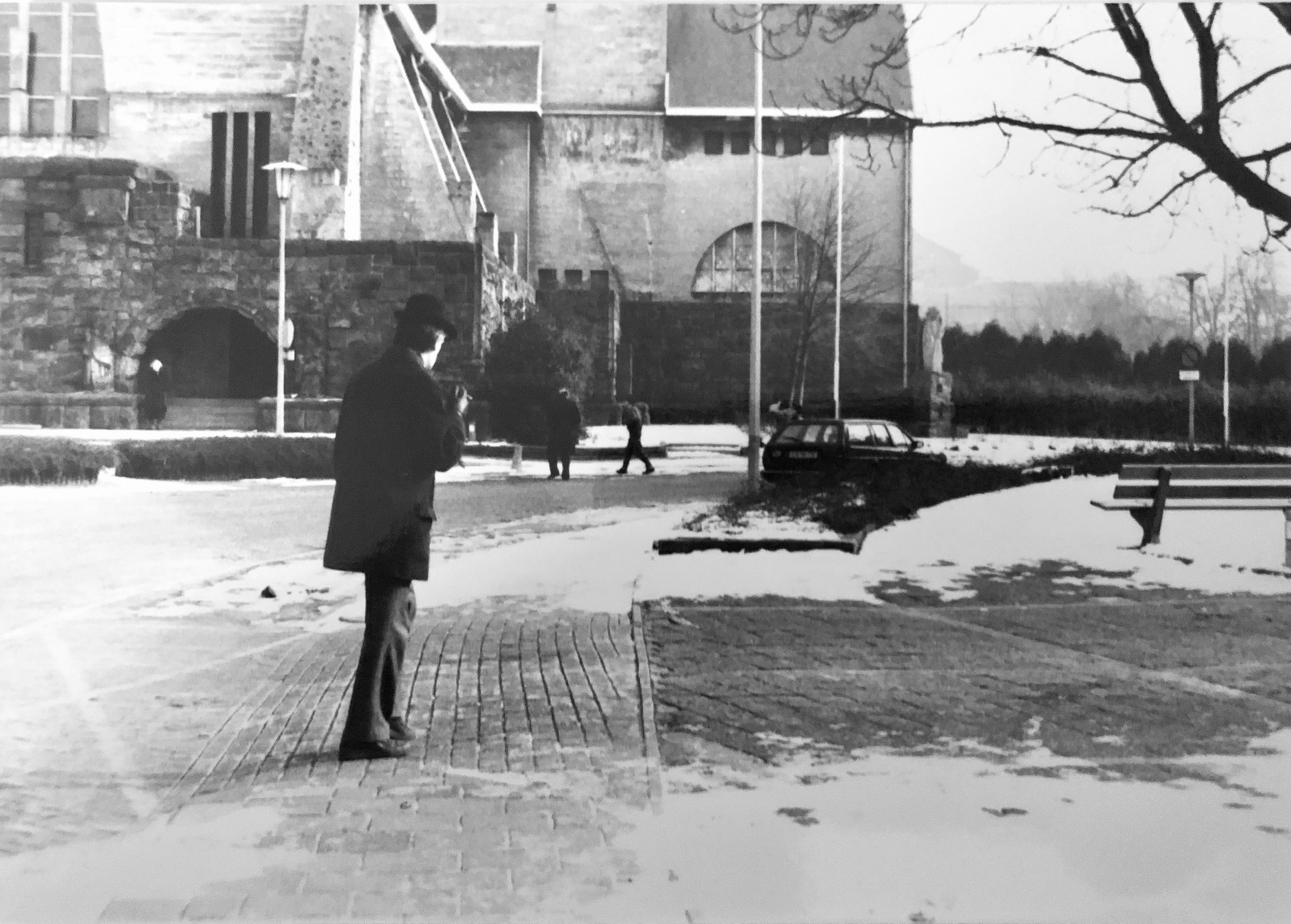
Image courtesy and copyright Amei Manten
Street Photography Is Social Documentary Photography
Writing last week's blog posts about the book Lost London: 1870-1945 made me realize that there is an easily overlooked aspect of street photography.
Every street photographer wants to capture a specific moment and create that 'one' image that will enthuse the world. With Olympians like Henri Cartier-Bresson, Vivian Mayer, Elliot Erwitt, and so many others as examples, we street photographers try to emulate their vision, their images, and their success.
But street photography is so much more, and street images can mean much more to our audience.
Street photography is not and does not always have to be about the decisive moment.
The images in Lost London: 1970-1945 made me realize that there is so much more to these pictures than the decisive moment. These images capture a particular place during a specific time that has a special meaning for contemporary viewers.
Allow me to explain this with an example of an image not related to the book.

Image courtesy and copyright Amei Manten
Recently I posted an image from the small village my wife and I grew up in on Facebook. My then-girlfriend, now wife, created the picture in the mid-1980s as part of a photography assignment while studying at the University of Leiden (the Netherlands).
It is quite an ordinary image: a village street with a woman.
However, posting this image on Facebook had a surprising result. Numerous people commented on the street and the buildings, with many trying to figure out who the woman in the picture was.
This result and the images from the book Lost London: 1870-1945 made me realize that street photography always is a form of social documentary photography. With or without a decisive moment captured, street images provide contemporary viewers and later generations insights into our environment's current state; it captures the Zeitgeist.

Image courtesy and copyright Amei Manten
The look of the streets, the buildings that may change or totally disappear in the future, the people, the clothes they wear, their occupation, and other details of daily life we at this moment take for granted but will be of interest later.
This realization gave me a feeling of calmness.
I no longer have that unsatisfied urge to hunt or fish for the decisive moment when creating street images. Instead, I am more aware of my surroundings and what my image might mean to future viewers. Maybe they lived in this specific area I am capturing; perhaps I captured one of their family members in my frame.
Street photography, for me, now is more about capturing the current state, and it's not only about the decisive moment.
I still will look out for it, and if and when I capture such a moment: outstanding, excellent! But, if not, I move on with the knowledge that at least I captured something from which future viewers can learn how the world looked today.
Book Review: Lost London 1870-1945 by Philip Davies
How A Photo Book With Old Images Impacted My Photography
I was lucky enough to stumble upon this book while browsing the bargains area of Barnes & Noble. It is a photo book with old images from London, United Kingdom, taken between 1870 and 1945, providing a unique insight into how the city and its inhabitants looked during those years.

How A Photo Book With Old Images Impacted My Photography
Introduction
I was lucky enough to stumble upon this book while browsing the bargains area of Barnes & Noble.
It is a photo book with old images from London, United Kingdom, taken between 1870 and 1945, providing a unique insight into how the city and its inhabitants looked during those years.
Philip Davies has curated the images in the book, an architectural historian who - from 2005 to 2011 was the Planning and Development Director for London and South-East England at English Heritage.
From the dust jacket: "Lost London 1870-1945 is a spectacular collection of more than 500 of the best images from the formor London County Council archive of photographs... Most have been never published before. Taken to rovide a unique recored of whole districts of London as they were vanisching, each of the photographs is a full-plate image, a stunning work of art in its own right."
Published: 2009
Publisher: Transatlantic Press
ISBN: 978-0-9557949-8-8
Size: 11 6/8" x 9 7/8" x 1 1/2"
Review
The book has 14 sections, with the photo sections arranged according to period and city areas:
Foreword by HRH The Duke of Gloucester
Author's Note
Introduction - The Lost City - Images of London 1870-1945
Chapter One - Urban Penumbra - The City fringe
Chapter Two - Engine of Commerce - The City of London
Chapter Three - Between Two Cities - Holborn and Strand
Chapter Four - Imperial Capital - Westminster and the West End
Chapter Five - City Of Dreadful Night - The East End
Chapter Six - London-Over-The-Water - South London
Chapter Seven - Urban Villages - Villas and leafy gardens
Chapter Eight - Zenith 1918-39 - Sovereign of cities
Chapter Nine - Catastrophe 1940-1945 - A city in ruins
Index
Acknowledgements
The first thing that struck me was that the quality of the images is remarkable. They have great detail and excellent tonality. We only wish future generations can view our currently mainly electronically created images with the same quality after one or two hundred years.

Lost London 1870-1945, page 71
The book also provides a great history of photography in London in its Introduction. Not only its 'why' but also its 'how.'
"Photography was not easy in London. Henry Dixon recorded how he had to obtain a photograph in a crowded street by removing a wheel from a wagon, and while his assistant pretended to mend it, he photographed his subject from under the canvas." [pp. 24-25]
The images also show how the photographers had to work the light to create their photos: look at how buildings in the background are over-exposed due to the exposure time needed for foreground objects.

Lost London 1870-1945, page 23
The book's main objective is to create a sense of urgency with the viewers of the importance of preserving architectural gems. To paraphrase from the Foreword: This kind of photography emphasizes the task of English Heritage (and similar organizations in other countries!) to preserve the best of historic buildings, help the general public understand why they should be kept, and increase the understanding of the significance of these buildings for our history.
For me, however, the value and importance of the book and the photographs go far further than this. The images of the streets, buildings, and people provide us with a unique insight into how people lived during the period covered by the book. It is a true social documentary trove and "Spanning a period of 75 years from the mid 1870s to 1945, [the photographs] depict a world in transition." [p. 9]
"Some of the physical impacts of these profound changes can be seen in these photographs - the arrival of tramlines, the progressive replacement of horse-drawn vehicles by motor cars,..." [p. 27]

Lost London 1870-1945, pages 202-203
While Davies, in his Introduction, does a great job to explain the importance of the images from an architectural history perspective and while he provides us with a socio-economic reference frame for the period covered, it is the images themselves that tell that story best.
"As primary sources of historical evidence, [the photographs] are by their very nature impartial, and bear witness to past places or events, undistorted by the interpretation of their creator." [p. 9]
One of my first reactions was Eugene Atget coming to mind when first browsing through the images: the streets, sometimes with and sometimes without people. Important in that context is that "[The images] have been selected to show the commonplace rather than the great-set pieces,....which conveys so vividly the actual feel of London as it then was..." [p. 9] and they are "important documents of social and topographical history,..." [p. 9]

Lost London 1870-1945, page 69
Consequently, I dare say that Davies did for the multiple photographers whose images he used in the book what Berenice Abbott did for Eugène Atget.
Other images reminded me of Lewis Hine with their harsh directness and focus.

Lost London 1870-1945, page 14
Conclusion and Recommendation
This book is a monumental document about one of the world's great cities and about the photographers who documented the changes in London over 75 years.
It provides a unique, intimate insight into the status of London's buildings and streets and the lives of its inhabitants.
In conclusion, this is a remarkable document, and it has very much influenced my view about street and social documentary photography. Creating images of the places I visit, I also try as much as possible to have my photographs as impartial and undistorted by my interpretation of the scenes I observe as possible.
Hello Mrs. Cartier-Bresson
Greenville, SC | S Main St - W McBee Ave | January 2022
When I saw this lady walking towards me, I almost froze. Where did I see those sunglasses before?

Greenville, SC | S Main St - W McBee Ave | January 2022
When I saw this lady walking towards me, I almost froze.
Where have I seen those sunglasses before?
Could it be?
Is it her?
If only HCB was here, he would be able to tell
61 years... impossible, it can't be her...
Maybe her daughter?
Paying Attention
Washington, DC | Lincoln Memorial | August 2014
One of the joys of street photography, actually the reason I think most street photographers do what they do, is observing people…

Washington, DC | Lincoln Memorial | August 2014
One of the joys of street photography, actually the reason I think most street photographers do what they do, is observing people.
People on their own, in small groups, or, as in this image, in large groups of individuals who are not in any way related to each other than for the fact that they are coincidentally in the same place at the same time.
When visiting the Lincoln Memorial in 2014 (obviously very much during pre-pandemic times) I noticed that most visitors are not really paying attention to the statue of the great man. Several were walking around in circles like lost in the vast space of the Memorial building, some were talking in groups, and quite a few were busy taking selfies with their omnipresent phones.
Except…
Except for this one woman, who stood still in the middle of the moving, chattering and self-focused crowd.
She was looking at the image of President Lincoln. Paying attention. As if to say: “What can you tell me. What can you teach me.”
And isn’t that what we all should do more often? Paying attention. Putting the phone away. Stop talking. Stop being focused on ourselves. And just pay attention.
Passersby
Greenville, SC | S Main St | September 2021
This black and white image of two people in silhouette in downtown Greenville, SC probably depicts one of the most interesting parts of street photography…

Greenville, SC | S Main St | September 2021
This black and white image of two people in silhouette in downtown Greenville, SC probably depicts one of the most interesting parts of street photography.
We take pictures of strangers without knowing anything from them. Are they are happy or sad, rich or poor, on vacation or walking to work. We don’t know…
We take their pictures, but they are like silhouettes to us: we don't see the details of their lives.
Conversation
Greenville, SC | S Main St - N Court St | September 2021
As a street photographer, I always wonder about the background of the people in my photographs: who are they,…

Greenville, SC | S Main St - N Court St | September 2021
As a street photographer, I always wonder about the background of the people in my photographs: who are they, where do they come from, what are they thinking?
When looking at the man and woman sitting together here and both looking straight ahead, I could create two different stories: one of them being annoyed with each other and not wanting to talk, and one of them being so comfortable with each other that no words are needed to communicate.
I prefer the latter.

Why Subjects Need Space
To Crop Or Not To Crop, The Question Is
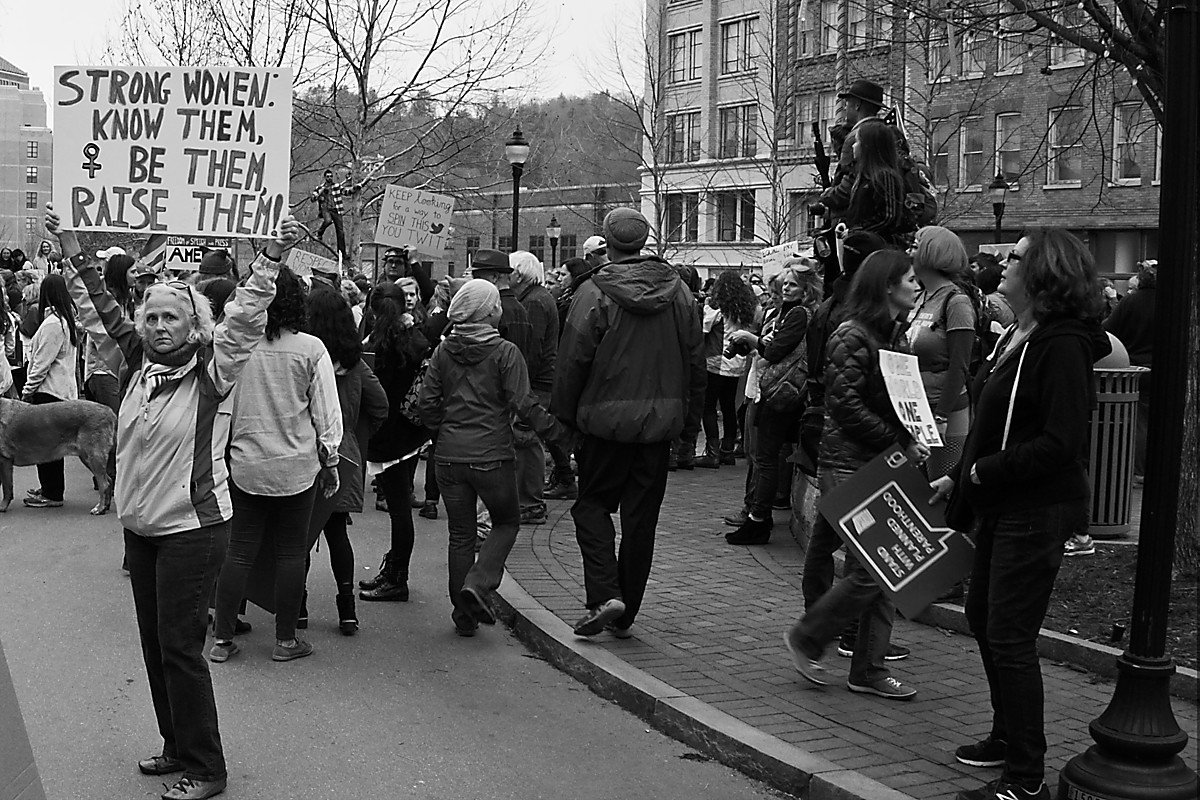
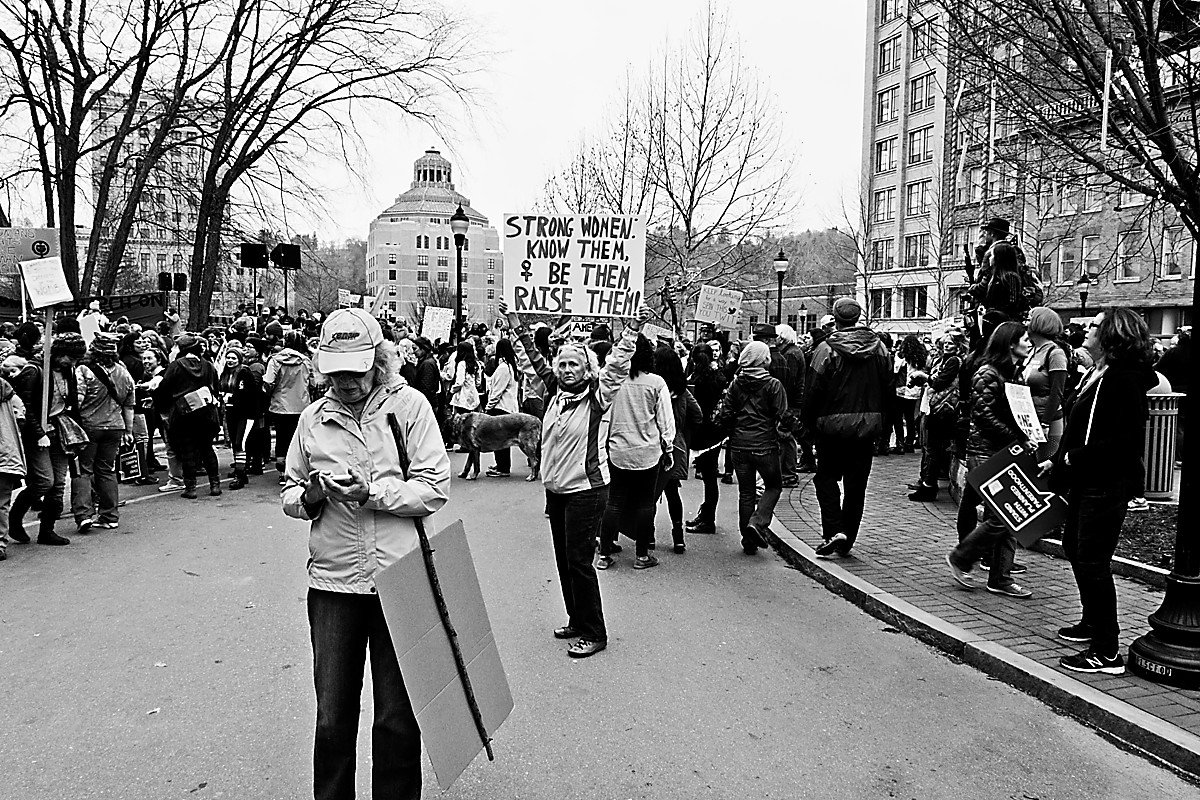
I need to think more about when to crop my images and when not. Reducing what the viewer can see of the subject of an image to the bare minimum can take away from the message that I want to share.
To Crop Or Not To Crop, The Question Is
I need to think more about when to crop my images and when not. Reducing what the viewer can see of the subject of an image to the bare minimum can take away from the message that I want to share.
Why I Sometimes Crop Images
While I challenge myself to get my composition right when taking a picture for my social documentary-type images, I sometimes still feel the need to crop the image for a better (very subjective indeed) result.
The reason to crop images, for me, can be one of two:
I want to change the aspect ratio of the image, or
I want the viewer to see something special.
The first reason is basically for esthetics: I really love images in the 4:5 aspect ratio and an added perk is that 4:5 images print great on letter-sized paper.
The main reason I would crop an image in post-production, however, is to ensure that the viewer sees what I want them to see. When reviewing some Street Candid images, I feel that the viewer would benefit from some guidance for what to look at to fully understand why I took the picture.
Why Cropping Doesn’t Always Result In A Better Picture
It is the second reason I want to talk a bit more about today. After reading the feedback I got on my initial publication of the image “Alley Leg”, I realized that cropping with the intent to show the viewer something special that I saw when creating the image, can actually work adversely
Because I 'zoom' too far into the subject I want to show, the viewer does not see, can not see why I want to show it.
If I want to show something important, the viewer doesn't grasp the importance.
If I want to show something funny, the viewer doesn't grasp the joke.
The reason for this is that I eradicated the context from what I wanted to show.


I saw that something was important because I saw it in its context. I saw that something was funny because I saw it in a specific context. By cropping, I removed the context. And as a consequence, the viewer has no clue about what I actually want to show!
This, of course, is not always the case. Sometimes cropping can help to remove distracting elements from the image. And limited cropping might help to just improve the composition sufficiently to make the image more interesting.
And Sometimes Cropping Is Just “Not Done”
As I mentioned above, for my social documentary-type images I challenge myself to get my composition right in-camera. The main reason for this, as I explained in a previous article, is that I want to be as unbiased as possible when showing the viewer what happened during the events I documented. And although there always will be some subjectivity (whenever you take a picture you always have to decide what to show in the frame and what not), this challenge helps me to provide an as objective as possible record of what happened.
Good examples are the two images at the top of this article that are from the same event: one cropped, and one uncropped. Do you ‘read’ each image differently?

In Focus: Bargain Found
The Joy of Finding a Bargain at a Madrid Market
This image was created during a stroll in sunny Madrid, Spain, in August 2019…

The Joy Of Finding A Bargain At A Madrid Market
Background Story
This image was created during a stroll in sunny Madrid, Spain, in August 2019.
I used my home leave from my assignment to South Africa to spend a week in Madrid with my wife, prior to traveling on to The Hague, the Netherlands, for some time with my youngest daughter.
Madrid has an abundance of squares (plazas), shopping streets, small back alleys, and parks to explore. The weather was great that week and we enjoyed a couple of days strolling through the beautiful capital of Spain.
That particular day we visited several open-air street markets, where a large diversity of goods was being sold. Fruit, vegetables, meat, fish, musical instruments, potter, leatherware, shoes, t-shirts, artisan bread, cheese, handheld fans, bags, tools; you name it, they sold it. And fabrics of course.
A fabrics stall at a market is always interesting to observe. Often the merchandise is just laying on a table or on the ground, and prospective buyers are picking it up, holding it to the light, and showing it to each other to determine if it is the right quality, size, and color for whatever they are creating at home.
And always there is this hope to find a real bargain.
As you can imagine, this creates numerous situations to make a photo. And this was just the right one for me.
How It Was Made
Only a couple of weeks earlier I was fortunate to purchase a just CLA’d Leica M4 and a Summaron 35mm f/2.8 lens for a very reasonable price. And since my wife brought my Voigtländer VCII lightmeter from home, I was experimenting with the camera, lens, lightmeter combination.
As you will know by now, I love black and white images and I had my favorite film, Ilford Delta 400, loaded.
Why It Works
The subject matter of this image is right up my alley: the busyness of the market, people interacting with each other, and the play of light and shadows.
The main subject is formed by the two hugging women in the center of the frame.
The pile of fabric and the piece held up by the lady to the left create a nice diagonal, leading the viewer’s eye through the composition.
The small tree and its support to the right and the larger tree to the left frame the main subjects of the image, while at the same time creating sub-frames for other points of interest: see the walking man perfectly framed by the small tree and the wooden support? This was a nice bonus that I only discovered after getting the film back from the lab.
As always, the light plays a major factor in making this image work for me. The harsh sunlight to the left and right of the group of women, with the shadows on the street in the foreground and the dark leaves of the trees, provides an additional frame for the main subject.
All parts work together to create several frames around the center of the image, focusing the view towards the two women in the center.
How Can This Image Be Used
There are several ways to use an image like this in a commercial setting.
There might be a hotel nearby that can use this image to show their guests the area they are located at, and how close they are to classical Madrid markets.
And the City of Madrid could use it to show prospective visitors its relaxed but lively street life and market culture, ideally for tourists who want to experience the real Spanish.
Although countries and cities are opening up after what hopefully was the worst of the Covid-19 / Coronavirus impact it might be a while until we can strolling the markets of Madrid again. Until then, images like this one will remind us of the better times to come.

In Focus: Food Envy
Pre-Pandemic Diners In The Hague
We all remember those carefree pre-pandemic afternoons and evenings when we could stroll the streets…

Pre-Pandemic Diners In The Hague
Background Story
We all remember those carefree pre-pandemic afternoons and evenings when we could stroll the streets without face masks and go to restaurants to enjoy a good meal without being restricted in how many friends to meet. Don’t we?
This image was created during a warm summer evening stroll in The Haag (Den Haag), The Netherlands, in August 2019.
I had spent a week in Madrid, Spain, with my wife and now enjoyed the additional time off with my youngest daughter who just moved for her studies to this lovely city in the Netherlands.
I stayed in the Park Centraal Hotel which is in a beautiful 160-year-old building. And in the Molenstraat and neighboring streets immediately outside the hotel are several small shops, restaurants, and eateries.
Tourists and locals alike enjoyed dining inside and on the terraces outside. The relaxed atmosphere, the darkening sky, and the light inside the restaurants created a tableau that depicted the typical Dutch “gezelligheid”. While this can be translated with “cosiness”, the Dutch word encompasses more: a general feeling of wellbeing and safety.
I find it always amusing to see how passersby look at people eating outside. In fact, they might not be as much interested in the diners as well as in the food on their plates. Are they deciding what they want to order themselves? Or are they going to an eatery which they anticipate has a less enjoyable menu; are they a bit envious maybe? Is food envy a concept?
Anyhow. The environment was right, the people were at the right place. And I made the photo.
How It Was Made
It was only in January of that year that I purchased the Fujifilm X100F, and I was still experimenting with its settings and discovering its capabilities.
I love black and white images (did you notice that all images on this website are monochrome?) and in this instance, I used the Acros standard camera preset.
Although I actually like that preset very much, when editing the image I selected the ON1 preset for Ilford Delta 400. I just love that film and I also wanted to check how the built-in preset would compare to scans from actual film images.
Why It Works
First of all, I like the subject matter.
A small city street with restaurants and outside diners. People passing by; what are they thinking?
Are the passers-by envious of the diners? Are the diners disturbed by the people walking in the street?
Then there are the leading lines that lead the viewer’s eye through the image.
The curb and the awnings are perfect examples of converging lines, anchored in the bottom right corner by the blackboard with snack offerings.
And, finally, the light. Ah, the light!
The combination of pre-sunset light and the soft incandescent light from the restaurants, creating that special atmospheric mood that is so typical of lazy summer evenings.
I can just not get enough of it.
How Can This Image Be Used
Images like this can well be used in a commercial setting.
Humphrey’s Restaurant might use it to connect their customers to the location (unfortunately their restaurant in the Molenstraat has been closed, but at the time of writing of this article they still operate a restaurant in Scheveningen, near The Hague), or to show them the great ambiance they have.
The Park Centraal Hotel can use this image to show their guests the nice area they are located at, and how close they are to restaurants and nightlife.
And the City of The Hague could use it to show prospective visitors how a big city can offer coziness and a safe environment to spend the evening.
With the current Covid-19 / Coronavirus-related restrictions in place, it might be a while until we can enjoy dining out in the Molenstraat again. But the time will come that we are allowed again! Until then, images like this will remind us how great having dinner outside with friends is.

In Focus: Mobsters
Party-Goers In Black And White
When I saw this group standing in the street between the Westin and the old courthouse building, I was…
Party-Goers In Black And White
Background Story
I love living near Greenville, South Carolina. It is very walkable, and it has several districts that are great for the types of images I like to create. Greenville's downtown area has the right mix of shops, restaurants, and parks to generate some hustle and bustle while maintaining that small-town USA feeling.
And there is always something going on.
I love to stroll Greenville's streets, looking for situations that could make interesting subjects for my Street Candids series. On this particular day, I noticed a group of party-goers standing in a street near the famous Westin Hotel on Main.
How It Was Made
I worked with the Canonet QL17 rangefinder camera, loaded with Ilford Delta 100, a fine-grained film excellently suited for that day's sunny conditions.
After taking some pictures of the old Greenville News building on Main, I roamed some time in the area around The Westin Poinsett, the old Chamber of Commerce building, and the clock and fountains at the crossing of Main and Court Street.
When I saw this group standing in the street between the Westin and the old courthouse building, I was immediately intrigued. I walked towards them and composed the image to include parts of the road and create leading lines.
In post-processing, I cropped the original image to the 1:1 aspect ratio to ensure the group of men was in the center of the image and to emphasize the leading lines in the composition.
Why It Works
I like this image for several reasons.
First of all, the subject matter. A group of men in black suits, standing in an alley-like street. What are they talking about? What are they: party-goers, members of a band, or maybe...?
Zooming in, a man is visible standing in front of and facing the group. Is he a photographer taking a group picture? Or is he confronting the group; are they confronting him?
Then the image's mood: to me, it looks intriguing and maybe even a bit intimidating. The contrast between the black and white areas in the image increases the dramatic feeling: the suits, the walls, the shadow in the street.
Lastly, the crop I used: changing the image to a square format enhanced the leading lines and increased the group's focus in the middle.
One Additional Thought
While this is one of my Street Candids I like best, looking at the image triggered some thoughts regarding the decisions I made regarding capturing and presenting the image.
One of the strengths of photography is also one of its most significant challenges: by choosing a specific composition, the photographer decides what their audiences will see and influence their audiences' conclusions and emotional response to the image.
Using a specific film or film-simulation while capturing a scene or making certain adjustments to the image during processing, the photographer can add a certain mood to the picture.
The photographer can even more impact how people will look at the image and experience it by adding a caption.
Concerning this image, the men might have been wedding guests or maybe even the groom and his best men. Or perhaps it was a bunch of guys attending some other formal event.
However, by capturing them this way, using a specific film, and adding a caption, I turned them into something very different.
How easy, or difficult, is it for you to view this image as I present it now to see them as something else than a group of 1930's gang members? To what extend is your initial reaction to and assessment of this picture influenced by the choices I made?
These observations and questions take us back to how "straight" straight photography is, or to what extent it can be; which is something for a separate article.
In Focus: Watering Hole
Street Photography As An Urban Safari
Going out with the intent to create street candids sometimes reminds me of being on a safari…

Street Photography As An Urban Safari
Going out with the intent to create street candids sometimes reminds me of being on a safari.
An essential part of the fun when my family and I went on a safari in South Africa was the excitement of searching for wildlife before actually seeing any animals. The increased awareness of your surroundings and watching for any movement that could indicate a lion, elephant, giraffe, or one of the many antelopes.
Walking the streets of a city in search of candid street photos provides me the same excitement. Continually looking at people and their behavior, in the hope that something worthwhile photographing occurs.
A couple of months ago (this image is pre-Covid; hence the high number of people close together), I roamed the streets of downtown Greenville, SC, and noticed this group of people playing with the water of a fountain on Main Street.
The scene immediately reminded me of animals gathered around a watering hole as I have seen on safaris in South Africa. Even the person to the right fits nicely in the scene, appearing to stand on guard for the group.
I like how this image worked out and how it reminds me that going out for street photography is like being on an urban safari.
Behind The Scenes: From Both Sides Now
Freedom Of Speech At Work
captured today’s image while walking the streets of downtown Greenville, SC, looking for …

Freedom Of Speech At Work
I captured today’s image while walking the streets of downtown Greenville, SC, looking for pictures for my fine art shop.
Background Story
Last Saturday I went to downtown Greenville, SC, which is just a 30-minute ride from where I live. I took the Fujifilm X-Pro1 with a Nikon AF Nikkor 35mm 1:2D mounted. The reason why I picked this camera/lens combination might be a topic for a future blog post.
The idea was, to create some images for my fine art shop, and to print at home for the upcoming Mini Farmers Market in our neighborhood. And maybe also capture some Street Candy on the go.
As you might be aware, 2020 is a Presidential Election year here in the USA and you probably are also aware that the candidates of the two largest parties are quite ‘verbal’ in addressing each other. So are their respective supporters.
How It Was Made
Strolling downtown I noticed a group of pro-Biden supporters who were protesting against his opponent: current President Trump. They were waving some signs, some were dressed up, and they were trying to get the attention of passers-by. All very friendly and not aggressive.
I took one or two shots on the go of this group and walked on, to my main subjects of the day: some old buildings in Greenville’s West End and Fluor Field. The latter is a minor league baseball field and home to the Greenville Drive, a feeder club for the Boston Red Sox.
Walking back to my car, I had to pass the demonstrators again. And as it happened, a small caravan of pickup trucks and other cars drove by displaying large US flags and pro-Trump flags. This cavalcade continued to drive on Main Street, through the group of pro-Biden supporters who were standing on the sidewalks to the left and right.
I raised my camera and quickly shot a couple of frames of this sight.
To me, this was just great!
Of course, both groups were shouting at each other and the people in the cars were honking the horns, but it was enthusiasm everyone displayed. Not anger, not being mean, but using their freedom of speech to try and get their message across.
The cars drove on to wherever they were going next, and the group on the street continued their demonstration for their cause.
And is this not how it always should be? Enthusiasm, but not anger. Passion, but no violence.
Why It Works
This is the image of the set I like best and it works for me first and mostly because it shows what it shows: the passion and the non-violent demonstrations.
Then, of course, there is the juxtaposition of the pro-Trump and anti-Trump supporters. The story of this year’s election captured in one frame.
And then there are some small details in the picture that add a bit extra. The ‘One Way’ street sign, for example. Is this a sign of what is happening elsewhere in the country, where opposing groups are less peaceful? The face masks. A sign of our times, or are they going to stay?
The more I look, the more I discover.