
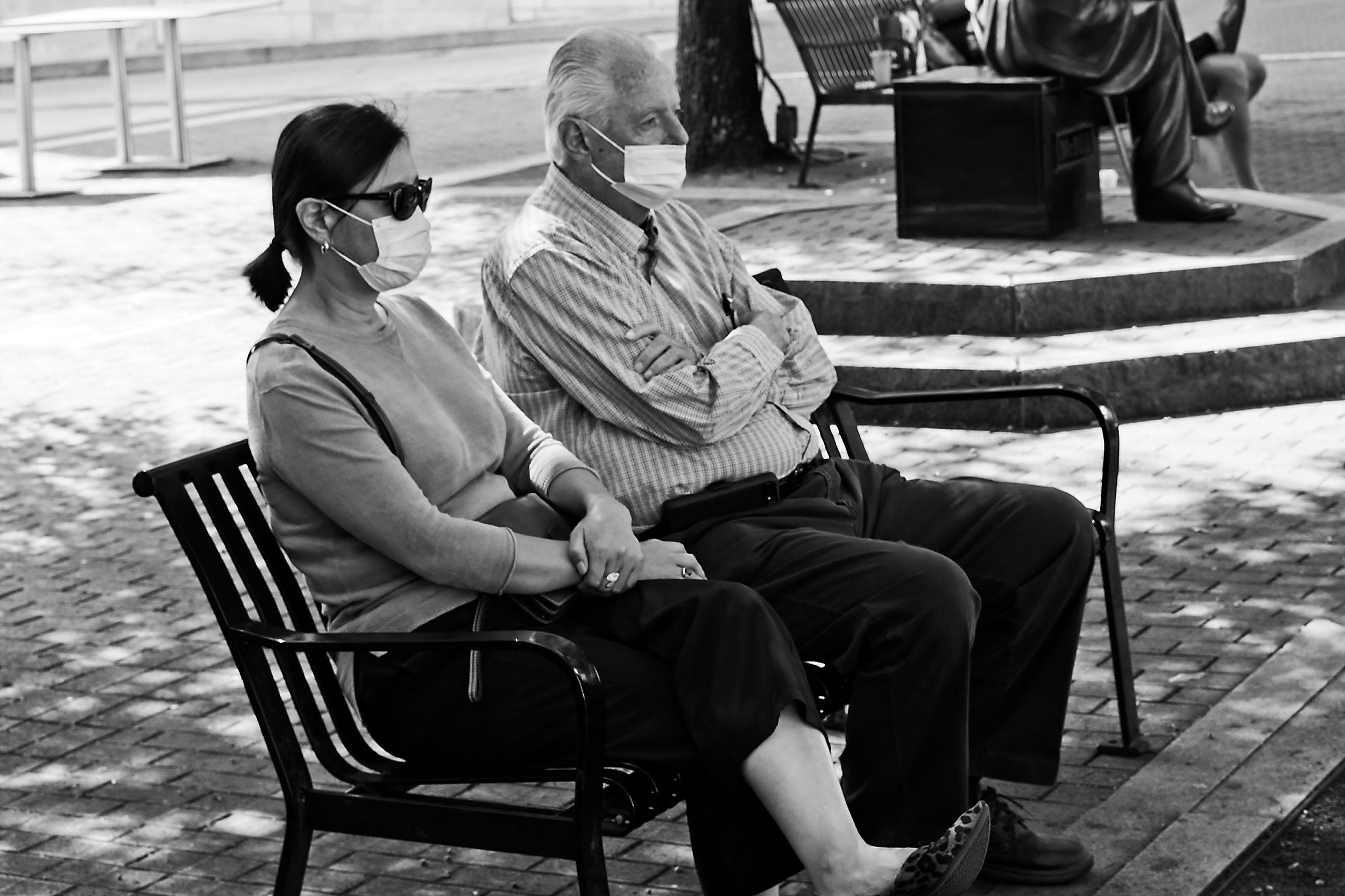
What Is A Good Photo?
If your pictures aren't good enough, you're not close enough - is that it?
What does make a good photo? Is it just proximity to the subject (as Robert Capa famously said)? Or is there more to it? In this article, I provide some insights into the elements that could make a good photo, and also some tips to get educated about photography.
If your pictures aren't good enough, you're not close enough - is that it?
If you had only one social media account, you would be bombarded with hundreds of images daily. But, as most people do, if you have multiple, this number will go up into the thousands. Daily!
Assuming that you are interested in looking at photographs, possibly following photographers whose images you like, I recommend that you educate yourself about how to look at a photo and know if it is a 'good' one.
Now, here I am moving into dangerous territory.
Defining a 'good' photo is dependent on a multitude of factors
Robert Capa famously said: "If your pictures aren't good enough, you're not close enough."
But proximity to the action and capturing the decisive moment is only one part of the equation: Composition, the use of or absence of color, and the use of light are other and more important criteria to consider.
And then, of course, the most important is the artist's vision: what do they want to communicate with a specific image?
"Are my images good enough" is a question I ask myself when reviewing the images I created and considering whether they are worth putting on the website for viewing by others.
The first indication that an image might be 'good' is the use of technique
How did the photographer use the light? How was the subject chosen and placed, and how is the general composition of the image? Mastering technique is essential to get the basics right and to understand what you are doing as a photographer. There are a lot of rules to follow, and once you know how to follow the rules, better images sometimes can be created by breaking the rules.
The second and more significant indication that a photo might be 'good' is how viewers react to and interact with the image
To start with some quotes from famous photographers: "There are always two people in every picture: the photographer and the viewer" (Ansel Adams) and "To me, photography must suggest, not insist or explain" (Brassaï).
The questions to ask are: how did the photographer apply technique to create a story that the viewer can read and interpret? How did she create a mood, a feeling, to entice a reaction from the viewer?
Or, to speak with David duChemin: does the image have a soul?
The latter is, for me, far more important than knowing that I created a technically perfect image.
Black and white: look for tonality
When looking at black and white images, I not only look for the elements mentioned above. I, in addition, pay specific attention to the picture's tonality.
To understand what 'tonality' means, we first need to understand what 'tonal range' means: the range of grey tones in an image between pure black and pure white. A picture can have a wide tonal range, which means that besides pure black and white, the image has a lot of shades of grey. Conversely, a photo with a small tonal range has only a limited number of greys.
Tonality relates to the balance of blacks, whites, and greys in the photos.
An image that I consider to have 'great tonality' has a full range of well-balanced grey tones and pure black and white.
However, having low tonality does not mean that the image is automatically not good!
Examples of images with low tonality are:
Images with high contrast.
High key images.
Low key images.
Middle key images (typically only grey tones and no pure black and pure white).
Get educated about photography.
As we have seen above, there is a lot to consider when contemplating whether a photo is a 'good' one. Therefore, before being able to discern a 'good' image, you have to educate yourself about photography.
And for me, the only way to do this - to learn how to 'read' an image, understand what to look for in a picture, and understand what type of images you like - is to look at many photos.
You could do this on your phone's/tablet's/computer's screen or by looking at photography books.
I, however, recommend going to a museum or a gallery and looking at actual prints of images. A photo looks much better printed.
Furthermore, a gallery owner can talk to you about the pictures, explain the photographer's vision, the techniques used, the background of the images, and much more.
Most larger cities have at least one photo gallery and probably more. And don't forget to check the smaller galleries outside the cities. There is a photographic world to explore out there!
Go an do it. Check it out.
Pro tip: when in Greenville, SC, check out the SE Center for Photography and the Artists Guild Gallery of Greenville
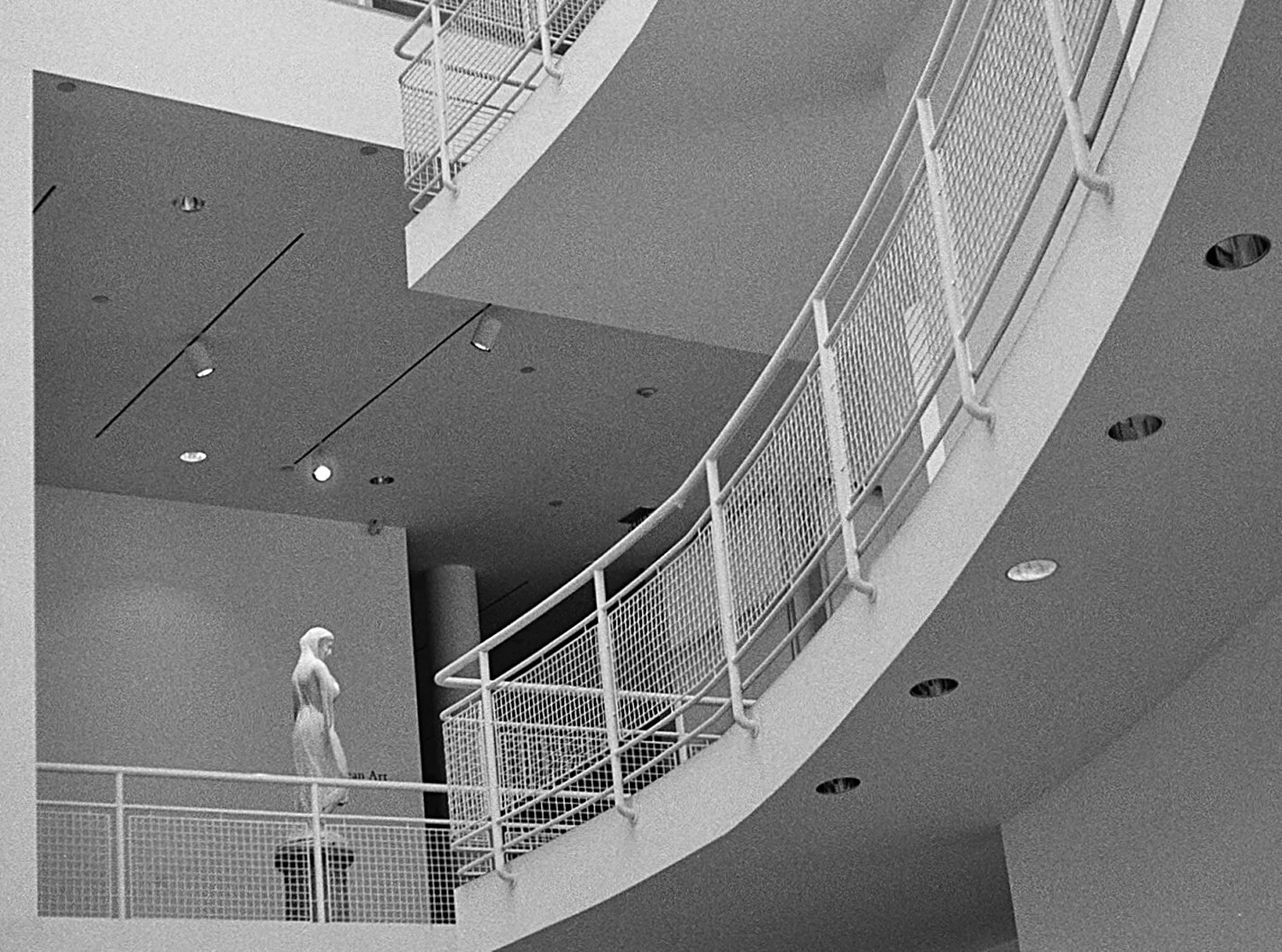
7 Lessons I Learned From Visiting Art Galleries And Museums
Photographers should regularly visit art galleries and museums to learn from other artists
Being a photographer, there is quite a chance you not only express yourself with visual content; you also are…
Photographers should regularly visit art galleries and museums to learn from other artists
Being a photographer, there is quite a chance you not only express yourself with visual content; you also are a visual learner. This means that you best explore and learn by seeing things.
What then, could be a better place to learn than an environment that focuses on visual expression: an art gallery or museum.
I encourage all photographers to regularly visit art galleries and museums, and any other place where art is being exhibited, to take advantage of the learning aspects looking at art provides.
Why? After the break, 7 lessons I learned from visiting art galleries and museums.

1 Discovering artists
How many visual artists are there globally? I don't know. But, depending on how you search for this on Google, you get from 'hundreds of thousands' to 'millions'.
Do you know them all? Have you seen work from all? Probably not. I for sure have not!
Instead of randomly searching the internet: go to an art gallery or museum. Not only will you probably discover a 'new' artist, but the gallery owner or museum info desk most likely will also have some background information available about the artists and the art on display.
Similarly, while it is great, and easy, to browse the internet for images and photographers, experiencing photos in print is a total game-changer.
Even the best digital rendering of an image on a great quality screen can not compete with the real thing. Especially not when it is a large or very large format print.
You just must have experienced this to understand what I am saying. So, find the nearest art gallery or museum and look at some prints.
And while you are there: check out the gallery or museum shop, they probably will have some nice photography books to take home.
2 Learning about style
Looking at art in art galleries and museums provides a great opportunity to learn about style.
How did the artist use color or tonality? how was composition used? What can you learn about structures and textures in the artworks?
Whether looking at photographic prints, paintings, two-dimensional or three-dimensional art: try to discover how the artists used their medium to express themselves and to get their message across.
3 Photographic Techniques
When visiting art galleries or museums to look at photographic prints there is a lot to learn about photographic techniques.
While photography is not as much about the tools used as about the photographer's vision, learning about tools and techniques can improve your images.
See the differences between photos created on 35mm film, medium format film, and large format film. Experience the impact of using a large format camera or a pinhole camera.
Learn about different street photography techniques, Dutch angles, and the difference between available-light and flash photography.
4 Printing
Look at the images on display and learn about different printing techniques. Was the photo developed in a traditional wet darkroom process or was it printed digitally?
And then the different techniques for each of these! There is so much to learn: archival pigment ink prints, aluminum prints, daguerrotypes, wet plate collodion, albumen, digital-C prints, and many more techniques.
5 Presentation
Staying with photography and painting for a while: learn about the impact of how images and paintings are being presented.
Starting with how prints are being matted and framed, to how they have been placed in the display area. Notice how space and place where images are being displayed impact how they are being perceived?!
Notice the lighting of the images in the art gallery or museum!
6 How to write captions and information
Part of displaying art involves writing captions and other information. Does the artwork have a title? If yes: how does that impact your perception of it? If no: how does thát impact your perception of it?
Is there any information about the art on display? Whether it is an open edition, a limited edition, or a unique piece? Information about the medium and tools used?
How does that information influence how you see and perceive the art?
The curators of most art galleries and museums have perfected the art of writing captions; learn from it!
7 How to approach and see an object
When you are a photographer there probably is a chance that you specifically go to art galleries and museums to enjoy photographic art and maybe paintings.
But do not ignore the three-dimensional artworks on display. There is a lot to learn from those too!
Every time you look at a sculpture or an installation, you could do the following short pre-visualization exercise:
Try to imagine how you would take an image of the object on display. What camera and lens combination would you use; what angles (composition!) would you use; how and on what medium would you print your image; what lighting would you apply?
You see (no pun intended) how much you can learn from visiting art galleries and museums? How it can improve your photography?
I very much encourage other photographers to explore art; one of the reasons I post my ongoing articles with Weekend Gallery Tips on my Facebook, Instagram and Twitter pages.
So next weekend, get out and visit a gallery or museum to experience some great art and enjoy a learning opportunity to improve your photography.