
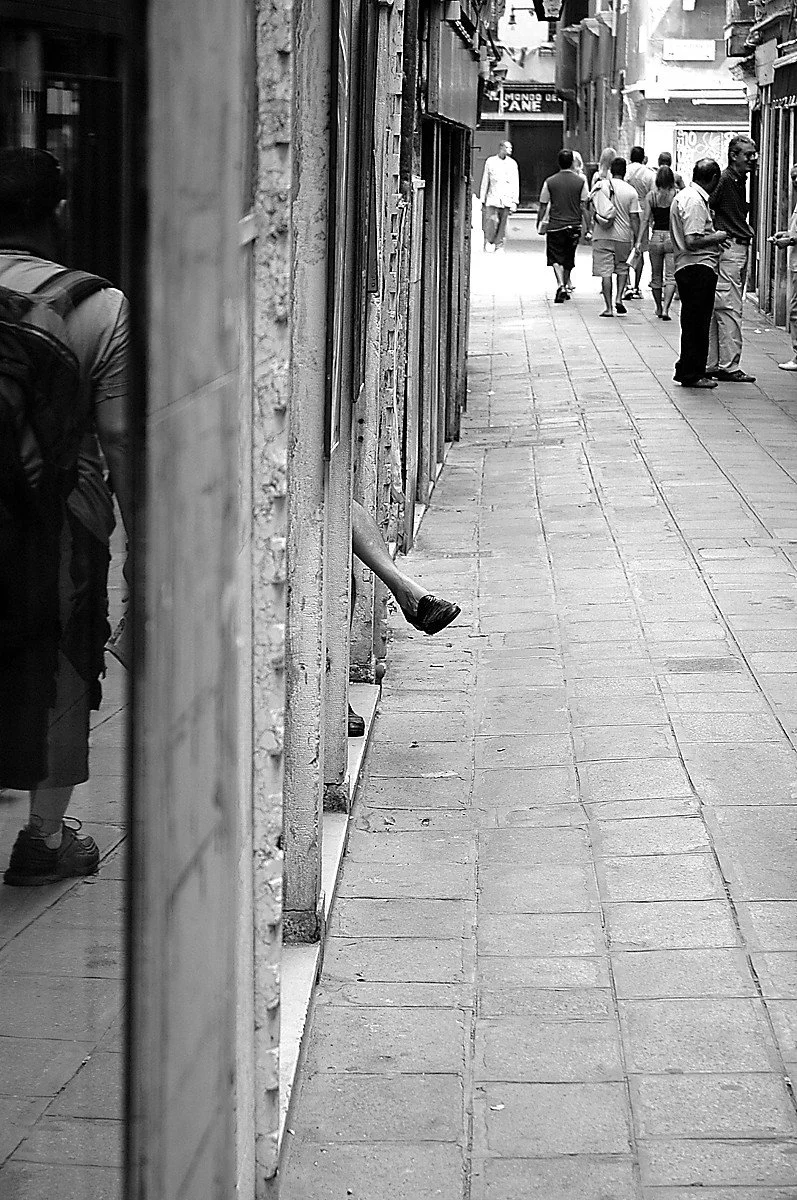
Why Subjects Need Space
To Crop Or Not To Crop, The Question Is
I need to think more about when to crop my images and when not. Reducing what the viewer can see of the subject of an image to the bare minimum can take away from the message that I want to share.
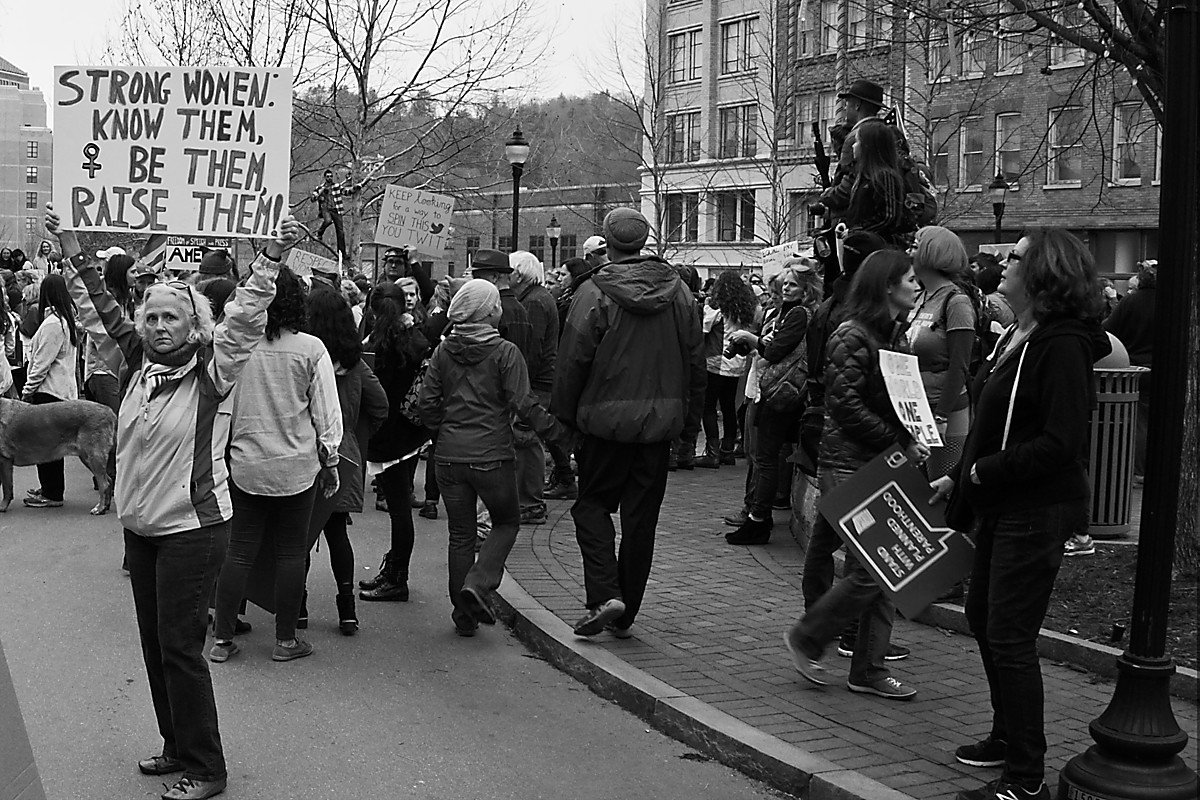
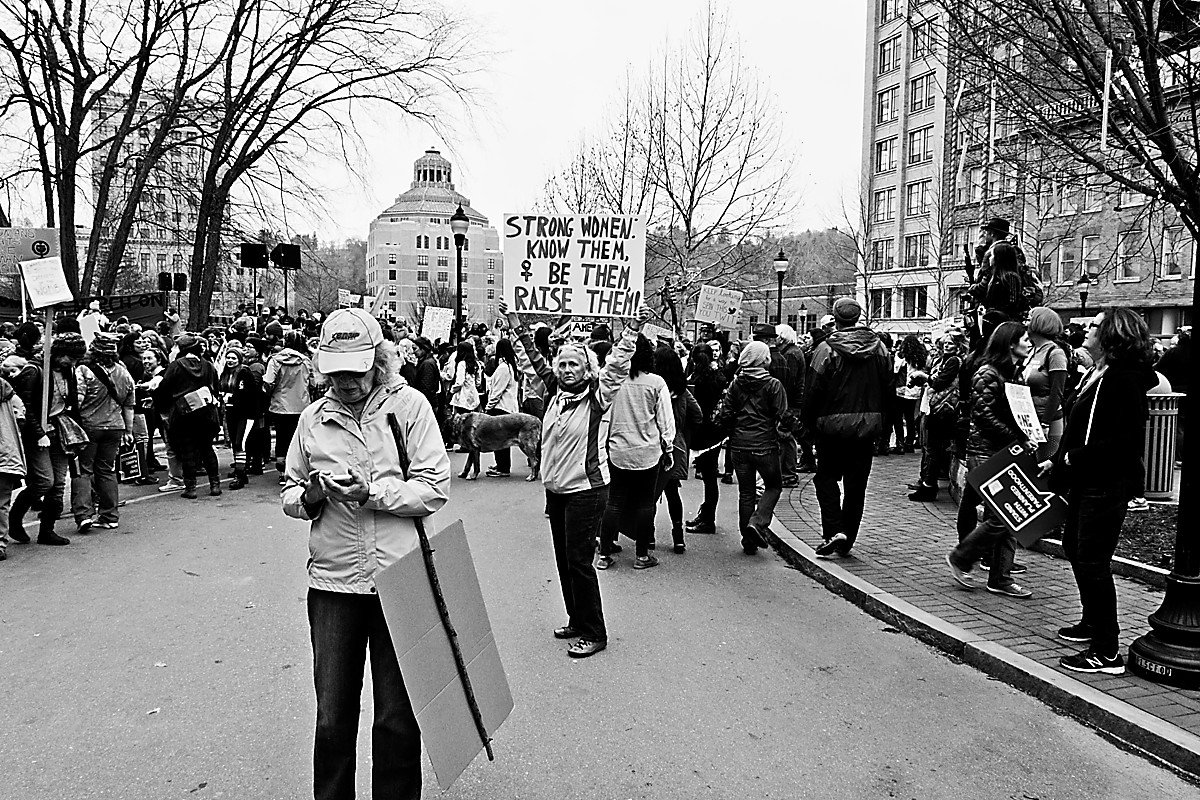
To Crop Or Not To Crop, The Question Is
I need to think more about when to crop my images and when not. Reducing what the viewer can see of the subject of an image to the bare minimum can take away from the message that I want to share.
Why I Sometimes Crop Images
While I challenge myself to get my composition right when taking a picture for my social documentary-type images, I sometimes still feel the need to crop the image for a better (very subjective indeed) result.
The reason to crop images, for me, can be one of two:
I want to change the aspect ratio of the image, or
I want the viewer to see something special.
The first reason is basically for esthetics: I really love images in the 4:5 aspect ratio and an added perk is that 4:5 images print great on letter-sized paper.
The main reason I would crop an image in post-production, however, is to ensure that the viewer sees what I want them to see. When reviewing some Street Candid images, I feel that the viewer would benefit from some guidance for what to look at to fully understand why I took the picture.
Why Cropping Doesn’t Always Result In A Better Picture
It is the second reason I want to talk a bit more about today. After reading the feedback I got on my initial publication of the image “Alley Leg”, I realized that cropping with the intent to show the viewer something special that I saw when creating the image, can actually work adversely
Because I 'zoom' too far into the subject I want to show, the viewer does not see, can not see why I want to show it.
If I want to show something important, the viewer doesn't grasp the importance.
If I want to show something funny, the viewer doesn't grasp the joke.
The reason for this is that I eradicated the context from what I wanted to show.


I saw that something was important because I saw it in its context. I saw that something was funny because I saw it in a specific context. By cropping, I removed the context. And as a consequence, the viewer has no clue about what I actually want to show!
This, of course, is not always the case. Sometimes cropping can help to remove distracting elements from the image. And limited cropping might help to just improve the composition sufficiently to make the image more interesting.
And Sometimes Cropping Is Just “Not Done”
As I mentioned above, for my social documentary-type images I challenge myself to get my composition right in-camera. The main reason for this, as I explained in a previous article, is that I want to be as unbiased as possible when showing the viewer what happened during the events I documented. And although there always will be some subjectivity (whenever you take a picture you always have to decide what to show in the frame and what not), this challenge helps me to provide an as objective as possible record of what happened.
Good examples are the two images at the top of this article that are from the same event: one cropped, and one uncropped. Do you ‘read’ each image differently?
In Focus: Mobsters
Party-Goers In Black And White
When I saw this group standing in the street between the Westin and the old courthouse building, I was…
Party-Goers In Black And White
Background Story
I love living near Greenville, South Carolina. It is very walkable, and it has several districts that are great for the types of images I like to create. Greenville's downtown area has the right mix of shops, restaurants, and parks to generate some hustle and bustle while maintaining that small-town USA feeling.
And there is always something going on.
I love to stroll Greenville's streets, looking for situations that could make interesting subjects for my Street Candids series. On this particular day, I noticed a group of party-goers standing in a street near the famous Westin Hotel on Main.
How It Was Made
I worked with the Canonet QL17 rangefinder camera, loaded with Ilford Delta 100, a fine-grained film excellently suited for that day's sunny conditions.
After taking some pictures of the old Greenville News building on Main, I roamed some time in the area around The Westin Poinsett, the old Chamber of Commerce building, and the clock and fountains at the crossing of Main and Court Street.
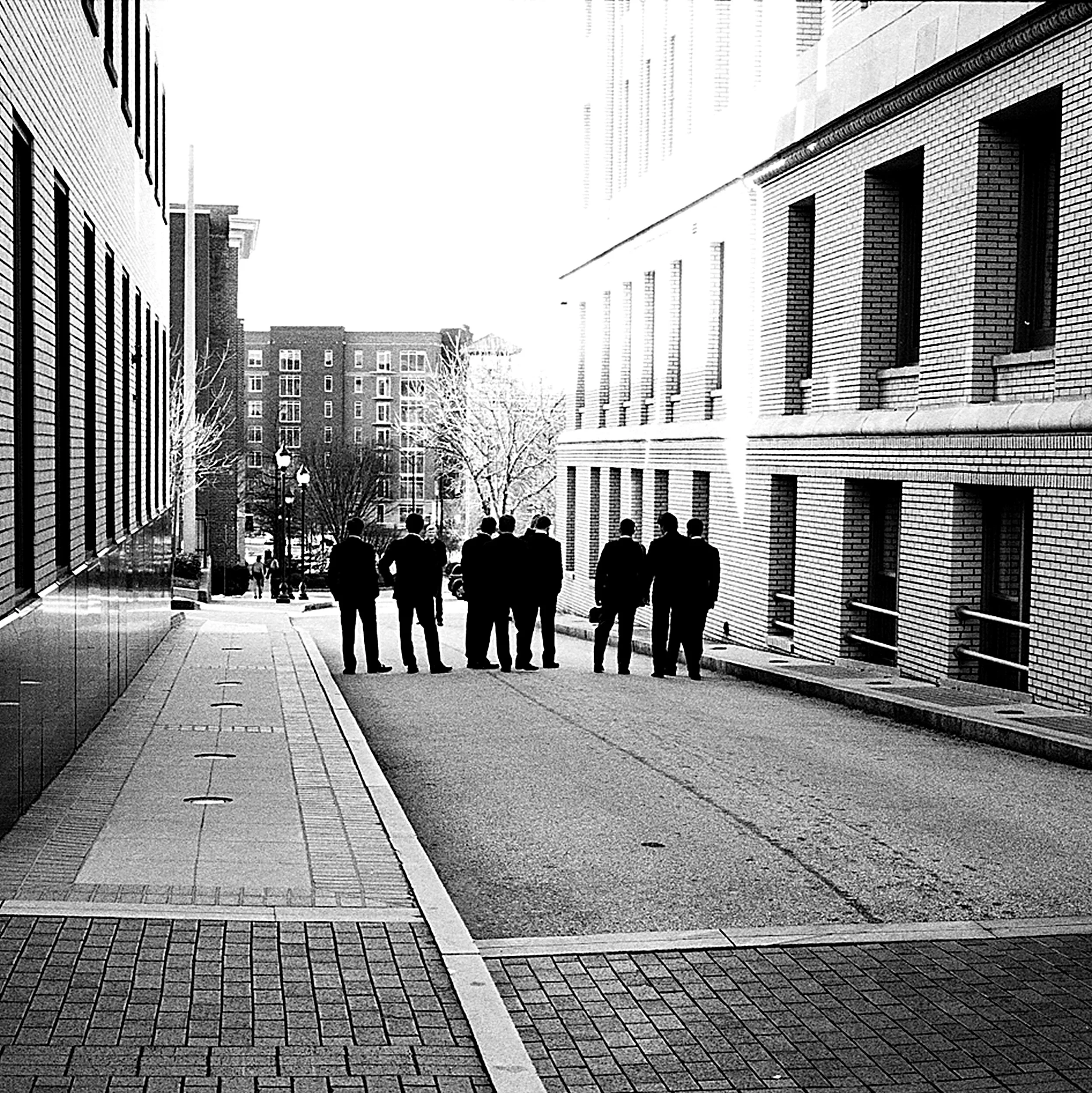
When I saw this group standing in the street between the Westin and the old courthouse building, I was immediately intrigued. I walked towards them and composed the image to include parts of the road and create leading lines.
In post-processing, I cropped the original image to the 1:1 aspect ratio to ensure the group of men was in the center of the image and to emphasize the leading lines in the composition.
Why It Works
I like this image for several reasons.
First of all, the subject matter. A group of men in black suits, standing in an alley-like street. What are they talking about? What are they: party-goers, members of a band, or maybe...?
Zooming in, a man is visible standing in front of and facing the group. Is he a photographer taking a group picture? Or is he confronting the group; are they confronting him?
Then the image's mood: to me, it looks intriguing and maybe even a bit intimidating. The contrast between the black and white areas in the image increases the dramatic feeling: the suits, the walls, the shadow in the street.
Lastly, the crop I used: changing the image to a square format enhanced the leading lines and increased the group's focus in the middle.
One Additional Thought
While this is one of my Street Candids I like best, looking at the image triggered some thoughts regarding the decisions I made regarding capturing and presenting the image.
One of the strengths of photography is also one of its most significant challenges: by choosing a specific composition, the photographer decides what their audiences will see and influence their audiences' conclusions and emotional response to the image.
Using a specific film or film-simulation while capturing a scene or making certain adjustments to the image during processing, the photographer can add a certain mood to the picture.
The photographer can even more impact how people will look at the image and experience it by adding a caption.
Concerning this image, the men might have been wedding guests or maybe even the groom and his best men. Or perhaps it was a bunch of guys attending some other formal event.
However, by capturing them this way, using a specific film, and adding a caption, I turned them into something very different.
How easy, or difficult, is it for you to view this image as I present it now to see them as something else than a group of 1930's gang members? To what extend is your initial reaction to and assessment of this picture influenced by the choices I made?
These observations and questions take us back to how "straight" straight photography is, or to what extent it can be; which is something for a separate article.