

Why Subjects Need Space
To Crop Or Not To Crop, The Question Is
I need to think more about when to crop my images and when not. Reducing what the viewer can see of the subject of an image to the bare minimum can take away from the message that I want to share.
To Crop Or Not To Crop, The Question Is
I need to think more about when to crop my images and when not. Reducing what the viewer can see of the subject of an image to the bare minimum can take away from the message that I want to share.
Why I Sometimes Crop Images
While I challenge myself to get my composition right when taking a picture for my social documentary-type images, I sometimes still feel the need to crop the image for a better (very subjective indeed) result.
The reason to crop images, for me, can be one of two:
I want to change the aspect ratio of the image, or
I want the viewer to see something special.
The first reason is basically for esthetics: I really love images in the 4:5 aspect ratio and an added perk is that 4:5 images print great on letter-sized paper.
The main reason I would crop an image in post-production, however, is to ensure that the viewer sees what I want them to see. When reviewing some Street Candid images, I feel that the viewer would benefit from some guidance for what to look at to fully understand why I took the picture.
Why Cropping Doesn’t Always Result In A Better Picture
It is the second reason I want to talk a bit more about today. After reading the feedback I got on my initial publication of the image “Alley Leg”, I realized that cropping with the intent to show the viewer something special that I saw when creating the image, can actually work adversely
Because I 'zoom' too far into the subject I want to show, the viewer does not see, can not see why I want to show it.
If I want to show something important, the viewer doesn't grasp the importance.
If I want to show something funny, the viewer doesn't grasp the joke.
The reason for this is that I eradicated the context from what I wanted to show.


I saw that something was important because I saw it in its context. I saw that something was funny because I saw it in a specific context. By cropping, I removed the context. And as a consequence, the viewer has no clue about what I actually want to show!
This, of course, is not always the case. Sometimes cropping can help to remove distracting elements from the image. And limited cropping might help to just improve the composition sufficiently to make the image more interesting.
And Sometimes Cropping Is Just “Not Done”
As I mentioned above, for my social documentary-type images I challenge myself to get my composition right in-camera. The main reason for this, as I explained in a previous article, is that I want to be as unbiased as possible when showing the viewer what happened during the events I documented. And although there always will be some subjectivity (whenever you take a picture you always have to decide what to show in the frame and what not), this challenge helps me to provide an as objective as possible record of what happened.
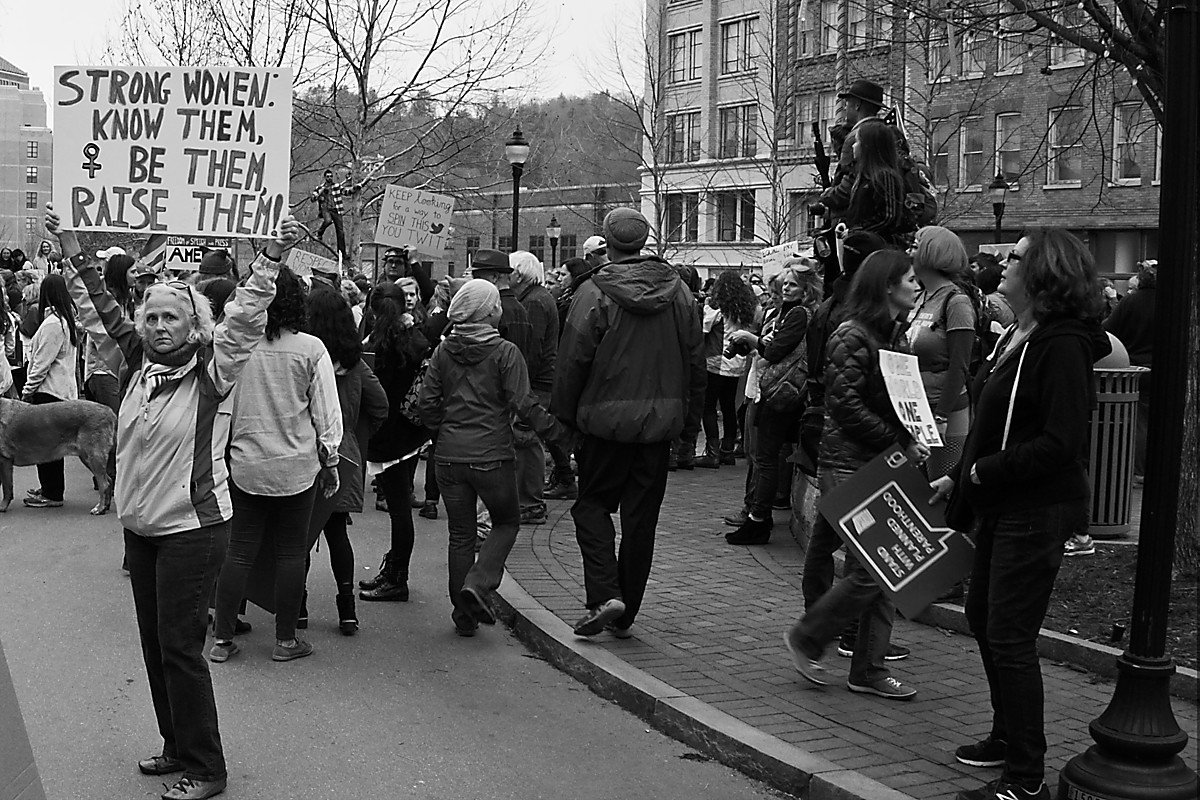
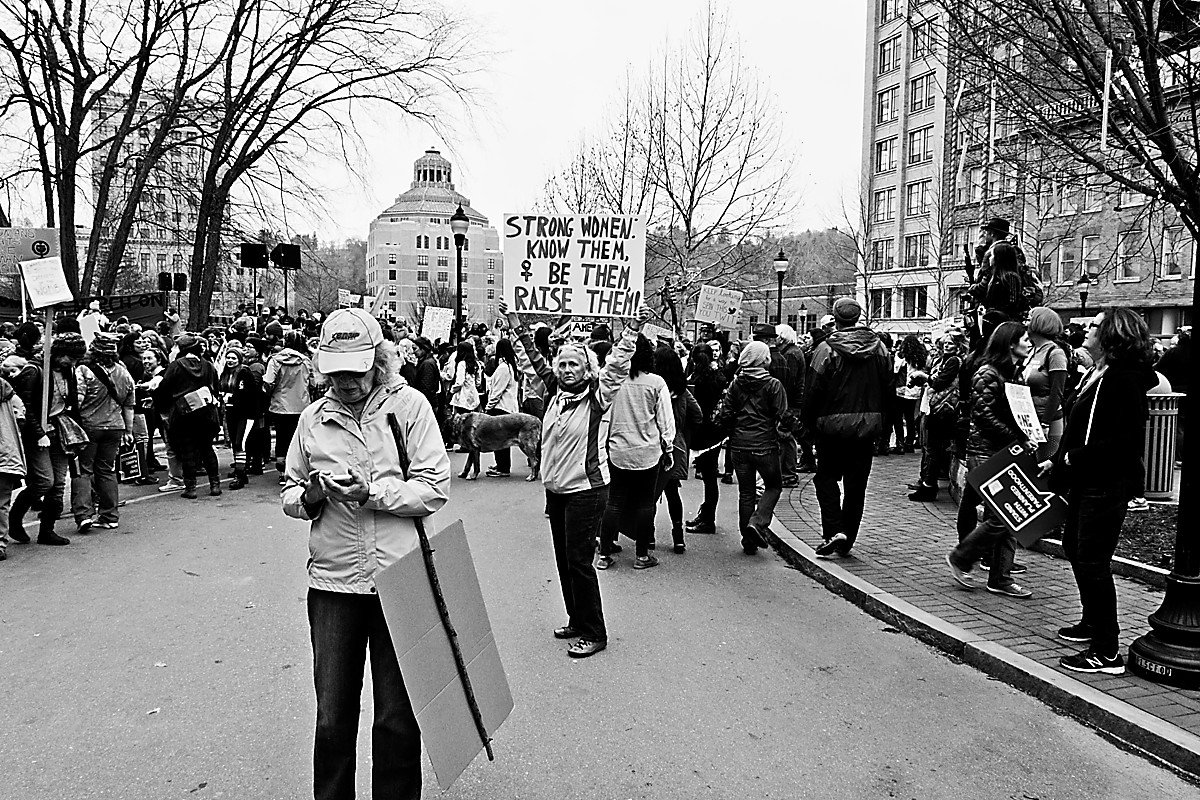
Good examples are the two images at the top of this article that are from the same event: one cropped, and one uncropped. Do you ‘read’ each image differently?
Behind The Scenes: From Both Sides Now
Freedom Of Speech At Work
captured today’s image while walking the streets of downtown Greenville, SC, looking for …

Freedom Of Speech At Work
I captured today’s image while walking the streets of downtown Greenville, SC, looking for pictures for my fine art shop.
Background Story
Last Saturday I went to downtown Greenville, SC, which is just a 30-minute ride from where I live. I took the Fujifilm X-Pro1 with a Nikon AF Nikkor 35mm 1:2D mounted. The reason why I picked this camera/lens combination might be a topic for a future blog post.
The idea was, to create some images for my fine art shop, and to print at home for the upcoming Mini Farmers Market in our neighborhood. And maybe also capture some Street Candy on the go.
As you might be aware, 2020 is a Presidential Election year here in the USA and you probably are also aware that the candidates of the two largest parties are quite ‘verbal’ in addressing each other. So are their respective supporters.
How It Was Made
Strolling downtown I noticed a group of pro-Biden supporters who were protesting against his opponent: current President Trump. They were waving some signs, some were dressed up, and they were trying to get the attention of passers-by. All very friendly and not aggressive.
I took one or two shots on the go of this group and walked on, to my main subjects of the day: some old buildings in Greenville’s West End and Fluor Field. The latter is a minor league baseball field and home to the Greenville Drive, a feeder club for the Boston Red Sox.
Walking back to my car, I had to pass the demonstrators again. And as it happened, a small caravan of pickup trucks and other cars drove by displaying large US flags and pro-Trump flags. This cavalcade continued to drive on Main Street, through the group of pro-Biden supporters who were standing on the sidewalks to the left and right.
I raised my camera and quickly shot a couple of frames of this sight.
To me, this was just great!
Of course, both groups were shouting at each other and the people in the cars were honking the horns, but it was enthusiasm everyone displayed. Not anger, not being mean, but using their freedom of speech to try and get their message across.
The cars drove on to wherever they were going next, and the group on the street continued their demonstration for their cause.
And is this not how it always should be? Enthusiasm, but not anger. Passion, but no violence.
Why It Works
This is the image of the set I like best and it works for me first and mostly because it shows what it shows: the passion and the non-violent demonstrations.
Then, of course, there is the juxtaposition of the pro-Trump and anti-Trump supporters. The story of this year’s election captured in one frame.
And then there are some small details in the picture that add a bit extra. The ‘One Way’ street sign, for example. Is this a sign of what is happening elsewhere in the country, where opposing groups are less peaceful? The face masks. A sign of our times, or are they going to stay?
The more I look, the more I discover.