
The Case For Film
Will Artificial Intelligence aid the revival of film photography?
Since the inception of photography, photographers have manipulated images to show something different from what they initially captured when pushing the shutter button…
Will Artificial Intelligence aid the revival of film photography?
Since the inception of photography, photographers have manipulated images to show something different from what they initially captured when pushing the shutter button.
And since Niépce created the first photographic image, the evolution of technology has made it increasingly easy for us to change the original image.
Initially, photographers could only do this in the wet darkroom, with techniques like dodging and burning, hiding parts of the negative or stacking negatives.
Now, in the digital age, after scanning a negative or working directly with a file from a digital camera, photographers can easily remove or add objects, change colors, distort images, add filters to create specific moods, and make a multitude of other changes to the original image.
And while digital photo editing tools have been around for several decades, the latest development in image creation and manipulation is a total game changer: text-to-image Artificial Intelligence (AI).
AI can do more than manipulate an image: it can create a photo without needing an actual subject, using program instructions (not totally accurate, of course: text-to-image AI uses databases with millions of images made of real objects or people).
While still in its infancy, developments are going extremely fast, and we already see AI being used to create photo-like images of portraits, landscapes, food, and pictures in the style of the old masters of painting.
Since photographers using Photoshop already led to controversies, AI has the potential for even more debate.
What images can we trust?
Digital photography increased the challenge of answering this question because digital photos don't exist: they are only a bunch of specifically arranged zeroes and ones. Not even that: they are bits stored in a magnetic region on a disk or as electrical charges on an SSD.
And while we can ask the trust question regarding any photo altered with editing software, the use of AI to create images out-of-thin-air makes this question even more critical.
Digital photography, as I pointed out in a previous article, still needs a subject that reflects, absorbs, or blocks light to create a picture. Therefore, we still would have that subject against which we can check the 'truthfulness' of the created image. With AI, we don't even have that.
We are entirely at the mercy of the binary gods.
It is probably not without reason that image fact-checking is now a common practice on social media and other communication channels.
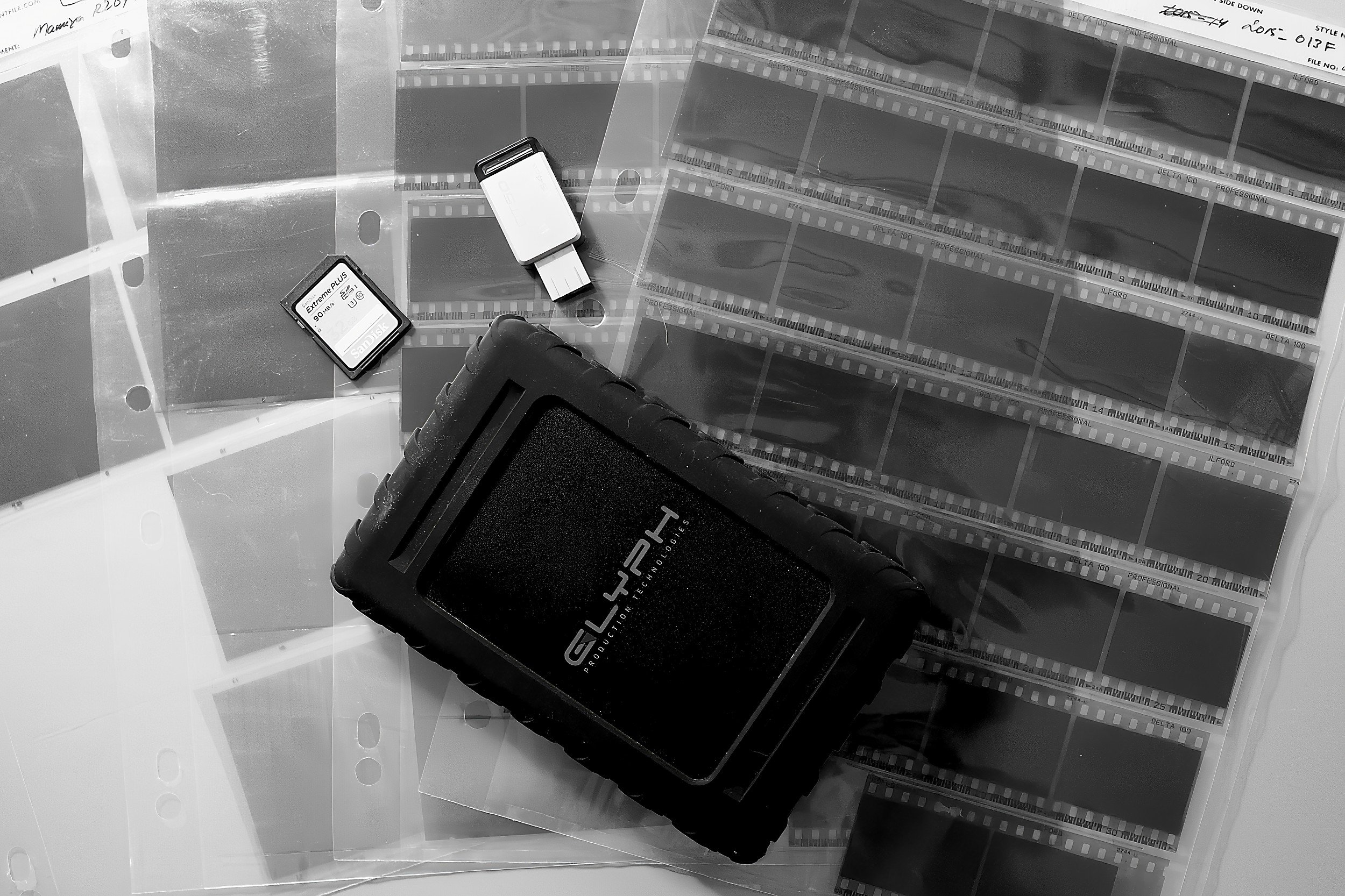
Photos created on film, in stark contrast, are tangible from the start.
A roll of film base with a light-sensitive emulsion is exposed to light and then chemically developed, creating a negative film strip you can hold in your hand! And while it is possible to alter that negative (e.g., with markers or acid), it would bear clear evidence.
Therefore, any final image that starts on film, whether printed in a wet darkroom or scanned and edited with photo editing software, is backed up by a negative that provides tangible proof of the image as the photographer initially captured it.
Consequently, I can see the revival of film photography, which has been going on for several years now, becoming even more vital for specific genres. Especially with people for whom the image's truthfulness is critical:
Crime and other photography that needs 100% proof of not being manipulated;
Documentary photography and news photography;
Art collectors;
Museums and students: to see what the original image was and what the photographer has edited to achieve his vision or message.
Will artists, and other professional and hobby photographers, now flock in swarms back to film photography?
I don't think so.
Digital photography is too far evolved and has too many positive aspects: going back to film will not be practical from a workflow perspective for most photographers.
And while I don't use it, AI, the newest member of the image creation family, is, in my opinion, an excellent development. It is a new tool that has its rightful place in the complete range of visual arts.
Entirely digital art also has found its place in the photography and public art world: look only at the fact that NFTs achieve (sometimes extremely) high price points.
However, like the written proof of authenticity that photographers add to their prints, the tangible film negative could become the new proof of authenticity for those photos that require it.
And as such, the increased digitization of art through AI could be an additional stimulus for photographers in specific genres to go back to film.
In Focus: Bargain Found
The Joy of Finding a Bargain at a Madrid Market
This image was created during a stroll in sunny Madrid, Spain, in August 2019…

The Joy Of Finding A Bargain At A Madrid Market
Background Story
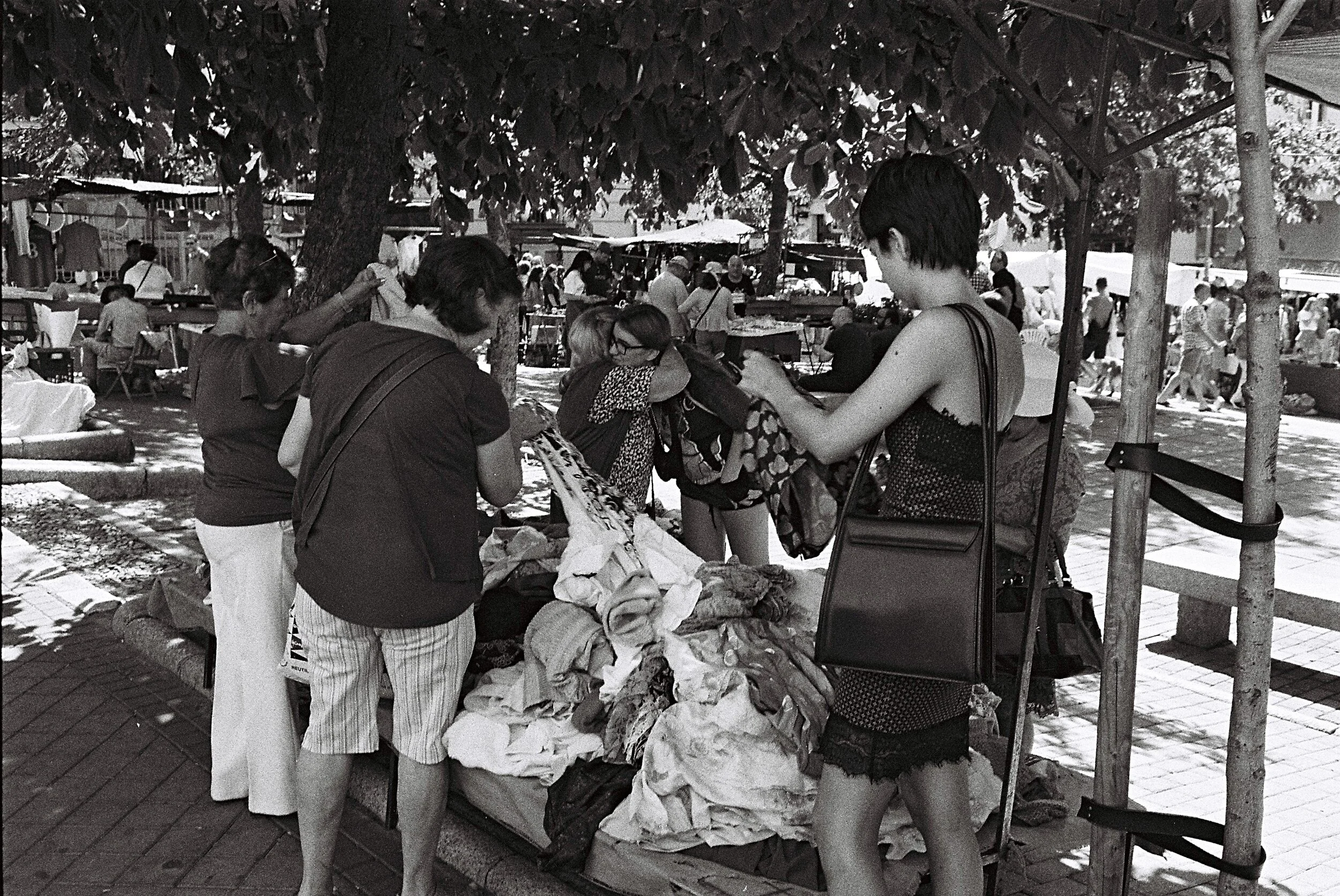
This image was created during a stroll in sunny Madrid, Spain, in August 2019.
I used my home leave from my assignment to South Africa to spend a week in Madrid with my wife, prior to traveling on to The Hague, the Netherlands, for some time with my youngest daughter.
Madrid has an abundance of squares (plazas), shopping streets, small back alleys, and parks to explore. The weather was great that week and we enjoyed a couple of days strolling through the beautiful capital of Spain.
That particular day we visited several open-air street markets, where a large diversity of goods was being sold. Fruit, vegetables, meat, fish, musical instruments, potter, leatherware, shoes, t-shirts, artisan bread, cheese, handheld fans, bags, tools; you name it, they sold it. And fabrics of course.
A fabrics stall at a market is always interesting to observe. Often the merchandise is just laying on a table or on the ground, and prospective buyers are picking it up, holding it to the light, and showing it to each other to determine if it is the right quality, size, and color for whatever they are creating at home.
And always there is this hope to find a real bargain.
As you can imagine, this creates numerous situations to make a photo. And this was just the right one for me.
How It Was Made
Only a couple of weeks earlier I was fortunate to purchase a just CLA’d Leica M4 and a Summaron 35mm f/2.8 lens for a very reasonable price. And since my wife brought my Voigtländer VCII lightmeter from home, I was experimenting with the camera, lens, lightmeter combination.
As you will know by now, I love black and white images and I had my favorite film, Ilford Delta 400, loaded.
Why It Works
The subject matter of this image is right up my alley: the busyness of the market, people interacting with each other, and the play of light and shadows.
The main subject is formed by the two hugging women in the center of the frame.
The pile of fabric and the piece held up by the lady to the left create a nice diagonal, leading the viewer’s eye through the composition.
The small tree and its support to the right and the larger tree to the left frame the main subjects of the image, while at the same time creating sub-frames for other points of interest: see the walking man perfectly framed by the small tree and the wooden support? This was a nice bonus that I only discovered after getting the film back from the lab.
As always, the light plays a major factor in making this image work for me. The harsh sunlight to the left and right of the group of women, with the shadows on the street in the foreground and the dark leaves of the trees, provides an additional frame for the main subject.
All parts work together to create several frames around the center of the image, focusing the view towards the two women in the center.
How Can This Image Be Used
There are several ways to use an image like this in a commercial setting.
There might be a hotel nearby that can use this image to show their guests the area they are located at, and how close they are to classical Madrid markets.
And the City of Madrid could use it to show prospective visitors its relaxed but lively street life and market culture, ideally for tourists who want to experience the real Spanish.
Although countries and cities are opening up after what hopefully was the worst of the Covid-19 / Coronavirus impact it might be a while until we can strolling the markets of Madrid again. Until then, images like this one will remind us of the better times to come.