

Finding Focus
THE NEXT STAGE IN MY PHOTOGRAPHIC EVOLUTION, OR: HOW TRYING PURE STREET PHOTOGRAPHY HELPED ME TO FIND MY ROAD AHEAD
While I explored different photographic genres over the years, since moving to the US and being driven by my passion for people, I have come home to my true passion: documentary-style street photography and essays.
THE NEXT STAGE IN MY PHOTOGRAPHIC EVOLUTION, OR: HOW TRYING PURE STREET PHOTOGRAPHY HELPED ME TO FIND MY ROAD AHEAD
Have you ever looked at a vintage photograph and wondered who the people in that image were, how they lived, and how the cities seemed so different then?
As you can read on my About page, I grew up in a small village in the Netherlands, and when I got my first point-and-shoot camera in the early 1970s, I could not foresee that it would ignite a lifelong passion for photography.
While I explored different photographic genres over the years, since moving to the US and being driven by my passion for people, I have come home to my true passion: documentary-style street photography and essays.
When I talk about documentary-style photography, I don't mean documenting the 'big' things: famine, the US border crisis, global warming, deforestation.
Of course, if I get the chance, I will take images at a Women's March or similar events I might be able to attend (or stumble upon), but in general, I am more interested in the mundane of daily life.
Creating stories about regular people who make up the diverse population of my adopted country, showing how a small town looks today and the people in it; documenting small events like car shows that show the enthusiasts who come together there and create a unique culture; people at a horse race track, dancing, eating, gambling, having fun; telling the story of a master craftsman, who creates beautiful objects with his tools.
While maybe mundane, these all are unique pockets of the world we live in and the people who inhabit it. And when I do take pictures at events, I am more interested in the individuals attending (the proponents, the opponents, and the spectators) than in the event itself because I firmly believe that the individual stories provide the human connection to those events.
For some time, I thought creating and focusing on pure street photography images would satisfy my urge to tell these stories. So I started making what I thought were nice street photos and joined street photography groups on Facebook and Instagram.
The critique I received from experts in the field was an eye-opener and made me more critical about my and other photog's street images. And the more I learned about street photography, the more I (tried to) create street photography, and the more I looked at other photogs street photography, I found it unsatisfactory, boring, disappointing, and repetitive. So many images tagged as street photography are not, and I often saw a lot of copy-cats (how many iterations of pictures of people walking through a patch of light in an area otherwise in darkest shadow can one create?).
Understand me well: pure street photography is excellent, and I love looking at those images! But it also is rare and challenging to create.
Pure street photography is very much dependent on a decisive moment, and I realized there is so much more than the decisive moment: I want to capture a current moment, documenting in 1/125th of a second the sociohistorical situation of a particular place at a specific time. Wow, those are big words! But you probably understand what I ideally want to achieve.
Capturing a 'decisive moment' for me is a bonus, not a goal. There is so much more to show, achieve, share, and create awareness of that might not be captured when focusing on the decisive moment. Instead, I want to tell that broader story, which can be about people, a place, or an event and which, for obvious reasons, in most cases, is a combination of these.
While I like to work on projects to create photo essays, you can ask if a single 'snapshot' also can tell this broader story.' I think so. But I also want to explore how that single image relates to other pictures looking for patterns in human behavior.
Reading photo books helps me understand what I want to create.
On my journey to finding my focus, I have 'met' several current and past photographers whose work has influenced my thoughts about what I want to achieve and how to achieve it: Eugène Atget, W. Eugene Smith, Jill Friedman, Bob Friedlander, Helen Levitt, Robert Frank, Inge Morath, Sally Mann, O.N. Pruitt, Berenice Abbott, Jacob Riss, Dorothea Lange, Lewis Hine, the photographers who took the images in Lost London, Elliott Erwitt, and many others.
As mentioned above: making a good street photo is challenging. Is this next stage in my photographic evolution possibly a flight because it is too complicated?
To answer my question: No, composition, situation, image quality, light, and all other ingredients that make a pure street photo are also crucial to making the documentary-style photos and essays I (want to) create.
As I mention in my artist’s statement, inspired by a quote from Anais Nin, I want to share not the obvious but what we usually are unable to see: when I document, what can I show that others might not see?
Are you familiar with the phrase "write down to remember"? I want to "photograph to remember" and to help others remember. Now and, hopefully, in the future. While I create images and stories for me and my current audience, it would be great if I could make the 'vintage images of the future.' If even only one.
Looking back at the images I created over the years, especially since I live in the USA, it is not surprising that my journey is taking me in this direction. But with the help of the critique I received, seeing what current and past photographers create(d), and looking at street photography on social media, I have found the focus I was missing.
Now that I know better what type of images I want to create, I also can better define the tools I want to use. So while my camera setup underwent some changes last year, my main tools will continue to be the Fujifilm X-Pro1 and the Leica M4. Both with 35mm (or equivalent) lenses.
Why these?
Both are (relatively) small and discreet cameras and very well suited for the work described above, most of which still will happen on the streets.
Digital has all the positive assets we have learned to appreciate over the last couple of decades and cannot miss from any photographer's toolkit.
But why film?
First, even after scanning, film still has that unique look that is very difficult to emulate in digital post-processing.
Secondly, because of its limitations, working with film makes me more aware of the 'why' and 'what' to photograph.
And thirdly. There is no third. I do not use film because it 'makes me slow down.'
Of course, it slows me down: hand-metering light, manual focusing, manual film transport, only 36 images before I have to rewind and change the roll manually. And I will remember every time before pressing the shutter release button that every picture on film is far more expensive than one taken with the X-Pro1.
Now here is a curve ball.
Talking about film, I ponder using medium format for my documentary-style work. But that is a story for another day.
My journey is not over yet, and I still have a long way to go, but I have found focus and a road ahead.
Forever Young
Washington, DC | 11th Street NW | July 2014
Bob Dylan, Rod Stewart, Alphaville, and probably many others sang about it. Movies have been made about it.
Staying forever young: a wish that many people need to have.

Washington, DC | 11th Street NW | July 2014
Bob Dylan, Rod Stewart, Alphaville, and probably many others sang about it. Movies have been made about it.
Staying forever young: a wish that many people need to have.
If we must believe the music and film industries.
And cosmetics and clothing firms are playing well too.
Helping people to stay forever young.
Or at least: helping people feel they can stay forever young.
Or at least: making people feel they need to stay forever young.
Madrileñas
Madrid, Spain | Plaza Platería de Martinez | August 2019
Something that always strikes me in Spain is the strong and articulated women. Irrespective of social status or age, they are Present, with a capital P.

Madrid, Spain | Plaza Platería de Martinez | August 2019
Something that always strikes me in Spain is the strong and articulated women.
Irrespective of social status or age, they are Present, with a capital P.
After a stroll through Madrid's famous National Botanical Garden, my wife and I decided we earned some tapas and a refreshing drink. Since it was summer, most bars and restaurants had tables outside on the street, and we quickly found one near the botanical garden and the Prado museum.
While getting seated, I could not ignore these three ladies sitting at a table next to ours.
They were involved in deep conversation. One of the ladies passionately articulated her thoughts on a particular topic, while the other two listened with great attention.
I would have loved to eavesdrop to hear what they were so animated talking about, but that is not something one does. Also, my Spanish is not so good that I could fully understand what she said.
HOWEVER, what I could do was take my trustworthy Leica M4 and seize an image of this beautiful trio.
This photo might not capture a 'decisive moment', but, as I explained previously, street photography is not always about the decisive moment and is far more.
This image, for me, represents a typical situation that someone easily can encounter in Madrid. Or in any town and city of Spain.
Three ladies are having a great afternoon, enjoying some food and drinks and discussing current events, maybe talking about global wars and inflation, or gossiping about the new girlfriend of one of their sons.
Not The Decisive Moment
Street Photography Is Social Documentary Photography
Writing last week's blog posts about the book Lost London: 1870-1945 made me realize that there is an easily overlooked aspect of street photography.
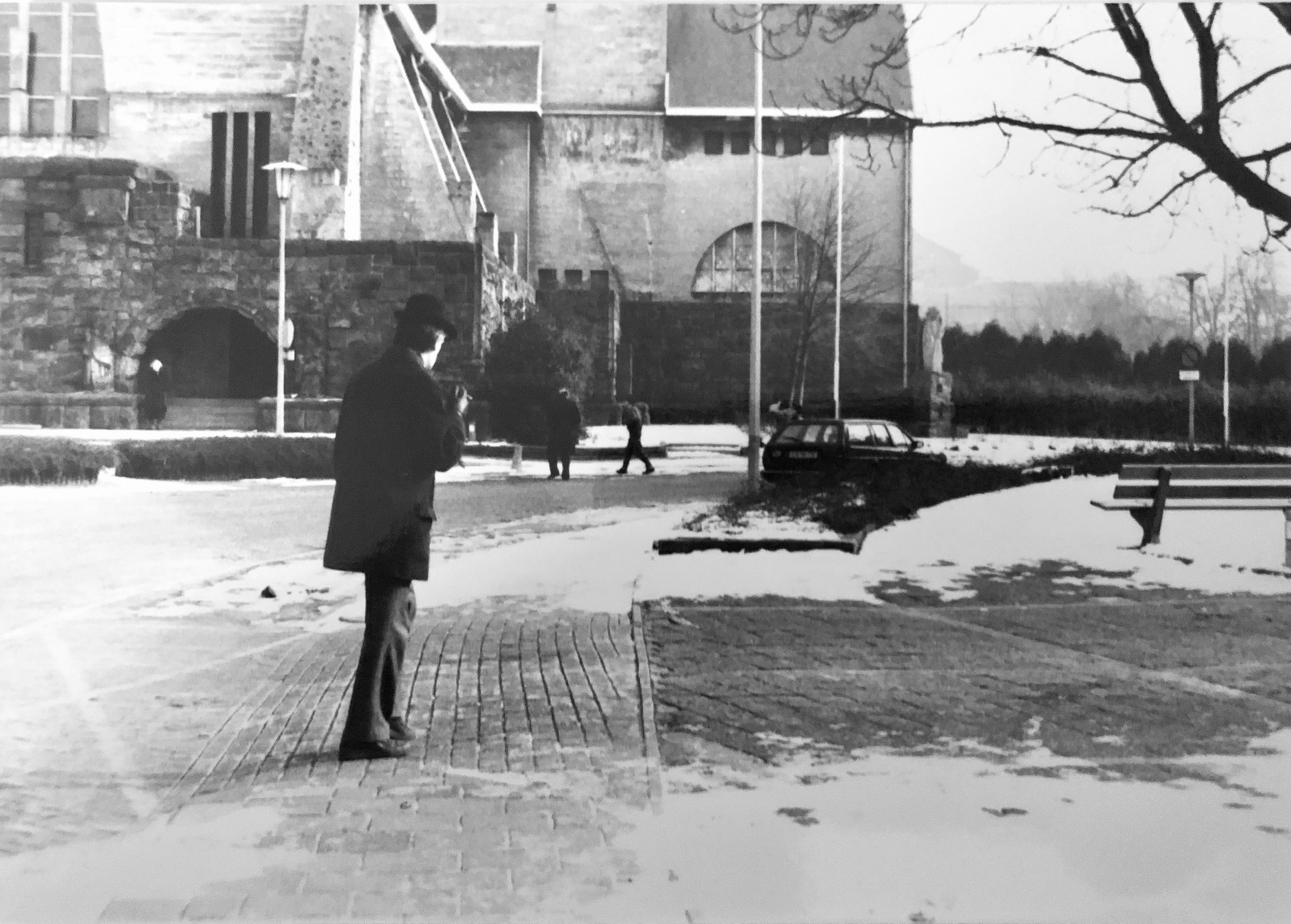
Image courtesy and copyright Amei Manten
Street Photography Is Social Documentary Photography
Writing last week's blog posts about the book Lost London: 1870-1945 made me realize that there is an easily overlooked aspect of street photography.
Every street photographer wants to capture a specific moment and create that 'one' image that will enthuse the world. With Olympians like Henri Cartier-Bresson, Vivian Mayer, Elliot Erwitt, and so many others as examples, we street photographers try to emulate their vision, their images, and their success.
But street photography is so much more, and street images can mean much more to our audience.
Street photography is not and does not always have to be about the decisive moment.
The images in Lost London: 1970-1945 made me realize that there is so much more to these pictures than the decisive moment. These images capture a particular place during a specific time that has a special meaning for contemporary viewers.
Allow me to explain this with an example of an image not related to the book.

Image courtesy and copyright Amei Manten
Recently I posted an image from the small village my wife and I grew up in on Facebook. My then-girlfriend, now wife, created the picture in the mid-1980s as part of a photography assignment while studying at the University of Leiden (the Netherlands).
It is quite an ordinary image: a village street with a woman.
However, posting this image on Facebook had a surprising result. Numerous people commented on the street and the buildings, with many trying to figure out who the woman in the picture was.
This result and the images from the book Lost London: 1870-1945 made me realize that street photography always is a form of social documentary photography. With or without a decisive moment captured, street images provide contemporary viewers and later generations insights into our environment's current state; it captures the Zeitgeist.

Image courtesy and copyright Amei Manten
The look of the streets, the buildings that may change or totally disappear in the future, the people, the clothes they wear, their occupation, and other details of daily life we at this moment take for granted but will be of interest later.
This realization gave me a feeling of calmness.
I no longer have that unsatisfied urge to hunt or fish for the decisive moment when creating street images. Instead, I am more aware of my surroundings and what my image might mean to future viewers. Maybe they lived in this specific area I am capturing; perhaps I captured one of their family members in my frame.
Street photography, for me, now is more about capturing the current state, and it's not only about the decisive moment.
I still will look out for it, and if and when I capture such a moment: outstanding, excellent! But, if not, I move on with the knowledge that at least I captured something from which future viewers can learn how the world looked today.