

Beyond the Cars: Photography as a Window into the People and Communities that Surround Car Shows
How Photography Can Tell the Story of Car Shows As A Social Phenomenon
Since their conception, cars have captured the interest of all kinds of people: those who are interested in design, those who are interested in racing, people who are interested in mechanics and engines, those who like to show off with fancy cars, and individuals who collect cars, to name a few.

How Photography Can Tell the Story of Car Shows As A Social Phenomenon
Finally, finally, finally! I have finished my essay on car shows and the people who attend them!
It seems to me that an increasing number of car shows are happening in our country. During summer, there is at least one every weekend in every city and town, and often additional events during weeknights. And this appears to be the same in South Carolina (where I used to live), New York (which I now call home), or any other State, according to the announcements I see on social media.
Initially, I was made aware of these events by my daughter, who, for her final project, "The Soul of the Classic Car," for her BFA in photography from Winthrop University, focused on details of vintage cars.

I also may be particularly aware of them because I owned a Mazda Miata for some time, and looking at other small sports cars on display was fun.
As a result, while I am not a gearhead (I couldn't point out an alternator if my life depended on it), I have visited several car shows over the last three years. In the first instance, I did this partially because I owned that Miata, but the main reason for continuing to go to these shows was because I am intrigued by their social aspect.
A Photographer's Paradise
Car shows provide excellent opportunities for photographers to capture stunning images.
They may focus on photographing individual vehicles and capturing each car's unique design and details (as my daughter did), or they may catch the event's overall atmosphere, including the crowds, vendors, and other attractions.
These events are also excellent for trying various photography techniques, such as close-up shots of car details, panoramic views of the entire event, or capturing the vehicles in motion on the road or track. In post-production, photographers may give their photos a nostalgic feel or use other editing techniques that show the beauty and style of the cars they photographed.
Some photographers, like me, may even specialize in capturing the human element of car shows, focusing on the interactions between enthusiasts, collectors, and other car fans.
The latter group of photogs, and even more specifically, photographers interested in social-documentary, can capture various images that tell the story of the event and its attendees: they may focus on documenting the people who attend the event, including the collectors, enthusiasts, families, and vendors—for example, capturing portraits of attendees and candid shots of them interacting with the vintage cars on display.
In addition to documenting the people directly, a social-documentary photographer may also focus on images of the cars while telling the personal stories behind each vehicle. Or they can record the different activities at the show, such as competitions, demonstrations, or presentations.
Whatever the photographic genre they specialize in, photographers at car shows have a unique opportunity to capture the essence of automotive history and design, share that beauty with the world through their images, and highlight the significance of cars in American culture and history.
I am passionate about capturing stories and experiences of people and events through my camera lens. Therefore as a documentary-style photographer at car shows, I aim to capture the event and its attendees in a way that gives the viewer a sense of the atmosphere and the unique culture and community surrounding the cars.
And while I am often struck by the beauty of the cars on display, I am even more interested in the people who attend the show. So often, I approach attendees, introducing myself and asking about their stories and experiences with classic cars. Everyone has a unique story: about their first car, a restoration project, or the history behind the vintage vehicles on display.
I can spend an entire day taking pictures and talking with attendees, documenting their experiences and stories. I love to capture images of families enjoying the event, collectors admiring classic cars, and enthusiasts discussing the intricacies of vintage car design. Since I am there, I also take close-up shots of the cars, focusing on their unique features and design elements.

Some thoughts about the future of this social phenomenon
Visiting these events, I always wonder whether these car shows are part of a dying culture - specifically, those focused on vintage cars.
Not immediately, but how about 10 or 20 years from now? Most cars from the 1970s onwards, which by then will be 'vintage,' don't have the exciting designs that the vehicles from the 1940s through 1960s have. And even further in the future, will people get excited to see a 'vintage' Tesla?
Car enthusiasts will likely find ways to keep the current oldtimers running. I have seen vehicles from the 20s at car shows; keeping a 1950s car running for a few more decades might be doable.
And because the newer models and electric vehicles are less exciting, there will likely be more demand and enthusiasm to keep the oldies on the road and for enthusiasts to come together to enjoy them.
Is the current abundance of car shows a flare-up of a dying phenomenon, or will they survive despite, or maybe because, of the boring contemporary models and current EV developments? The future will tell.
For now, I hope my photos will help conserve some of the history and culture of the car-enthusiast community.

Never Too Old To Play
New York City NY | Hester St. Playground | Feb 2019
New York City's China Town area is a treasure trove for street photographers and cultural experiences.
New York City, NY | Hester St. Playground | February 2019
New York City's China Town area is a treasure trove for street photographers and cultural experiences.
I noticed two gentlemen near the Hester Street playground playing the Chinese game of Xiangqi.
I didn't know if they played for toothpicks, hard dollars, or fun, but they were having a good time, and the bitter cold temperature didn't bother them.
Several onlookers were sitting and standing around their table, undoubtedly providing their advice for the next move.
Unfortunately, I had to move on and never got to know who won.
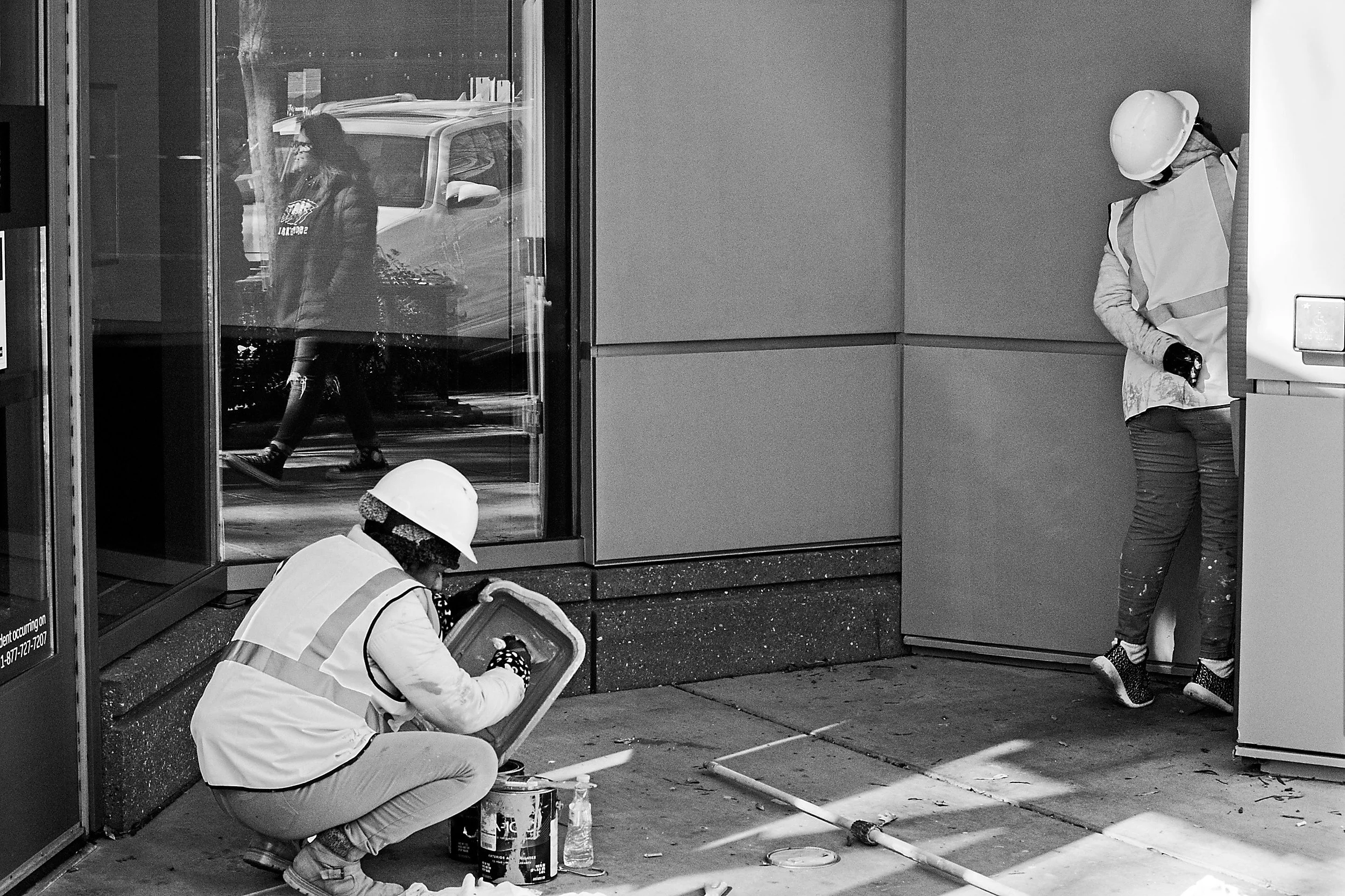
Teamwork
Greenville, SC | N Main St | January 2022
Walking on Greenville's, SC, Main Street, I saw these two workers repairing a wall…

Greenville, SC | N Main St | Jan 2022
Walking on Greenville's, SC, Main Street, I saw these two workers repairing a wall.
Working with their backs to the sidewalk, they seemed unaware of the people walking by. Focused on the task at hand, they quietly went about it, working together and getting the job done.
The public also did not notice them, indicated by the woman whose reflection is visible in the window in the background—going on with their daily chores, busy being busy. Not deliberately ignoring the workers, but not interested.
And is that not what generally is the case?
We all go about our busy lives without paying attention to the people around us.
It seems we are more interested in the actions and lives of movie stars, social media authorities, and other so-called 'influencers' than in the real people around us.
This thought inspired me to start working on a new project about real people: manual workers, parents, emergency services personnel, shoppers, office workers, etcetera.
In the upcoming weeks, I will need to flesh out the details: where to focus on possibly, what type of images, medium (film, digital, or both).
More to come.
Forever Young
Washington, DC | 11th Street NW | July 2014
Bob Dylan, Rod Stewart, Alphaville, and probably many others sang about it. Movies have been made about it.
Staying forever young: a wish that many people need to have.

Washington, DC | 11th Street NW | July 2014
Bob Dylan, Rod Stewart, Alphaville, and probably many others sang about it. Movies have been made about it.
Staying forever young: a wish that many people need to have.
If we must believe the music and film industries.
And cosmetics and clothing firms are playing well too.
Helping people to stay forever young.
Or at least: helping people feel they can stay forever young.
Or at least: making people feel they need to stay forever young.
Madrileñas
Madrid, Spain | Plaza Platería de Martinez | August 2019
Something that always strikes me in Spain is the strong and articulated women. Irrespective of social status or age, they are Present, with a capital P.

Madrid, Spain | Plaza Platería de Martinez | August 2019
Something that always strikes me in Spain is the strong and articulated women.
Irrespective of social status or age, they are Present, with a capital P.
After a stroll through Madrid's famous National Botanical Garden, my wife and I decided we earned some tapas and a refreshing drink. Since it was summer, most bars and restaurants had tables outside on the street, and we quickly found one near the botanical garden and the Prado museum.
While getting seated, I could not ignore these three ladies sitting at a table next to ours.
They were involved in deep conversation. One of the ladies passionately articulated her thoughts on a particular topic, while the other two listened with great attention.
I would have loved to eavesdrop to hear what they were so animated talking about, but that is not something one does. Also, my Spanish is not so good that I could fully understand what she said.
HOWEVER, what I could do was take my trustworthy Leica M4 and seize an image of this beautiful trio.
This photo might not capture a 'decisive moment', but, as I explained previously, street photography is not always about the decisive moment and is far more.
This image, for me, represents a typical situation that someone easily can encounter in Madrid. Or in any town and city of Spain.
Three ladies are having a great afternoon, enjoying some food and drinks and discussing current events, maybe talking about global wars and inflation, or gossiping about the new girlfriend of one of their sons.
Book Review: Lost London 1870-1945 by Philip Davies
How A Photo Book With Old Images Impacted My Photography
I was lucky enough to stumble upon this book while browsing the bargains area of Barnes & Noble. It is a photo book with old images from London, United Kingdom, taken between 1870 and 1945, providing a unique insight into how the city and its inhabitants looked during those years.

How A Photo Book With Old Images Impacted My Photography
Introduction
I was lucky enough to stumble upon this book while browsing the bargains area of Barnes & Noble.
It is a photo book with old images from London, United Kingdom, taken between 1870 and 1945, providing a unique insight into how the city and its inhabitants looked during those years.
Philip Davies has curated the images in the book, an architectural historian who - from 2005 to 2011 was the Planning and Development Director for London and South-East England at English Heritage.
From the dust jacket: "Lost London 1870-1945 is a spectacular collection of more than 500 of the best images from the formor London County Council archive of photographs... Most have been never published before. Taken to rovide a unique recored of whole districts of London as they were vanisching, each of the photographs is a full-plate image, a stunning work of art in its own right."
Published: 2009
Publisher: Transatlantic Press
ISBN: 978-0-9557949-8-8
Size: 11 6/8" x 9 7/8" x 1 1/2"
Review
The book has 14 sections, with the photo sections arranged according to period and city areas:
Foreword by HRH The Duke of Gloucester
Author's Note
Introduction - The Lost City - Images of London 1870-1945
Chapter One - Urban Penumbra - The City fringe
Chapter Two - Engine of Commerce - The City of London
Chapter Three - Between Two Cities - Holborn and Strand
Chapter Four - Imperial Capital - Westminster and the West End
Chapter Five - City Of Dreadful Night - The East End
Chapter Six - London-Over-The-Water - South London
Chapter Seven - Urban Villages - Villas and leafy gardens
Chapter Eight - Zenith 1918-39 - Sovereign of cities
Chapter Nine - Catastrophe 1940-1945 - A city in ruins
Index
Acknowledgements
The first thing that struck me was that the quality of the images is remarkable. They have great detail and excellent tonality. We only wish future generations can view our currently mainly electronically created images with the same quality after one or two hundred years.

Lost London 1870-1945, page 71
The book also provides a great history of photography in London in its Introduction. Not only its 'why' but also its 'how.'
"Photography was not easy in London. Henry Dixon recorded how he had to obtain a photograph in a crowded street by removing a wheel from a wagon, and while his assistant pretended to mend it, he photographed his subject from under the canvas." [pp. 24-25]
The images also show how the photographers had to work the light to create their photos: look at how buildings in the background are over-exposed due to the exposure time needed for foreground objects.

Lost London 1870-1945, page 23
The book's main objective is to create a sense of urgency with the viewers of the importance of preserving architectural gems. To paraphrase from the Foreword: This kind of photography emphasizes the task of English Heritage (and similar organizations in other countries!) to preserve the best of historic buildings, help the general public understand why they should be kept, and increase the understanding of the significance of these buildings for our history.
For me, however, the value and importance of the book and the photographs go far further than this. The images of the streets, buildings, and people provide us with a unique insight into how people lived during the period covered by the book. It is a true social documentary trove and "Spanning a period of 75 years from the mid 1870s to 1945, [the photographs] depict a world in transition." [p. 9]
"Some of the physical impacts of these profound changes can be seen in these photographs - the arrival of tramlines, the progressive replacement of horse-drawn vehicles by motor cars,..." [p. 27]

Lost London 1870-1945, pages 202-203
While Davies, in his Introduction, does a great job to explain the importance of the images from an architectural history perspective and while he provides us with a socio-economic reference frame for the period covered, it is the images themselves that tell that story best.
"As primary sources of historical evidence, [the photographs] are by their very nature impartial, and bear witness to past places or events, undistorted by the interpretation of their creator." [p. 9]
One of my first reactions was Eugene Atget coming to mind when first browsing through the images: the streets, sometimes with and sometimes without people. Important in that context is that "[The images] have been selected to show the commonplace rather than the great-set pieces,....which conveys so vividly the actual feel of London as it then was..." [p. 9] and they are "important documents of social and topographical history,..." [p. 9]

Lost London 1870-1945, page 69
Consequently, I dare say that Davies did for the multiple photographers whose images he used in the book what Berenice Abbott did for Eugène Atget.
Other images reminded me of Lewis Hine with their harsh directness and focus.

Lost London 1870-1945, page 14
Conclusion and Recommendation
This book is a monumental document about one of the world's great cities and about the photographers who documented the changes in London over 75 years.
It provides a unique, intimate insight into the status of London's buildings and streets and the lives of its inhabitants.
In conclusion, this is a remarkable document, and it has very much influenced my view about street and social documentary photography. Creating images of the places I visit, I also try as much as possible to have my photographs as impartial and undistorted by my interpretation of the scenes I observe as possible.
Hello Mrs. Cartier-Bresson
Greenville, SC | S Main St - W McBee Ave | January 2022
When I saw this lady walking towards me, I almost froze. Where did I see those sunglasses before?

Greenville, SC | S Main St - W McBee Ave | January 2022
When I saw this lady walking towards me, I almost froze.
Where have I seen those sunglasses before?
Could it be?
Is it her?
If only HCB was here, he would be able to tell
61 years... impossible, it can't be her...
Maybe her daughter?