
Passersby
Greenville, SC | S Main St | September 2021
This black and white image of two people in silhouette in downtown Greenville, SC probably depicts one of the most interesting parts of street photography…

Greenville, SC | S Main St | September 2021
This black and white image of two people in silhouette in downtown Greenville, SC probably depicts one of the most interesting parts of street photography.
We take pictures of strangers without knowing anything from them. Are they are happy or sad, rich or poor, on vacation or walking to work. We don’t know…
We take their pictures, but they are like silhouettes to us: we don't see the details of their lives.
Conversation
Greenville, SC | S Main St - N Court St | September 2021
As a street photographer, I always wonder about the background of the people in my photographs: who are they,…

Greenville, SC | S Main St - N Court St | September 2021
As a street photographer, I always wonder about the background of the people in my photographs: who are they, where do they come from, what are they thinking?
When looking at the man and woman sitting together here and both looking straight ahead, I could create two different stories: one of them being annoyed with each other and not wanting to talk, and one of them being so comfortable with each other that no words are needed to communicate.
I prefer the latter.
Why Subjects Need Space
To Crop Or Not To Crop, The Question Is
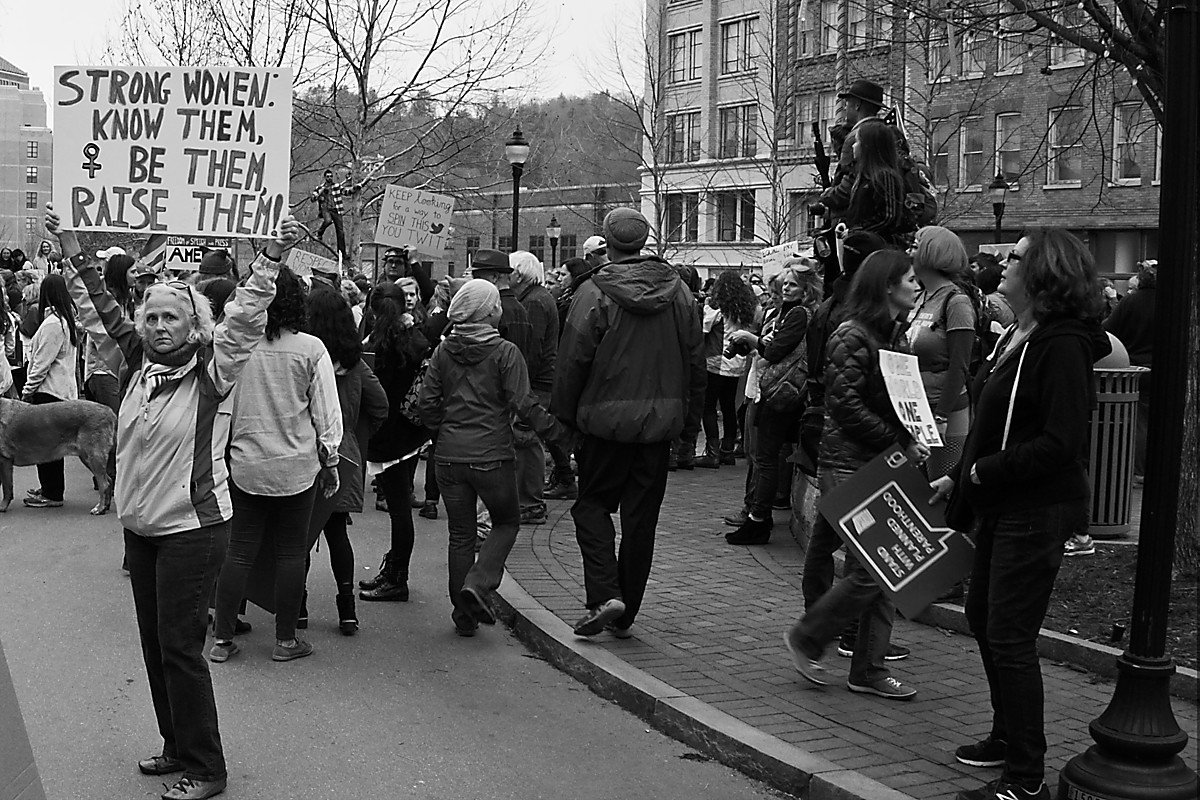
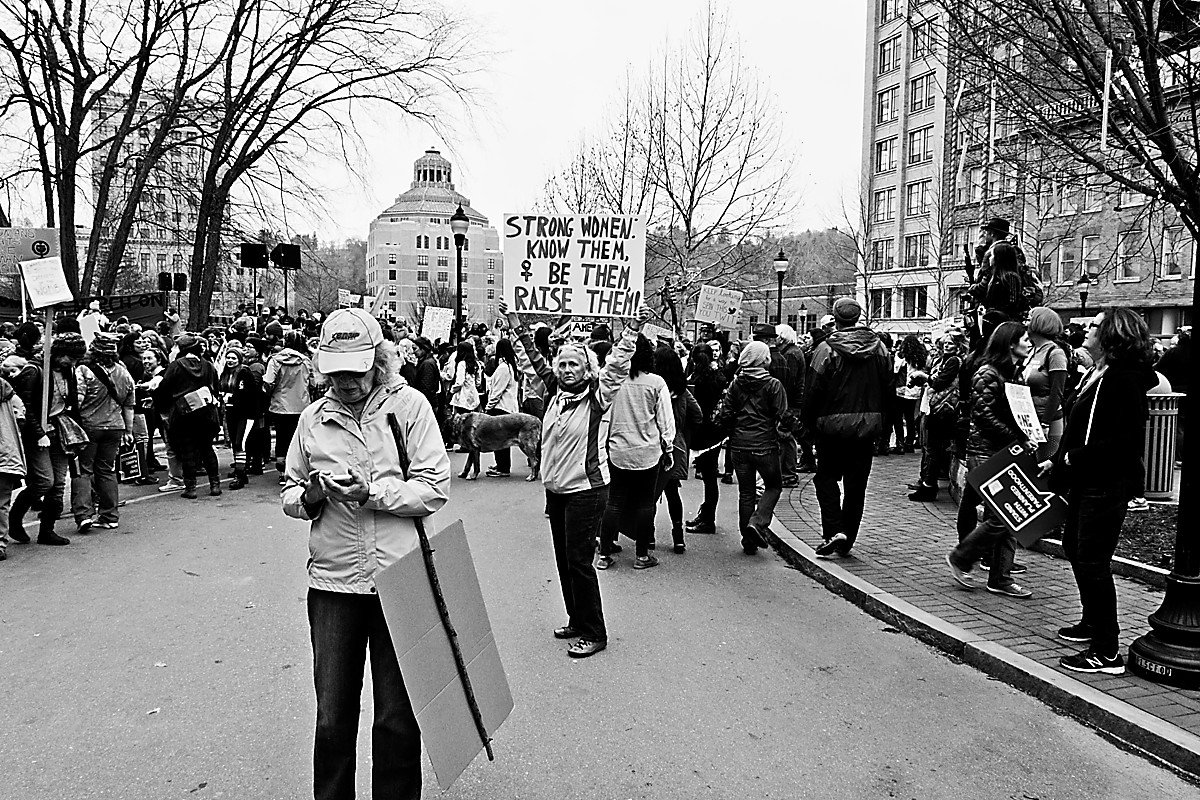
I need to think more about when to crop my images and when not. Reducing what the viewer can see of the subject of an image to the bare minimum can take away from the message that I want to share.
To Crop Or Not To Crop, The Question Is
I need to think more about when to crop my images and when not. Reducing what the viewer can see of the subject of an image to the bare minimum can take away from the message that I want to share.
Why I Sometimes Crop Images
While I challenge myself to get my composition right when taking a picture for my social documentary-type images, I sometimes still feel the need to crop the image for a better (very subjective indeed) result.
The reason to crop images, for me, can be one of two:
I want to change the aspect ratio of the image, or
I want the viewer to see something special.
The first reason is basically for esthetics: I really love images in the 4:5 aspect ratio and an added perk is that 4:5 images print great on letter-sized paper.
The main reason I would crop an image in post-production, however, is to ensure that the viewer sees what I want them to see. When reviewing some Street Candid images, I feel that the viewer would benefit from some guidance for what to look at to fully understand why I took the picture.
Why Cropping Doesn’t Always Result In A Better Picture
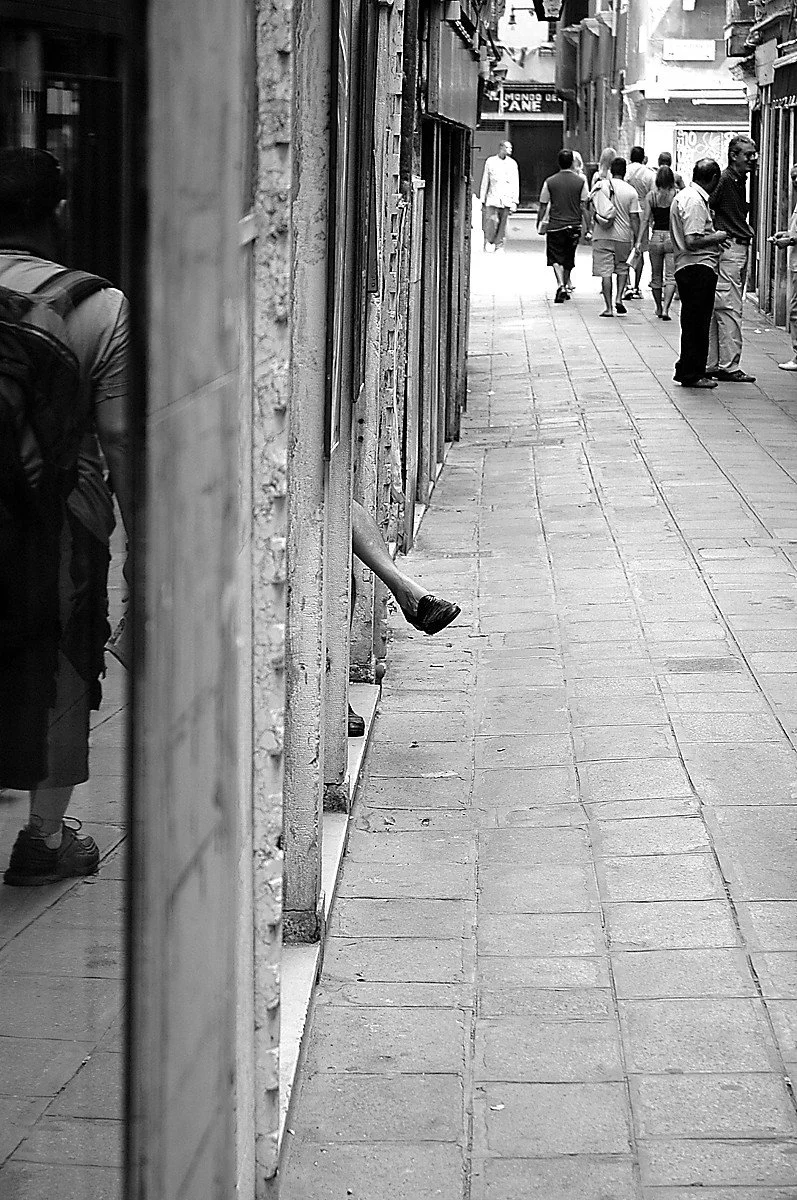
It is the second reason I want to talk a bit more about today. After reading the feedback I got on my initial publication of the image “Alley Leg”, I realized that cropping with the intent to show the viewer something special that I saw when creating the image, can actually work adversely
Because I 'zoom' too far into the subject I want to show, the viewer does not see, can not see why I want to show it.
If I want to show something important, the viewer doesn't grasp the importance.
If I want to show something funny, the viewer doesn't grasp the joke.
The reason for this is that I eradicated the context from what I wanted to show.


I saw that something was important because I saw it in its context. I saw that something was funny because I saw it in a specific context. By cropping, I removed the context. And as a consequence, the viewer has no clue about what I actually want to show!
This, of course, is not always the case. Sometimes cropping can help to remove distracting elements from the image. And limited cropping might help to just improve the composition sufficiently to make the image more interesting.
And Sometimes Cropping Is Just “Not Done”
As I mentioned above, for my social documentary-type images I challenge myself to get my composition right in-camera. The main reason for this, as I explained in a previous article, is that I want to be as unbiased as possible when showing the viewer what happened during the events I documented. And although there always will be some subjectivity (whenever you take a picture you always have to decide what to show in the frame and what not), this challenge helps me to provide an as objective as possible record of what happened.
Good examples are the two images at the top of this article that are from the same event: one cropped, and one uncropped. Do you ‘read’ each image differently?
Book Review: Henri Cartier-Bresson - The Modern Century, by Peter Galassi
Eight Lessons I Learned From MoMA's Henri Cartier-Bresson Retrospective The Modern Century
Henri Cartier-Bresson. Admiringly called HCB by his followers, almost no documentary photography documentary does not mention him. Loved, imitated, copied: the photographer who defined documentary and street photography.

Eight Lessons I Learned From MoMA's Henri Cartier-Bresson Retrospective The Modern Century
Introduction
Henri Cartier-Bresson.
Admiringly called HCB by his followers, almost no documentary photography documentary does not mention him.
Loved, imitated, copied: the photographer who defined documentary and street photography.
And while he was only one of the founders of Magnum (together with Robert Capa, George Rodger, and David "Chim" Seymour), Henri Cartier-Bresson is often considered the father of documentary and street photography.
I wanted to explore what we can learn from his approach and photographic philosophy. How can we create images that are as impactful as his? Or at least try doing so.
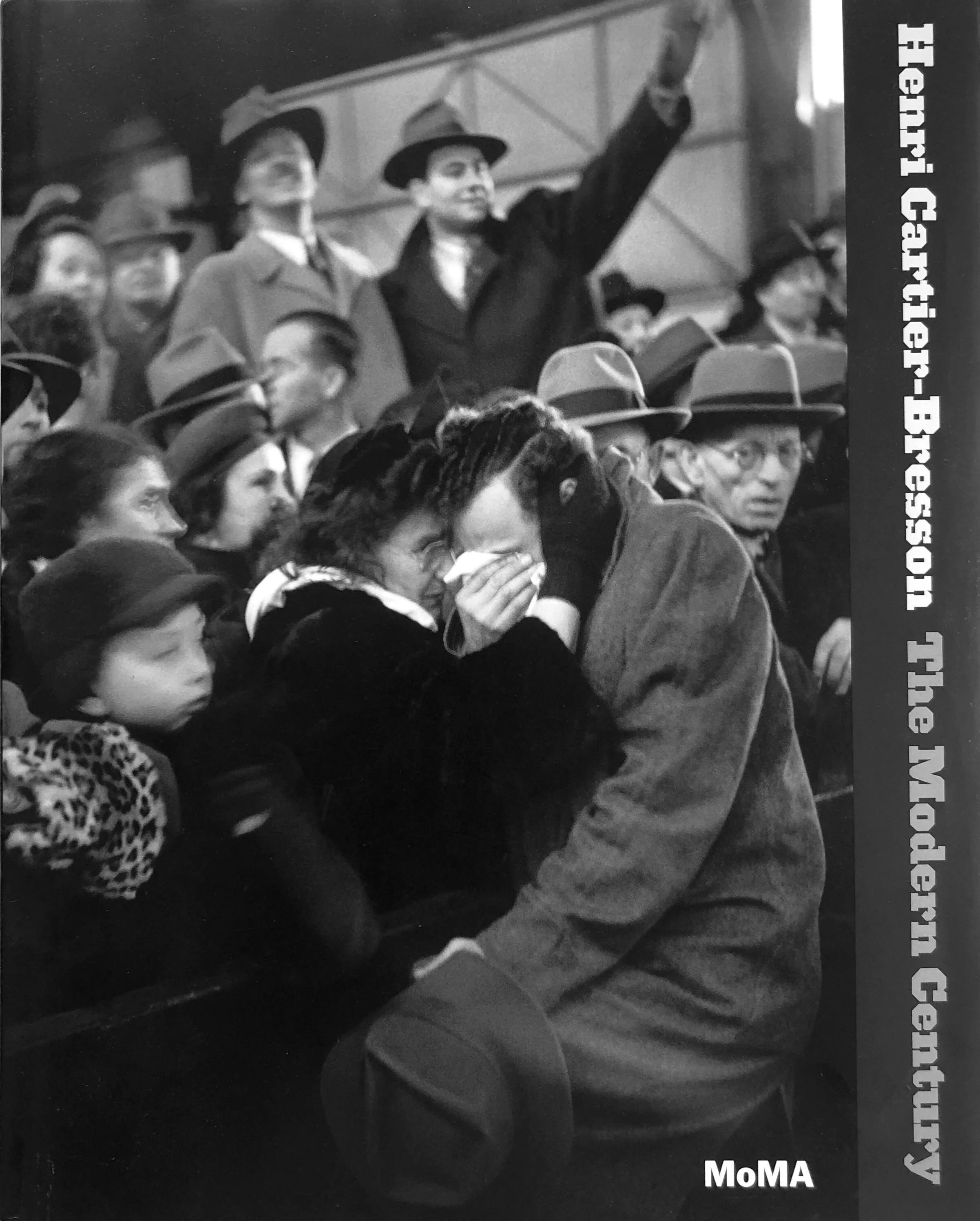
While multiple books and documentaries are available about this master photographer, a great starting point to understand his photography is Henri Cartier-Bresson - The Modern Century by Peter Galassi, Chief Curator of MoMA's Department of Photography (1991 - 2011).
It also is the catalog to the 2010 Museum of Modern Art (MoMA) exhibition that was the "first major retrospective since the photographer's death in 2004." [p. 6].
With 376 pages and 463 reproductions, The Modern Century is a pleasure to read, a comprehensive reference work, and a treasure trove of images.
The book has 12 sections:
Foreword, by Gleen D. Lowry - Director of MoMA
Preface and Acknowledgements
Old Worlds, Modern Times
Photographs
List Of Photographs
Points Of Reference
At Home Everywhere: A Chronology Of Cartier-Bresson's Travels
For The Printed Page: Cartier-Bresson's Work In The Periodical Press
Chronology Of Major Photographic Exhibitions And Books
Selected Bibliography And Filmography
Index
Trustees Of The Museum Of Modern Art
While large parts of the main essay "Old Worlds, Modern Times" reflect on Henri Cartier-Bresson's life, I was especially interested in reading about his approach to photography and what we can learn from it related to working as a documentary image creator.
A Photojournalist Is A Jack Of A Thousand Trades
While every aspiring documentary photographer probably dreams of making a living from their work while traveling the world, one of the essential lessons from this book is that this job encompasses a lot more.
As Galassi explains, "...being a photojournalist didn't mean being just a photographer: It meant being a student, a diplomat, a traveler, an investigator, a reporter, a historican. To Cartier-Bresson, it meant engaging the whole of the world." [p. 12].
And some of the thousand trades the documentary photographer needs to balance can even be conflicting - the most challenging probably being an artist while at the same time being a truthful reporter.
"When Cartier-Bresson took Capa's advice and embraced the role of photojournalist, though, the artist in him did not evaporate." [p. 60].
"About his decision to join Magnum, he loved to cite Capa's advice: "Watch out for labels. They're reassuring, but somebody's going to stick one on you that you'll never get rid of: 'little Surrealist photographer.' You'll be lost, you'll get precious and mannered. Take instead the label of 'photojournalist' and keep the other thing for yourself." [p. 12].
This decision to continue to use his artistic vision while taking documentary images was possible and accepted because "The boldest innovation (or discovery) of interwar photography was the recognition that plain fact could be the chimerical stuff of a new art." [p. 32].
But Cartier-Bresson realized that as a documentary photographer, he needed to maintain the balance between creating visually attractive images and showing the world the reality of his subjects. "Cartier-Bresson sometimes spoke in somewhat romantic terms not only about Magnum but about his profession generally as a guild of craftsment whose job was to report honestly, not to flaunt their artistry." [p. 50].
Be Disciplined In Your Work
"Cartier-Bresson's conviction that "one must let the things grow in you" would become legendary, as would his distaste of deadlines and other editorial demands." [p. 20].
Letting a project grow and taking the time to develop its content, however, does not mean that we should not have a strong discipline and work ethic.
On the contrary, as Cartier-Bresson showed us, "shaking himself free of the worst idiocies of arrogant editors in New York did not require shedding the discipline and instincts of a journalist - qualities that he exhibited to a very high degree." [p. 21].
Cartier-Bresson's disciplined approach to photography started with visualizing the final image before he released the shutter. His contact sheets unquestionably reveal this: "...he rarely released the shutter simply because he was struck by a particular subject or action. That is, he took a shot only after he had translated the subject into a picture: if it was a vertical with a doorway anchoring the left side, then that element was already in place in the first frame of a sequence." [p. 42].
This visualization was vital to limit the number of frames he would need to use to get to the final image, "Four or five attempts was general the upper limit, unless the subject was particularly important or demanding or potentially fruitful. Two or three frames was more common." [p. 42].
And, finally, we can learn from Cartier-Bresson's composition discipline. Through visualization and carefully framing his subjects, he created images that contain everything needed to tell the story; "The frame includes everything that is relevant and nothing that isn't... The frame does not cut or exclude; it encloses and contains." [p. 46].
Go Out There Taking Pictures
The best, the only way to create meaningful images is to actually go out and create images.
Sometimes we, photographers, are in a creative rut: we don't know what to take pictures of, we don't know what story to tell, we sit down and pity ourselves for our lack of inspiration.
But no picture has ever been created by a photographer sitting in a chair, despairing what to do.
To be successful, we have to get up and make an effort.
Cartier-Bresson himself said it straightforwardly: "Do you know what it takes to be a photographer? It takes one finger, one eye, and two legs. I used to run or walk thirty or forty kilometers a day." [p. 60].
He understood that while we can, and should learn from the work of other photographers and educate ourselves about photographic techniques, "It's outside of school that one learns the most, in the street, in the workshop, at the stalls of a fair, at the theater, in railroad cars and on steamboats, in new landscapes and foreign cities." [p 29].
Focus On People
Most documentary photography exists because something happened. It is events that people are interested in, not things. Lifeless objects might be part of the event or even the reason the event occurs at all (e.g., a car show, the demolition of a building), but in the end, people are interested in people.
Thus, it is often more rewarding to focus on the people attending or watching an event than taking pictures of the actual event.
Cartier-Bresson learned that early in his documentary career when he got an assignment to cover the coronation of King George VI in Londen, 1937.
It was this assignment that started his approach of "...ignoring the event to study the crowd, who are all the more expressive, as a group and as individuals, because their attention is on neither themselves nor the photographer." [p. 38].
Photography Transforms What It Captures
As Sally Mann also teaches us, "Photography inescapably transforms what it describes" [p. 32].
Where Mann provides a great example of photography altering real memories when she talks about a picture of her father, Galassi states that "As the world passes through the lens into the camera, it retains the feel of reality but adapts to the very different realm of the picture." [p. 35].
Consequently, we have to live with the strange contradiction that "The still image possesses its power not because it is so real but because it is so artificial, as Rodin rightly insisted." [p. 45].
And this is where the importance of maintaining the balance between honest craftmanship and being an artist rears its head again, since "A great deal of what is generally classified as photojournalism is in fact not reportage but illustration - a matter of providing an appropriate... image to fill the space." [p. 54].
This transforming property of photography teaches us two lessons: "...the first is that the meanings of a picture can be influenced considerably by the context in which it appears... The second is that the significance of the tangible content of the picture depends upon both the photographer's capacity to grasp it and the viewer's capacity to interpret it." [p. 62].
And this leads us directly to the next learning point.
Take Notes, Write Captions, And Be Aware Of Their Impact
Captions are a topic that every photographer seems to struggle with: are they necessary for the viewer to understand the picture; should the photographer use them to direct the viewer's thoughts?
Cartier-Bresson was a firm believer in taking notes to his images, "He carried with him a notebook in which to scribble names and facts on the spot, then in the evening he sat down to translate the raw notes into a narrative rich in reflection and interpretation as well as facts." [p. 15].
And while captions sometimes seemingly might not be needed because an image "...so successfully transforms the particulars of a contingent event into a lasting symbol...that the caption is beside the point." [p. 17], they, in general, are needed to understand the broader context of the situation presented to the viewer.
And it is the photographer who was and is "...expected to provide not just the essential facts but the social, historical, and political background necessary to interpret the broader significance of the images." [p. 14].
We also need to be aware that it is not always the stand-alone event we are documenting that matters, "...but its potential to represent a much broader subject..." [p. 22].
Therefore, it is crucial that today's documentary photographers, similar to Cartier-Bresson, need to be "...acutely alert to the presence of the past." [p. 60], because their subject is not only what is immediately in front of the lens but is "...society, culture, civilization - that is, history." [p. 61].
Watch Out For The Decisive Moments
Henri-Cartier Bresson coined the phrase "The Decisive Moment, " which is also the title of his most known book.
What present-time photographers might not be aware of is that in a powerful photograph "...there are two quite distinct decisive moments, as Cartier-Bresson suggested in his famous formulation: "To me, photography is the simultaneous recognition, in a fraction of a second, of the significance of an event as well as of a precise organization of forms which give that event its proper expression." [p. 45].
And a photograph is most potent and successful when "...the decisive moment of the subject and the decisive moment of the photograph coincide perfectly. In terms of the definition, they are simultaneous." [p. 45].
Interestingly, as Galassi observes, "Much of the time, the subject offers no decisive moment at all; the climax of meaning is created by and exists only within the picture." [p. 45]. He provides as an example the image Cartier-Bresson in 1947 took of Jawaharlal Nehru with Edwina and Louis Mountbatten on the steps of Government House in New Delhi. The situation captured in the image is not of a decisive moment at all; however, how Cartier-Bresson composed the picture and placed the three people in it tells a whole story on its own.
Interestingly, the original French title of The Decisive Moment is Images à La Sauvette, which literally translated means "images on the sly."
We could also say that these are 'stolen' images: the pictures' subjects were not aware of the photographer capturing them.
I, therefore, think The Stolen Moment would be a better title for Cartier-Bresson's mastery. He was able to pre-visualize the image he wanted to create, needed only one or two instances to make the picture as he wanted it, and in this manner managed to produce a consistent body of work of powerful photographs.
Not All Photographers Are Editors
The final lesson I learned from reading The Modern Century is that not all photographers are good editors.
As Cartier-Bresson explained about himself, "My intuitive approach to photography and my constant preoccupation with the single image makes [sic] me a poor designer. I find it difficult to create a harmony among different photos. I leave this to my publisher friends, to art directors and curators with whom I always discuss the layout." [p. 58].
Whether deciding what image to publish or how to sequence and present a photo essay, most photographers probably are better off not doing that without help.
Editing and sequencing is an art on its own, and we should have the humility to recognize that creating images is not the same as selecting our best and bringing them all together in a story.
Suppose we don't have a trusted editor. In that case, the best we probably can do is leave all images alone for some time to ensure we are not as emotionally attached to them as we were immediately after creating them.
When we took the picture, we heard the noises, smelled the smells, and saw everything that was going on outside the frame.
Our viewers? They have to do with the image we managed to create and the captions we added. Let's be compassionate with them, for our picture's sake.
Conclusion
Henri Cartier-Bresson - The Modern Century is an insightful masterpiece, a pleasure to read, and a treasure trove for everything regarding this great photographer. From the story of his life to understanding how he was able to create his masterpieces to looking at the beautiful reproductions of HCB's famous and lesser-known pictures.
I highly recommend this book to all photographers, professionals, and hobbyists alike, irrespective of whether they want to be in the documentary photography business or active in any other photographic genre.
Author: Peter Galassi
Title: Henri Cartier-Bresson The Modern Century
Year Published: 2010
Copyright: The Museum of Modern Art, New York
Cover: Hardcover
Pages: 376
Publisher: The Museum of Modern Art, 11 West 53 Street, New York, NY 10019-5497 www.moma.org
ISBN: 978-0-87070-778-0 (cloth)
ISBN: 978-0-87070-777-3 (paper)
Buy it at the MoMA Store, Amazon, or Artbook.com (no affiliations).
More Information And Further Reading
The Boston Globe review of the exhibition
The Christian Science Monitor review
Review of the exhibition by John Haber
Review of the exhibition by Fundación MAPFRE
In Focus: Bargain Found
The Joy of Finding a Bargain at a Madrid Market
This image was created during a stroll in sunny Madrid, Spain, in August 2019…

The Joy Of Finding A Bargain At A Madrid Market
Background Story
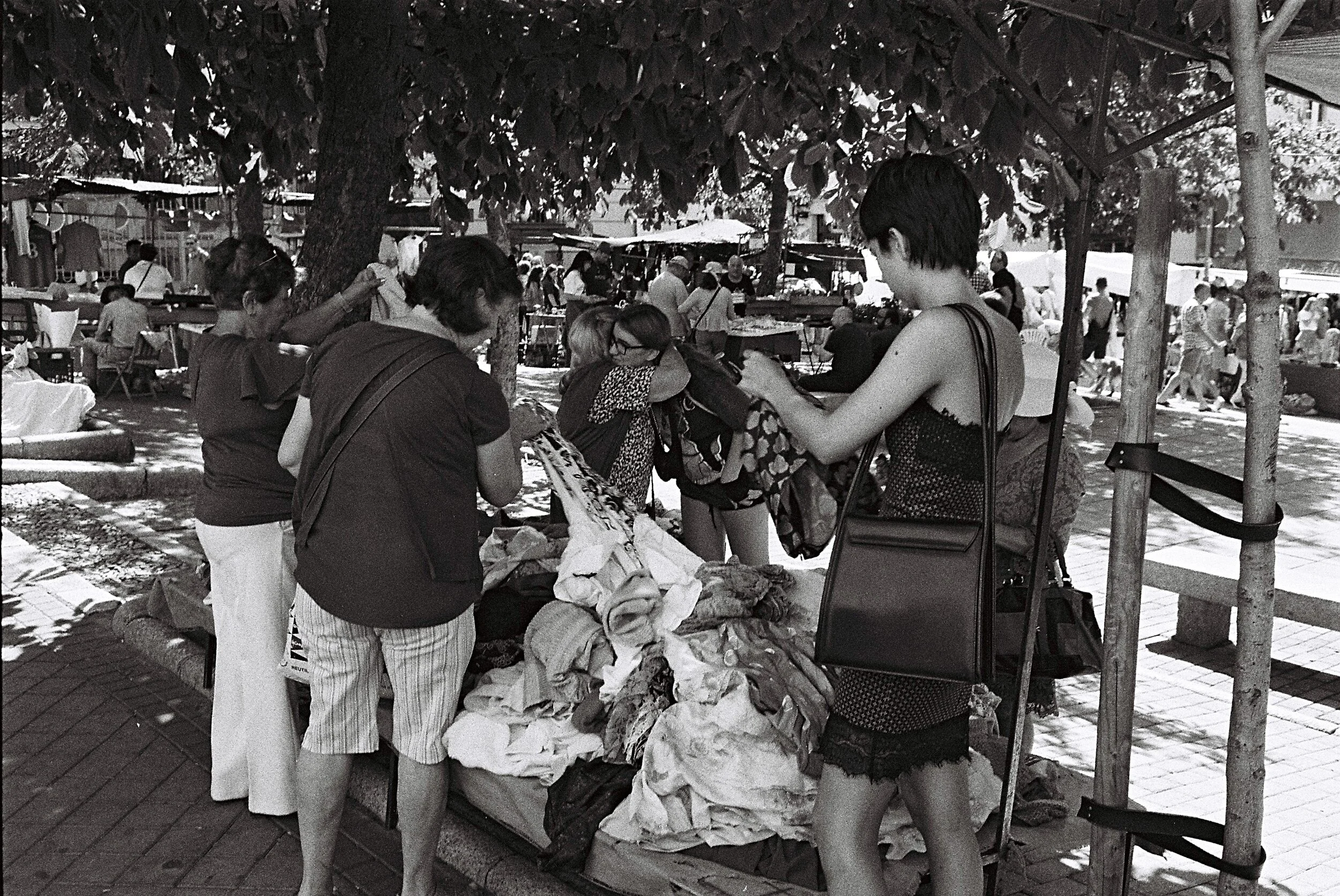
This image was created during a stroll in sunny Madrid, Spain, in August 2019.
I used my home leave from my assignment to South Africa to spend a week in Madrid with my wife, prior to traveling on to The Hague, the Netherlands, for some time with my youngest daughter.
Madrid has an abundance of squares (plazas), shopping streets, small back alleys, and parks to explore. The weather was great that week and we enjoyed a couple of days strolling through the beautiful capital of Spain.
That particular day we visited several open-air street markets, where a large diversity of goods was being sold. Fruit, vegetables, meat, fish, musical instruments, potter, leatherware, shoes, t-shirts, artisan bread, cheese, handheld fans, bags, tools; you name it, they sold it. And fabrics of course.
A fabrics stall at a market is always interesting to observe. Often the merchandise is just laying on a table or on the ground, and prospective buyers are picking it up, holding it to the light, and showing it to each other to determine if it is the right quality, size, and color for whatever they are creating at home.
And always there is this hope to find a real bargain.
As you can imagine, this creates numerous situations to make a photo. And this was just the right one for me.
How It Was Made
Only a couple of weeks earlier I was fortunate to purchase a just CLA’d Leica M4 and a Summaron 35mm f/2.8 lens for a very reasonable price. And since my wife brought my Voigtländer VCII lightmeter from home, I was experimenting with the camera, lens, lightmeter combination.
As you will know by now, I love black and white images and I had my favorite film, Ilford Delta 400, loaded.
Why It Works
The subject matter of this image is right up my alley: the busyness of the market, people interacting with each other, and the play of light and shadows.
The main subject is formed by the two hugging women in the center of the frame.
The pile of fabric and the piece held up by the lady to the left create a nice diagonal, leading the viewer’s eye through the composition.
The small tree and its support to the right and the larger tree to the left frame the main subjects of the image, while at the same time creating sub-frames for other points of interest: see the walking man perfectly framed by the small tree and the wooden support? This was a nice bonus that I only discovered after getting the film back from the lab.
As always, the light plays a major factor in making this image work for me. The harsh sunlight to the left and right of the group of women, with the shadows on the street in the foreground and the dark leaves of the trees, provides an additional frame for the main subject.
All parts work together to create several frames around the center of the image, focusing the view towards the two women in the center.
How Can This Image Be Used
There are several ways to use an image like this in a commercial setting.
There might be a hotel nearby that can use this image to show their guests the area they are located at, and how close they are to classical Madrid markets.
And the City of Madrid could use it to show prospective visitors its relaxed but lively street life and market culture, ideally for tourists who want to experience the real Spanish.
Although countries and cities are opening up after what hopefully was the worst of the Covid-19 / Coronavirus impact it might be a while until we can strolling the markets of Madrid again. Until then, images like this one will remind us of the better times to come.

In Focus: Food Envy
Pre-Pandemic Diners In The Hague
We all remember those carefree pre-pandemic afternoons and evenings when we could stroll the streets…
Pre-Pandemic Diners In The Hague
Background Story
We all remember those carefree pre-pandemic afternoons and evenings when we could stroll the streets without face masks and go to restaurants to enjoy a good meal without being restricted in how many friends to meet. Don’t we?
This image was created during a warm summer evening stroll in The Haag (Den Haag), The Netherlands, in August 2019.
I had spent a week in Madrid, Spain, with my wife and now enjoyed the additional time off with my youngest daughter who just moved for her studies to this lovely city in the Netherlands.
I stayed in the Park Centraal Hotel which is in a beautiful 160-year-old building. And in the Molenstraat and neighboring streets immediately outside the hotel are several small shops, restaurants, and eateries.
Tourists and locals alike enjoyed dining inside and on the terraces outside. The relaxed atmosphere, the darkening sky, and the light inside the restaurants created a tableau that depicted the typical Dutch “gezelligheid”. While this can be translated with “cosiness”, the Dutch word encompasses more: a general feeling of wellbeing and safety.
I find it always amusing to see how passersby look at people eating outside. In fact, they might not be as much interested in the diners as well as in the food on their plates. Are they deciding what they want to order themselves? Or are they going to an eatery which they anticipate has a less enjoyable menu; are they a bit envious maybe? Is food envy a concept?
Anyhow. The environment was right, the people were at the right place. And I made the photo.
How It Was Made
It was only in January of that year that I purchased the Fujifilm X100F, and I was still experimenting with its settings and discovering its capabilities.
I love black and white images (did you notice that all images on this website are monochrome?) and in this instance, I used the Acros standard camera preset.
Although I actually like that preset very much, when editing the image I selected the ON1 preset for Ilford Delta 400. I just love that film and I also wanted to check how the built-in preset would compare to scans from actual film images.
Why It Works
First of all, I like the subject matter.
A small city street with restaurants and outside diners. People passing by; what are they thinking?
Are the passers-by envious of the diners? Are the diners disturbed by the people walking in the street?
Then there are the leading lines that lead the viewer’s eye through the image.
The curb and the awnings are perfect examples of converging lines, anchored in the bottom right corner by the blackboard with snack offerings.
And, finally, the light. Ah, the light!
The combination of pre-sunset light and the soft incandescent light from the restaurants, creating that special atmospheric mood that is so typical of lazy summer evenings.
I can just not get enough of it.
How Can This Image Be Used
Images like this can well be used in a commercial setting.
Humphrey’s Restaurant might use it to connect their customers to the location (unfortunately their restaurant in the Molenstraat has been closed, but at the time of writing of this article they still operate a restaurant in Scheveningen, near The Hague), or to show them the great ambiance they have.
The Park Centraal Hotel can use this image to show their guests the nice area they are located at, and how close they are to restaurants and nightlife.
And the City of The Hague could use it to show prospective visitors how a big city can offer coziness and a safe environment to spend the evening.
With the current Covid-19 / Coronavirus-related restrictions in place, it might be a while until we can enjoy dining out in the Molenstraat again. But the time will come that we are allowed again! Until then, images like this will remind us how great having dinner outside with friends is.
Book Review: Hold Still, by Sally Mann
Five Lessons I Learned From Sally Mann’s Autobiography Hold Still
Sally Mann's 'Hold Still' is one of my favorite photographer (auto) biographies. It provides a fascinating and intimate view of her family's history and about how that history influences her life and how she photographs…

Five Lessons I Learned From Sally Mann’s Autobiography Hold Still
Introduction
Sally Mann's 'Hold Still' is one of my favorite photographer (auto) biographies.
It provides a fascinating and intimate view of her family's history and about how that history influences her life and how she photographs.
Several reviews have been written already of this book. But while most still focus on linking this book to the controversy decades ago around the images of her children, I read it specifically from a viewpoint to find perspectives on documentary photography.
For me, Sally Mann is the ultimate (social) documentary photographer with her images of her family's life and children, her documenting the South in general, and her documenting Civil War battlefields.
And as each documentary photographer does, she provides us with her very personal interpretation of the scene within the rectangle of the photograph.
Now let's look at the five takeaways for documentary photography I found in Hold Still.
There is no objective documentary photography: it creates its own memories
While Sally Mann, as many other photographers, discovered that "Time could be stopped, I thought, and by other hands than those of God." [p. 81], she also recognized that the specific moment captured in a photograph could alter the memory we have of that moment.
As soon as in her introduction, she indicates that looking at old photographs, she "...encountered the malignant twin to imperfect memory: the treachery of photography." [p. xiii], realizing that "No snapshot can do what the attractive mnemonic impediment can: when we outsource that work to the camera, our ability to remember is diminished and what memories we have are impoverished." [p. 301].
Mann provides a great example of photography altering or even replacing real memories when she talks about a photograph of her father. Looking at that image and recalling her memories, she realizes that "It's a picture, a photograph I am thinking of. I don't have a memory of the man; I have a memory of a photograph." [p. 302].
This discrepancy between real memories of an event and how a photographer captured that event creates a challenge explicitly when interpreting documentary photography.
Even the most 'honest' documentary image shows only a part of reality, of what happened; seen through the photographer's eye, directed by the photographer's interpretation.
Or, in Mann's words: "How can a sentient person of the modern age mistake photography for reality? All perception is selection, and all photographs - no matter how objectively journalistic the photographer's intent - exclude aspects of the moment's complexity." [p. 151].
Reading these words made me reflect on how we and people in the future (will) look at iconic documentary photographs. Think, e.g., of Tank Man on Tiananmen square, President Bush standing on the rubble of the World Trade Center, images of the Black Lives Matter marches and so many more.
The moment you capture people, you are taking something from them
Sally Man touches in Hold Still one of the most challenging aspects of documentary and street photography: when and how to capture images of people.
While it can be easy to photograph a person in an image that, in essence, is created for documentary reasons (and I consider street photography as a type of documentary photography), its impact and implications can be more extensive than intended.
What we always have to be aware of is the fact that we might "Catch a person in an awkward moment, in a pose or expression that none of his friends would recognize, and this one mendacious photograph may well outlive all corrective testimony; people will study it for clues to the subject's character long after the death of the last person who could have told them how untrue it is." [p. 308].
What about taking images of people in a demonstration? Or during a moment of anger, a moment of grief, or a time of misfortune?
While we might 'need' to create the picture because of its historical significance or maybe even because we want to challenge a social-economic situation, we always need to realize that "Exploitation lies at the root of every great portrait, and all of us know it. Even the simplest picture of another person is ethically complex, and the ambitious photographer, no matter how sincere, is compromised right from the git-go." [p. 292].
However well-meant our intentions, "Still, the fact remains that many, I daresay even most, good pictures of people come to one degree or another at the expense of the subject." [p. 292].
Reading this, images of homeless people immediately come to mind. However, one specific photograph that I had to consider when reflecting on Mann's words was The Falling Man, taken during the terrorist attacks on the World Trade Center buildings in 2001.
It, to me, is one of the most impactful images created during that catastrophic event. While it is a picture that never can be unseen, it does not tell us anything about the person in it. And, as a consequence, we should never assume anything about this person. The only thing we are allowed to do is to accept him as part of the event and honor and respect him with the thousands of other victims from that dreadful day.
Forget the photographers; learn from their work
The ethical dilemma regarding the exploitation of the subjects in documentary images, as mentioned in the previous section, also raises another question. Are we allowed to admire images that have documentary value but are created in an unethical manner or by photographers we - for whatever reason - do not like?
But how about the ethics of how the image was created? If someone makes a great image in an 'immoral' way, is it still a great image?
Mann's intriguing answer to these questions is that we should not forget who the photographers were, but we should forget how they were: "Even if I were all of those things, it should make no difference in the way the work is viewed, tempting as it is to make that moral connection." "If we only revere works made by those with whom we'd happily have our granny share a train compartment, we will have a paucity of art." [p. 153].
Also, here, Falling Man immediately comes to mind. Was it ethical to take this image? As the general public and as photographers, we can agree or disagree with the photographer who made it. But according to Mann, that is not to the point. We, the viewers, are not allowed to make that moral connection. We need to look at the image as it presents itself to us: as a witness of a significant historical event.
Captions are essential
But is an image is it presents itself to us sufficient to understand what we are seeing?
I am still struggling with whether to add captions to my images.
Do I need to add captions to clarify the picture (contradictory to the 'common' knowledge that 'a picture is worth more than 1,000 words)?
Or do I want to add captions to direct the viewers' impression to something I specifically want them to associate the picture with?
Mann answers this question clearly: "Just in case anyone could miss it, I made sure that the title drove the comparison home." [p. 114].
She deliberately uses captions to ensure that there is no ambiguity about what an image represents. She doesn't want the viewers of her work to speculate about its content or intent because "All these interpretations of this fictionalized fraction of a second have been posited, as have many more, sometimes to our amusement and sometimes to our distress." [p. 164].
And she doesn't restrict this to captions to individual images. Her essays are woven around images that need words to explain what is happening, why she created specific photos, and why she created in a particular manner. Saying that "That inherent relationship between my writing and my photography has never been clearer to me than it is now." [p. 206]. Explaining that images and words enforce each other.
You need to continue producing
The final lesson I learned from reading Hold Still is that we are obliged, driven, and doomed to continue creating images as photographers.
What photographer has never reached that point that we want to give up? When we think our creative inspiration is gone, our muse left us, and that we are listening to an internal voice that tells us to stop.
"That voice of despair suggests seducingly to me that I should give it up, that I'm a phony, that I've made all the good pictures I'm ever going to, and I have nothing more worth saying." [p. 281 - 282].
But then she goes on: "That voice is easy to believe, and,....., it leaves me with only two choices: I can resume the slog and take more pictures, thereby risking further failure and despair, or I can guarantee failure and despair by not making more pictures. It's essentially a decision between uncertainty and certainty and, curiously, uncertainty is the comforting choice." [pp. 282].
And sometimes, it isn't easy to continue, especially after having created one of those rare, specifically great pictures. "Each good new picture always holds despair within it, for it raises the ante for the ones that follow." [p. 283].
The photographer, however, needs to go on, to plod on. Because "Maybe you've made something mediocre - there's plenty of that in any artist's cabinets - but something mediocre is better than nothing, and the near-misses, as I call them, are the beckoning hands that bring you to perfection just around the blind corner." [p. 37].
Conclusion
Reading 'Hold Still' is a great pleasure.
It not only is the (auto) biography of one of my favorite photographers, it provides some learning points for documentary and street photography from someone I consider the ultimate documentary photographer.
Whether she talks about the un-objectivity of photography as a medium that influences our memories, about the morality of taking images, about judging pictures based on who created them, the necessity of captions, or the need to continue creating, these are all valuable lessons to contemplate for my personal work and to take into consideration when looking at the work of other photographers.
I, without any hesitation, recommend this book to all photographers in general and to anyone who creates or wants to create (social) documentary and street photography.
Author: Sally Mann
Title: Hold Still
Year Published: 2015
Cover: Hardcover
Pages: 482
Publisher: Little, Brown and Company
ISBN: 978-0-316-24776-4
Buy it at Amazon (note: no affiliation)
For more information and further reading
Review on Kirkus Reviews
Getting The Shot: Preventing Lens Flare
Using A JJC Lens Hood To Prevent Unwanted Lens Flare
One of my most popular images shows a considerable amount of lens flare, which, in this instance, adds in a positive way to the general mood and feeling of the picture…

Using A JJC Lens Hood To Prevent Unwanted Lens Flare
One of my most popular images shows a considerable amount of lens flare, which, in this instance, adds in a positive way to the general mood and feeling of the picture.

Sometimes, however, lens flare is not desired in an image and needs to be prevented.
What Is Lens Flare?
Before discussing some general ways to prevent lens flare, and my specific solution, let's first look at what lens flare is.
Lens flare is the appearance of light diffused or flared in a lens, often due to bright light - e.g., from the sun - scattered inside the lens because of internal reflections.
The more elements a lens has, the bigger the chance of lens flare because of the larger number of surfaces that can increase internal scattering.
Why Prevent It
Flare can manifest itself in two ways: as distinct artifacts and as haze across the image.
Visible artifacts might appear as sunbursts patterns caused by the aperture diaphragm, but it can also add (semi) circular halos or odd-shaped artifacts.
Glare makes the image look washed-out because it reduces contrast and saturation.
When To Use It
While lens flare is often undesired, it sometimes enhances the artistic essence, adding a soft color cast to the scene and adding mood and drama to the image.
For example, in the picture above, the flare adds drama and makes clear to the viewer why the people are seen as silhouettes.
How To Prevent Flare
As mentioned, flare generally occurs when shooting towards the sun or with the sun or another strong light source to the camera's left or right. Fortunately, you can take a couple of easy steps to prevent it from appearing in your images.
Use high-quality lenses
While these are expensive, high-quality lenses have fantastic coatings that significantly reduce or even eliminate flare.
Use prime lenses
Prime lenses usually have fewer optical elements. And fewer elements means less chance of flare.
Change your composition
Changing where the light source is in your frame or placing objects within your composition to partially or entirely obstruct any flare causing light sources can make the difference between a clear image or a washed-out one.
Block the light source
An easy method to reduce lens flare is using your hand or something else, e.g., a grey card or an umbrella, to block off the light.
Use a lens hood
And saving the probably most apparent solution for last: a good lens hood can virtually eradicate flare.
My Solution For The Fujifilm X100F
While most of the exchangeable lenses I use came with a lens hood specifically designed for that lens, the Fujifilm X100F setup did not include one for its fixed 23mm (35mm full-frame equivalent) lens.
After researching possible solutions, I quickly discovered that most lens hoods had one flaw: in almost all cases, their design resulted in obstructing the view through the viewfinder.
This would not be a problem when using the electronic viewfinder (EVF), but since I like to use the optical viewfinder (OVF) - I want to see the real world when taking images - it probably would start annoying me quickly.
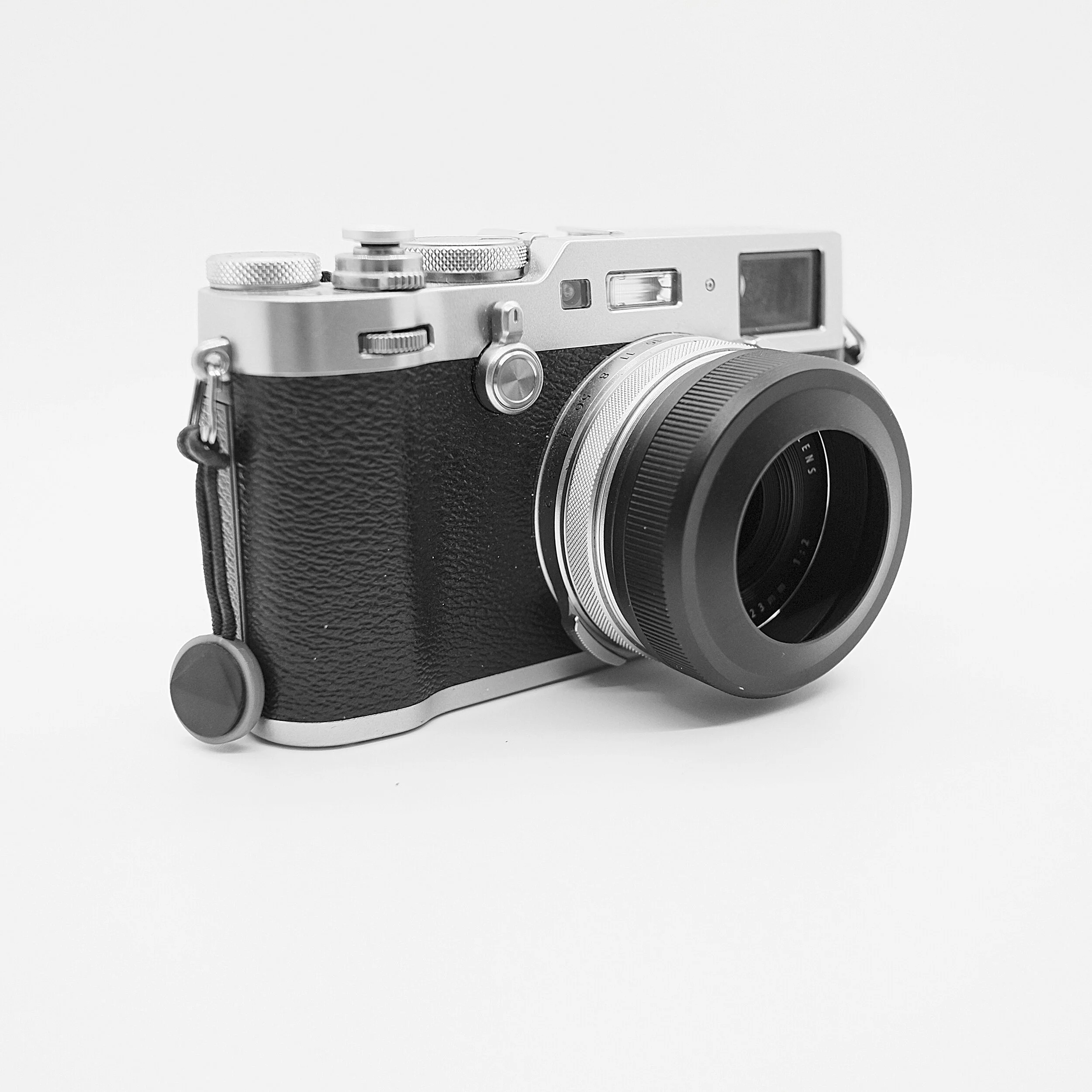
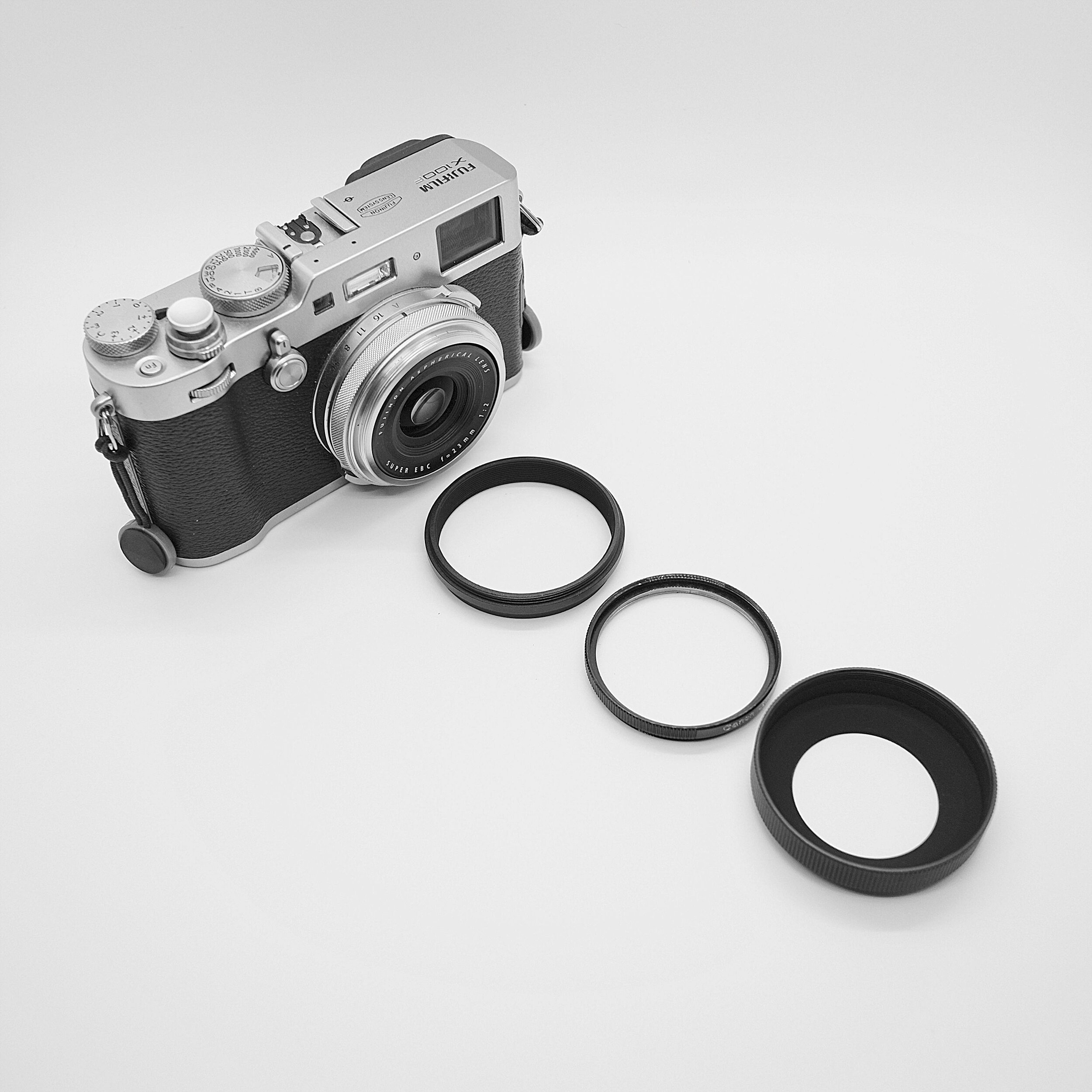
Fortunately, I discovered lens hoods explicitly designed for use with rangefinder type cameras. These lens hoods have an inwardly curved design, which means that they will not block the view from the viewfinder. To see what I mean, look at the images below.
Several brands manufacture these lens hoods, and I purchased one from JJC. To be specific: model LH-JX100II, which is compatible with the Fujifilm X100, X100S, X100T, and X100F cameras.
To mount this lens hood on the X100F, you need to replace the front ring at the front of the lens with a unique mounting ring that comes with and is part of the hood.


An additional benefit of this lens hood is that it allows for positioning filters between the mounting ring and the actual lens hood.
The lens hood is well manufactured, with an eye for detail like the felt matte black inside, which prevents any reflection of light into the lens.
I have this hood now for about ten months, and I am very pleased with it. It is very discreet and works very well in the field, doing its job as expected.
An additional benefit of its design is that it does not add much to the camera's size and - a bonus - that it is compatible with the original Fujifilm lens cap.


Where To Get
If you are interested in a similar type of lens hood, I recommend looking at the JJC products on Amazon (not an affiliate link).
In Focus: Mobsters
Party-Goers In Black And White
When I saw this group standing in the street between the Westin and the old courthouse building, I was…
Party-Goers In Black And White
Background Story
I love living near Greenville, South Carolina. It is very walkable, and it has several districts that are great for the types of images I like to create. Greenville's downtown area has the right mix of shops, restaurants, and parks to generate some hustle and bustle while maintaining that small-town USA feeling.
And there is always something going on.
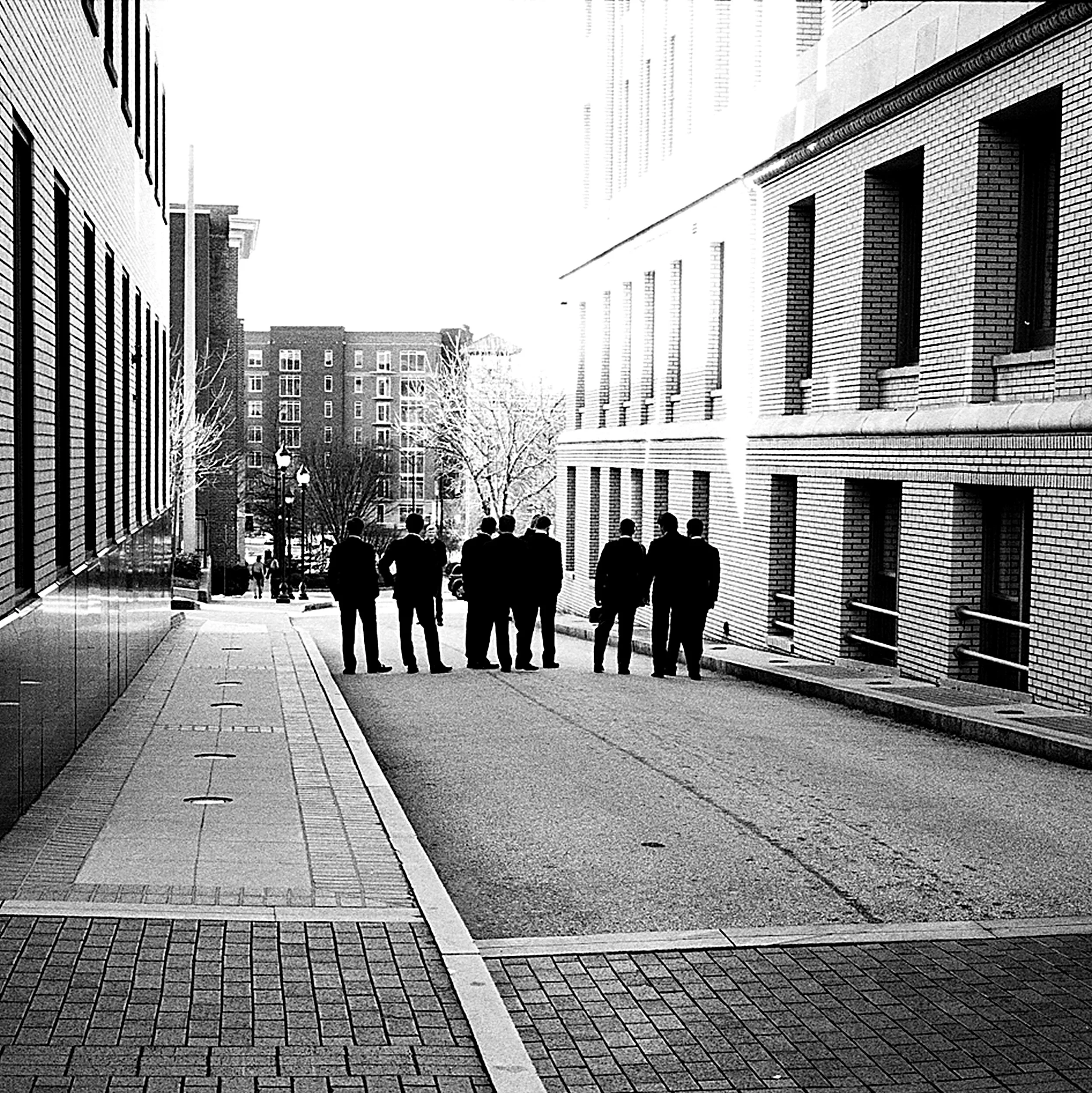
I love to stroll Greenville's streets, looking for situations that could make interesting subjects for my Street Candids series. On this particular day, I noticed a group of party-goers standing in a street near the famous Westin Hotel on Main.
How It Was Made
I worked with the Canonet QL17 rangefinder camera, loaded with Ilford Delta 100, a fine-grained film excellently suited for that day's sunny conditions.
After taking some pictures of the old Greenville News building on Main, I roamed some time in the area around The Westin Poinsett, the old Chamber of Commerce building, and the clock and fountains at the crossing of Main and Court Street.
When I saw this group standing in the street between the Westin and the old courthouse building, I was immediately intrigued. I walked towards them and composed the image to include parts of the road and create leading lines.
In post-processing, I cropped the original image to the 1:1 aspect ratio to ensure the group of men was in the center of the image and to emphasize the leading lines in the composition.
Why It Works
I like this image for several reasons.
First of all, the subject matter. A group of men in black suits, standing in an alley-like street. What are they talking about? What are they: party-goers, members of a band, or maybe...?
Zooming in, a man is visible standing in front of and facing the group. Is he a photographer taking a group picture? Or is he confronting the group; are they confronting him?
Then the image's mood: to me, it looks intriguing and maybe even a bit intimidating. The contrast between the black and white areas in the image increases the dramatic feeling: the suits, the walls, the shadow in the street.
Lastly, the crop I used: changing the image to a square format enhanced the leading lines and increased the group's focus in the middle.
One Additional Thought
While this is one of my Street Candids I like best, looking at the image triggered some thoughts regarding the decisions I made regarding capturing and presenting the image.
One of the strengths of photography is also one of its most significant challenges: by choosing a specific composition, the photographer decides what their audiences will see and influence their audiences' conclusions and emotional response to the image.
Using a specific film or film-simulation while capturing a scene or making certain adjustments to the image during processing, the photographer can add a certain mood to the picture.
The photographer can even more impact how people will look at the image and experience it by adding a caption.
Concerning this image, the men might have been wedding guests or maybe even the groom and his best men. Or perhaps it was a bunch of guys attending some other formal event.
However, by capturing them this way, using a specific film, and adding a caption, I turned them into something very different.
How easy, or difficult, is it for you to view this image as I present it now to see them as something else than a group of 1930's gang members? To what extend is your initial reaction to and assessment of this picture influenced by the choices I made?
These observations and questions take us back to how "straight" straight photography is, or to what extent it can be; which is something for a separate article.
Project Updates
Two Projects Selected For 2021
In addition to publishing 12 book reviews on the blog, I want to work on two specific long-term projects, which I started last year. The first project is about car enthusiasts. The second project I am working on is about people's dreams that…

Two Projects Selected For 2021
As I mentioned two weeks ago, although I didn't publish a looking-back-looking-forward post for 2020/2021, I set some goals for this year.
In addition to publishing 12 book reviews on the blog, I want to work on two specific long-term projects, which I started last year.
The first project is about car enthusiasts
In the Upstate of South Carolina, several groups arrange regular meetings for car lovers to meet up and do a show-and-tell about their cars.
The cars range from vintage, regularly 1950's models to hypermodern sports cars, and the owners usually have done beautiful restorations or made modifications to bodies, interiors, or engines.
I try to attend as many of these meetups as possible and usually do with my oldest daughter. She is in her final year of studying photography and art history and Winthrop University. But while she is focusing on creating images of the cars, my main interest is for the owners.
Interested in discovering why they are so passionate about their cars and cars in general, I love to listen to their stories and their discussions.
I started this project last year. Unfortunately, as a result of the COVID-19 pandemic, many of the meetups were canceled or attended by fewer participants, and, consequently, finishing it will probably longer than I anticipated. Still, I will continue to visit any gatherings as much as possible (while, of course, taking the right safety measures like distancing, wearing a mask, washing hands, etcetera).
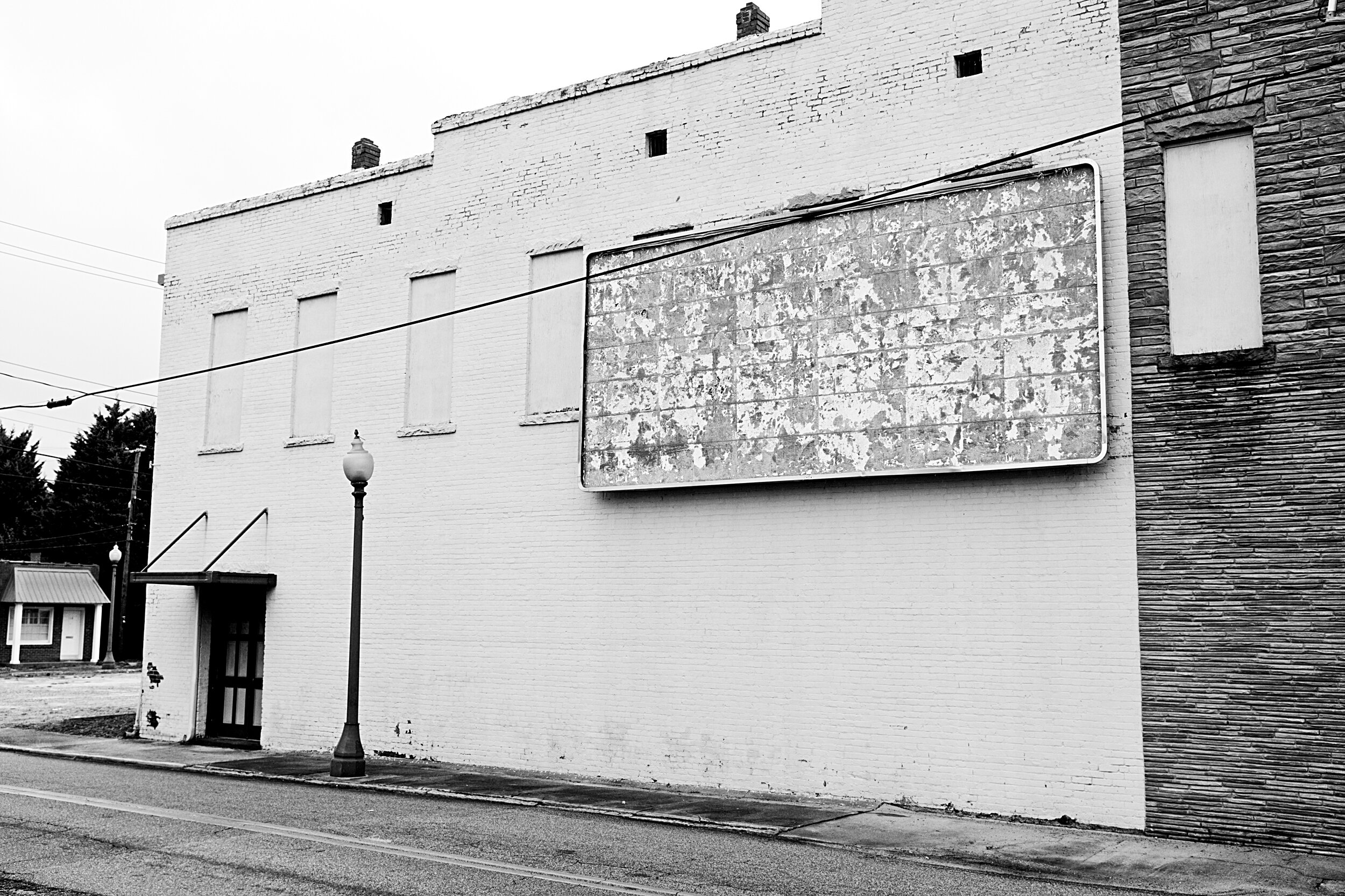
The second project I am working on is about people's dreams that didn't come true or had to be abandoned.
The images focus on abandoned houses, shops, and other buildings that show some indications of what they were used for.
Most people, I included, usually only see the old, abandoned, run-down buildings. While we might like to see the building restored to its old glory in some cases, we still only see the building.
But each of these buildings is so much more. They once were places where people worked, lived or played, and tried to realize their dreams. The old pop-and-mom shop, the restaurant that never really made it, maybe bowling alley or a bingo hall.
It is my objective to trigger some thoughts about who these individuals might have been. How did they live, why did they work here, why did they abandon their dream?
I don't know the answers, but I want my audience to realize that these buildings are more than mere physical remnants of times past. There are personal histories behind each.
This project also kicked off in 2020 and I envision that I will work on it for at least two more years before I can begin reviewing, culling, and selecting the final images. I will keep you all posted!
Getting The Shot: 5 Reasons For Shooting With Film In 2021
My Considerations For Continuing To Shoot With Film
Now, almost two years further on the road, it is time for me to reassess whether I want to continue shooting with film going forward…

My Considerations For Continuing To Shoot With Film
When I started this blog back in 2015, I published several articles to explain why I recommend photographers to try or continue shooting with film.
In 2018 I summarized why I still shot film then.
In 2019 I added a new digital camera to my toolbox (the Fujifilm X100F) and another film camera (the Leica M4).
Film is relatively expensive to use, as compared to shooting digital and I have to annually assess (convince myself) whether I want to continue using it. So now, almost two years further on the road, it is time for me to reassess whether I want to continue shooting with film going forward.
First, let's go back to the main reasons I mentioned in the past for shooting with film and see if these are still valid.
The need to be disciplined and follow a set process
It is essential to follow specific sequences to capture an image with most film cameras: from setting shutter speed and aperture to framing and focusing your subject.
The need to know your photography theory
Still valid! And very much related to the first reason mentioned above. To get the exposure you want, you need to know how shutter speed and aperture will impact the result. You also need to know the specifics of the film you are using, whether it is a reversal film or a slow black and white emulsion.
Film is just better for some shots
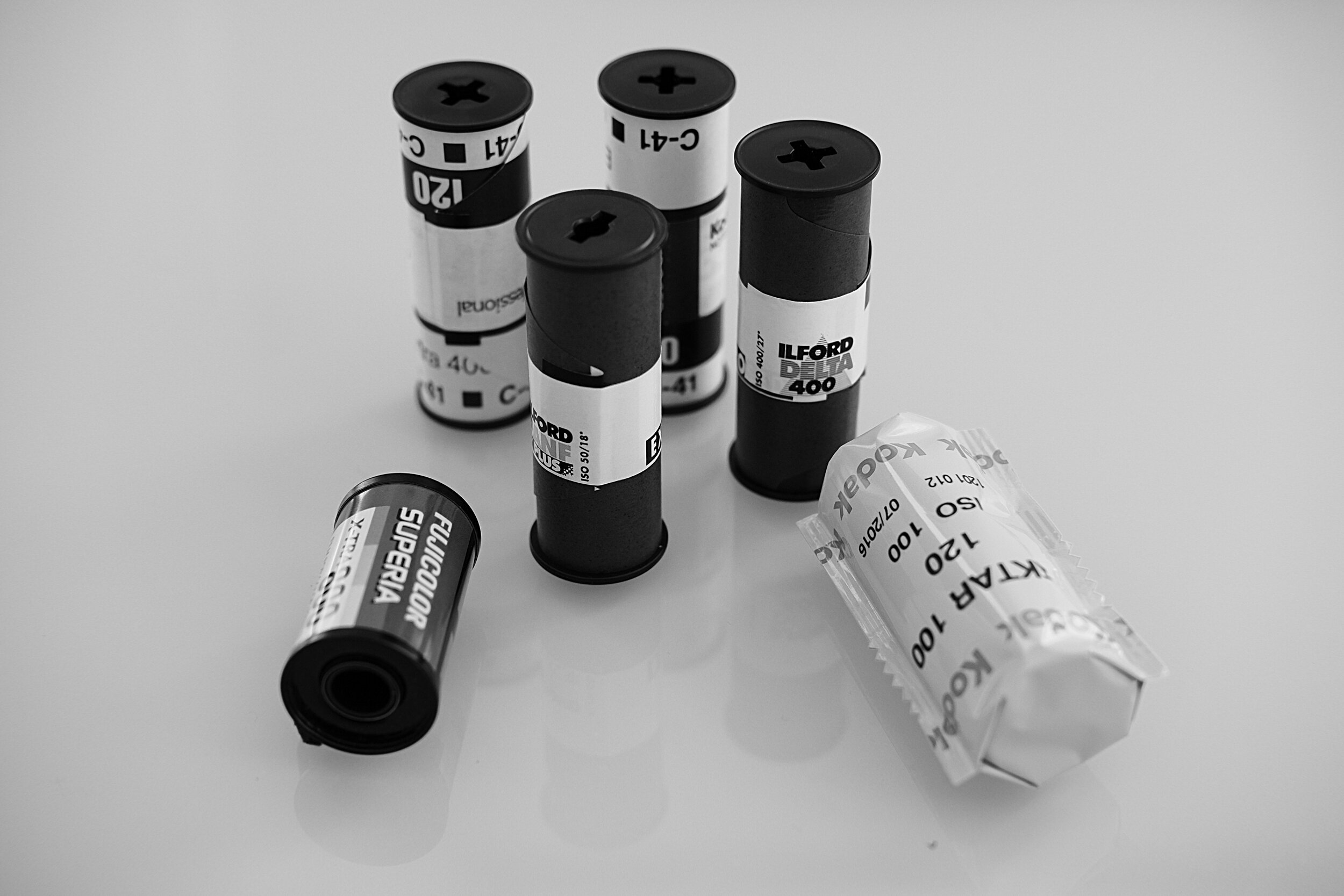
I love shooting with medium format cameras. For my fine-art images (link to ArtPal), medium format provides excellent results with its shallow depth of field and great details. Digital medium format backs, however, are quite expensive and create huge digital files that my computer can't handle.
Also, some grain effects (for example, as achieved when shooting an ISO 3200 film) are almost impossible to reproduce with a digital camera or post-processing.
And talking about post-processing: once you have mastered a specific film and camera combination, it is my experience that it is possible to get consistent results with not much post-processing needed after scanning the negatives. And who wants to spend more time behind their computer than necessary?
In conclusion, based on my assessment: I still want to continue shooting with film.
And there is one more reason I have not mentioned yet, which is the most important: I just love to work with film cameras!
Let's be clear: there is no need to shoot film. It is a personal choice.
I love it: the process, the results.
I love handling a film camera, going through all the actions to ensure all settings are correct. It is just more fun than working with a digital camera, even if you are shooting a DSLR or mirrorless camera in 'full manual' mode.
So do I want to continue shooting with film in 2021? Yes!
Both digital and film have their merits, and, depending on the situation, I choose a specific medium and method of creating images. I am lucky I can experience both worlds, with as my main go-to cameras for daily use the trinity Fujifilm X-Pro1, Fujifilm X100F, and Leica M4.
And keep in mind: whatever medium you use for creating images; in the end, it is not the tool that is important. Far more important is going out and creating at all.
Reading, And Learning From Photography Books
2021 Photography Book Review Schedule
…I decided to not have a looking-back-looking-forward article at the start of this year. However, this does not mean that I did not set some goals for my photography and this year's blog posts and one of the goals I have set…

2021 Book Review Schedule
With last year having been as it was, I did not want to post a review of 2020. And since we are still in the mids of a pandemic, looking forward to 2021 is a bit tricky. So I decided to not have a looking-back-looking-forward article at the start of this year.
However, this does not mean that I did not set some goals for my photography and this year's blog posts and one of the goals I have set for 2021 regarding the blog is to conduct 12 photography book reviews.
There is an abundance of photography books available, covering a lot of genres and topics. Therefore, to keep this effort manageable and cost-effective, the books I have selected (see list below) had to meet specific criteria:
First of all, I want to start with books I already have, which means I don't have to spend any money on new books. And more importantly, it forces me to re-read and re-enjoy the books I am going to review.
The books I will review have to be (social) documentary or candid street photography focused.
Their content must provide specific learning points; e.g., improving my ability to see the world as a candid/documentary photographer.
They must trigger new ideas for my projects: street or documentary topics and how to approach these.
Consequently, I will not include books with or about: fine art photography, technical aspects of photography only, or gear and tools.
Each of the books I will review covers one or more of the following:
(auto) biography of a (social) documentary photographer;
info about the events and circumstances the photogs had to work in;
examples of documentary photography with background info;
examples of documentary photography essays.
Also, the header of this article mentions Photography books and not Photobooks. Although some of the titles included can be considered photo books, my reviews cover a broader area like biographies and history books.
As an example of what to expect, check out my articles about David Hume Kennerly's book "Shooter", Simon Gabriel’s “On Ground”, and my comparison of “Abandoned America” and “Autopsy of America”.
The books I will cover this year are:
Hold Still [autobiography by Sally Mann]
Abu Dhabi - Life And Times [overview of the body of work of Noor Ali Rashid]
Lost London [documenting London from vintage pictures]
Armed With Cameras [history of the American military photographers of World War II]
Blood And Champaign [biography of Robert Capa]
Kids [an overview of Elliott Erwitt's candid images of children]
A Thousand Crossings [an overview of Sally Mann's body of work]
Imagining The Twentieth Century [documentary single images and essays]
The Genius Of Photography [documentary single images and essays]
The Modern Century [an overview of Henry Cartier Bresson's body of work]
Trip [a photographic essay by Susan Lipper]
Vivian Maier - Street Photographer [an overview of Maier’s body of work]
I hope you are as excited about these upcoming articles as I am. To ensure you won't miss any, subscribe with the form below!
In Focus: Watering Hole
Street Photography As An Urban Safari
Going out with the intent to create street candids sometimes reminds me of being on a safari…

Street Photography As An Urban Safari
Going out with the intent to create street candids sometimes reminds me of being on a safari.
An essential part of the fun when my family and I went on a safari in South Africa was the excitement of searching for wildlife before actually seeing any animals. The increased awareness of your surroundings and watching for any movement that could indicate a lion, elephant, giraffe, or one of the many antelopes.
Walking the streets of a city in search of candid street photos provides me the same excitement. Continually looking at people and their behavior, in the hope that something worthwhile photographing occurs.
A couple of months ago (this image is pre-Covid; hence the high number of people close together), I roamed the streets of downtown Greenville, SC, and noticed this group of people playing with the water of a fountain on Main Street.
The scene immediately reminded me of animals gathered around a watering hole as I have seen on safaris in South Africa. Even the person to the right fits nicely in the scene, appearing to stand on guard for the group.
I like how this image worked out and how it reminds me that going out for street photography is like being on an urban safari.
Behind The Scenes: From Both Sides Now
Freedom Of Speech At Work
captured today’s image while walking the streets of downtown Greenville, SC, looking for …

Freedom Of Speech At Work
I captured today’s image while walking the streets of downtown Greenville, SC, looking for pictures for my fine art shop.
Background Story
Last Saturday I went to downtown Greenville, SC, which is just a 30-minute ride from where I live. I took the Fujifilm X-Pro1 with a Nikon AF Nikkor 35mm 1:2D mounted. The reason why I picked this camera/lens combination might be a topic for a future blog post.
The idea was, to create some images for my fine art shop, and to print at home for the upcoming Mini Farmers Market in our neighborhood. And maybe also capture some Street Candy on the go.
As you might be aware, 2020 is a Presidential Election year here in the USA and you probably are also aware that the candidates of the two largest parties are quite ‘verbal’ in addressing each other. So are their respective supporters.
How It Was Made
Strolling downtown I noticed a group of pro-Biden supporters who were protesting against his opponent: current President Trump. They were waving some signs, some were dressed up, and they were trying to get the attention of passers-by. All very friendly and not aggressive.
I took one or two shots on the go of this group and walked on, to my main subjects of the day: some old buildings in Greenville’s West End and Fluor Field. The latter is a minor league baseball field and home to the Greenville Drive, a feeder club for the Boston Red Sox.
Walking back to my car, I had to pass the demonstrators again. And as it happened, a small caravan of pickup trucks and other cars drove by displaying large US flags and pro-Trump flags. This cavalcade continued to drive on Main Street, through the group of pro-Biden supporters who were standing on the sidewalks to the left and right.
I raised my camera and quickly shot a couple of frames of this sight.
To me, this was just great!
Of course, both groups were shouting at each other and the people in the cars were honking the horns, but it was enthusiasm everyone displayed. Not anger, not being mean, but using their freedom of speech to try and get their message across.
The cars drove on to wherever they were going next, and the group on the street continued their demonstration for their cause.
And is this not how it always should be? Enthusiasm, but not anger. Passion, but no violence.
Why It Works
This is the image of the set I like best and it works for me first and mostly because it shows what it shows: the passion and the non-violent demonstrations.
Then, of course, there is the juxtaposition of the pro-Trump and anti-Trump supporters. The story of this year’s election captured in one frame.
And then there are some small details in the picture that add a bit extra. The ‘One Way’ street sign, for example. Is this a sign of what is happening elsewhere in the country, where opposing groups are less peaceful? The face masks. A sign of our times, or are they going to stay?
The more I look, the more I discover.
Book Review: Shooter
David Hume Kennerly: War Photographer and Photographer Of Presidents
Although it contains several images by Kennerly, it is not a photobook. It is his story in his own words from how he became a photographer …

David Hume Kennerly: War Photographer and Photographer Of Presidents
Introduction
I was gifted this book by my daughter, who is a photography and art history student, and knows I am very interested in documentary photography.
David Hume Kennerly (born March 9, 1947) is an American photographer. He won the 1972 Pulitzer Prize for Feature Photography for his portfolio of photographs of the Vietnam War, Cambodia, East Pakistani refugees near Calcutta, and the Ali-Frazier fight in Madison Square Garden. He has photographed every American president since Lyndon B Johnson. He is the first Presidential Scholar at the University of Arizona.
source: Wikipedia
Although it contains several images by Kennerly, it is not a photobook. It is his story in his own words from how he became a photographer, his time as a war photographer, covering Gerald Ford’s presidency, and later his coverage of other important global events.
Published: 1979
Publisher: Newsweek Books
ISBN: 0-88225-265-8
Size: 7. 1/4” x 9. 1/4” x 7/8”
Review
The book has five main sections, grouped around Kennerly's most significant portfolios:
The time from him being a young rookie shooter up to the moment he won the Pulitzer Prize For Feature Photography for his Vietnam War coverage in 1971;
His photographic and other activities during the Asian wars in general;
His White House coverage, during the presidency of President Ford (2 sections);
And, finally, his coverage of critical global events and photographs of world leaders.
Kennerly's narrative provides an excellent insight into what it was to be a press photographer during the Vietnam War era and covering major world history events.
The five portfolio sections that divide the book contain impressive images. To name a few examples: President Richard Nixon in his last public appearance as Chief Executive, President Ford and Secretary of State Henry Kissinger in the Oval Office, Leonid Breshnev at the Helsinki Conference, and President Anwar Sadat in his home.
Conclusion and Recommendation
This book is an immensely impressive document by and about one of the great documentary photographers of the 20th century.
It provides a unique, intimate insight into the 'how' and 'when' of some of the most famous images of that era. And in the life and thoughts of the photographer who created them.
The curse of the shooter is that he is always an observer, never a participant.
For me, one of the most critical observations the author makes is, "The curse of the shooter is that he is always an observer, never a participant."
While Kennerly relates this to the fact that he felt that he was never able to see the stories he documented through to the end, it emphasizes that as a (social)documentary photographer, you need to record, not impact or change the events you are photographing.
This notion relates very much to my vision of straight photography, which I elaborated on in a previous blog post.
In conclusion, this is one of the best photography books I have read. Although written more than 40 years ago, it is still very current, and I recommend that every photographer get their hands on a copy to read.
Behind The Scenes: Atlanta Silhouettes
A Sun Flare And Shadows On A Cold Afternoon
The image I will discuss today is an older street image that I created during a trip to Atlanta, Georgia, in early 2014.

A Sun Flare And Shadows On A Cold Afternoon
The image I will discuss today is an older street image that I created during a trip to Atlanta, Georgia, in early 2014.
Background Story
At that time, my family and I had lived only for two years in the US, and while we already had been to Washington, DC, and New York City, Atlanta still was unexplored territory.
So we booked a hotel and drove the 2hrs and a bit to Georgia's capital.
We made sure that we covered all the regular tourist attractions: CNN headquarter and studios, the aquarium, the World of Coca-Cola, and of course, the house where Margaret Mitchell lived and wrote her famous novel Gone With The Wind.
Also on the list was the High Museum of Modern Art, which has a great art collection and where I was able to create some interesting images.
How It Was Made
It was January, cold, and the sun was setting early.
Besides my Fujifilm X-Pro 1, which I used as my primary tool, I had a Canonet QL17 loaded with Ilford Delta 400.
While walking a street downtown Atlanta, the sun in our faces, I lagged a bit behind my wife and daughters and noticed how the setting sun outlined their silhouettes.
I grabbed the Canonet, aimed, pushed the shutter, and hoped for the best.
Why It Works
After getting the developed roll back from the film lab, I was happily surprised by the result.
This image works for me for several reasons.
To start with the film grain: I love the looks of Delta 400. As I mentioned before, one of my all-time favorite films.
Then the tonality. What I did not expect was the detail in the shadows and the highlights. Look at the details of houses on the other side of the road. And even in the sun flare are details from the trees visible.
I also like how the composition turned out. The viewer's eye is directed to the main subjects in the frame by the lines created by the columns on the left and the trees and road on the right. The direction of their shadows in the foreground enhances this effect.
And lastly, I love how the large sun flare and the crispiness of the silhouettes turned out.
I think this might be one of my best candid street shots.
Pandemic
Conceptual Images Related To The Impact Of COVID-19
A couple of months ago, I wanted to create some conceptual images to capture the emotional impact of the…

Conceptual Images Related To The Impact Of COVID-19
A couple of months ago, I wanted to create some conceptual images to capture the emotional impact of the COVID-19 pandemic. The pandemic then was still new, scary, and, in a way, exciting. Now it is only frightening.
How do people cope?
Do they cope?
I did not want to focus on the apparent pictures of people wearing face masks and social distancing (or not). I wanted to show the hidden anxieties and fears the pandemic triggers, a more conceptual approach to the 2020 pandemic's impact on people's minds.
That is how I came up with this set of five images that each link to a specific set of behaviors triggered by the pandemic.
The Anxiety triggered by the unknown;
The Separation from other people in daily life;
The Search for meaning;
The quest for an Escape;
And, unfortunately, the Wrong Exit all these thoughts and anxieties possibly could drive to.
ANXIETY

SEPARATION

SEARCH

ESCAPE

WRONG EXIT
If you’re thinking about suicide, are worried about a friend or loved one, or would like emotional support, the Lifeline network is available 24/7 across the United States.
1-800-273-8255
Or go to suicidepreventionlifeline.org for other options.
Behind The Scenes: Gothic Fairies
Unexpected Discovery In Falls Park On The Reedy
I created this image in February 2019 when walking in Falls Park at the Reedy in my hometown Greenville, SC…

Unexpected Discovery In Falls Park On The Reedy
I created this image in February 2019 when walking in Falls Park at the Reedy in my hometown Greenville, SC.
During a pre-assignment trip to South Africa in January, I purchased a Fujifilm X100F. I was still learning how to use the camera and experiment with its film simulation settings.
While walking on one of the park's higher located walkways, I noticed two girls having a photoshoot down at the river bank.
Because I was using the Acros (black and white) film simulation setting, and because of how one of the girls dressed, they almost looked like two fairies to me who were playing near the river.
This image works for me for three reasons.
First, the black and white rendering gives it a classic look and, together with the fact that the two subjects are relatively small in the frame, enhances the feeling of looking at something from an old picture book.
Second, I like how the diagonal, formed by the giant stone slabs on which the girls stand and the riverbed flow, guides the eye from the lower right to the right upper corner.
And finally, because the main subjects of the image are not immediately apparent, which adds to the surprise of finding them in the middle of the picture. Almost like stumbling on them in an enchanted forest.
My Favorite Black and White Films
The Two Black And White Films That I Use Most
Someone asked me once what the best black and white film is…

The Two Black And White Films That I Use Most
Someone asked me once what the best black and white film is.
I have created images with several b/w film stock, including Kodak TMax 400, Efke R25, and a whole range of Ilford products: Pan F, Delta 100, Delta 400, Delta 3200, and HP5 Plus.
And most of these in 135 and 120 formats.
Each film has its characteristics, and I select the film type specifically for the subject that I will take images of and the mood I want to create.
For example, for still lifes, I like slow, fine-grain films like Efke R25, or Ilford Delta 100, while Ilford Delta 3200 is excellent for night photography.
After thinking about this and considering the results I got with several types of black and white film, I need to say that there is no 'best' for me. However, my favorite black and white films are Ilford Delta 400 for daily use and Ilford Delta 3200 for night photography.
Ilford Delta 400 Professional: Daily Work Horse
As I might have mentioned once or twice before, my favorite general-use 'go-to' black and white film of choice is Ilford Delta 400. I love how its emulsion combines sharpness with just the right amount of grain and how it has more contrast than, for example, Ilford's HP5 (which is an excellent film on its own).
While it is a medium speed film, it produces beautiful grain and produces images with excellent tonality. The film is quite forgiving: maintaining great detail in shadows and with perfect contrast.
Ilford Delta 3200 Professional: Queen Of The Night
My go-to film for evening and night photography is Ilford Delta 3200: a black and white film perfect for shooting anything in the darkness; outside when doing street photography in the evening, but also inside in dim-lit rooms and venues (think for example concert photography).
Although it is an ISO 3200 film, the best results are accomplished by shooting at Exposure Index 1600 and developing for ISO 3200.
Because it is an ISO 3200 film, and you should expect quite an amount of grain, the grain is quite pleasing, and the overall effect is very nice.
And before you ask: yes, you can shoot Ilford Delta 3200 during the daytime too. Just make sure you adjust your shutter speed and aperture accordingly.
In conclusion, I almost always use Ilford Delta 400 and Delta 3200: two great black and white films for everyday use and night photography.
Behind The Scenes: One More Scoop
Ice Cream On A Busy Street In Madrid
I created this image in August 2019 during a trip to Madrid, Spain…

Ice Cream On A Busy Street In Madrid
I created this image in August 2019 during a trip to Madrid, Spain.
At the time, I was for a work assignment living in South Africa, while my family stayed in the US. My daughter decided to go to university in the Netherlands, and since my wife was going to help her settle in, we came up with a plan.
My wife and daughter would fly to Amsterdam via Madrid, and on her way back, my wife would stay a couple of nights in the Spanish capital. I was going to visit my daughter in the Netherlands and fly from Johannesburg via Madrid to Amsterdam. We arranged it in a way that my wife on her way back and I on my way in could have a couple of days together in Madrid.
This arrangement worked very well, and my wife and I had a great time in what I still consider as one of the greatest cities in the world. We lived in Madrid during another work assignment, and it was very nice to revisit all the well-known and lesser know spots in the city we remembered from then.
One of the main streets in Madrid is the Calle del Arenal, a pedestrian shopping area in the middle of the city. While walking the street, I turned around and snapped this image of a young couple sharing some ice cream as the main subject. Hence the title: One More Scoop.
I like how my eye first is drawn to the couple in the front, and then to the man in the white shirt in the middle of the image. And next to the movement of the other people in the street in the background. While I was, and still am, very pleased with how the image turned out, I also learned a lot from the critique I got after submitting this image for review to Lensculture:
We see a couple sharing a cup of ice cream. It's a nice, intimate moment that is worthy of a photograph. As a rule, our eyes are initially drawn to the brightest highlight in an image. This photograph is a bit confusing because I immediately identified the man in the center of the frame as the focal point. It's because of his placement, his white shirt, and the fact that he is fully in-focus. Consider using a shallow depth-of-field to help distinguish the focal point in your images.
This feedback refreshed my knowledge of how people first look at highlights in images; it also made me realize that I have memories that define the picture for me in a way other viewers don’t.
Since I remember that the first thing I saw was the couple with the ice cream (the man in the white shirt walked a bit later into the frame), I look at them first. Viewers who don't have that memory will look first at the man in the white shirt.
The Lensculture reviewer got confused by this image. However, I wonder if the confusion was not as much created by the image, as by its title. Would the reviewer have been less confused if I called it, e.g., 'man in white shirt shopping'?
Based on this feedback, I learned three critical things for my photography:
To be aware of highlights that can draw the viewer's attention from the main subject
To use depth of field to ensure the viewer knows what the intended main subject of the image is
To be intentional with image titles
To remember that I have memories regarding each image I created that other viewers will not have, which will affect what they and I see in an image.
In the end, I still like this image as a nice example of candid street photography, and I consciously decided not to change the title.
Let me know in the comments what you see, where is your eye drawn to first?