
The Trinity Is No More
One Camera Is Gone, And It Is Probably Not The One You Would Expect
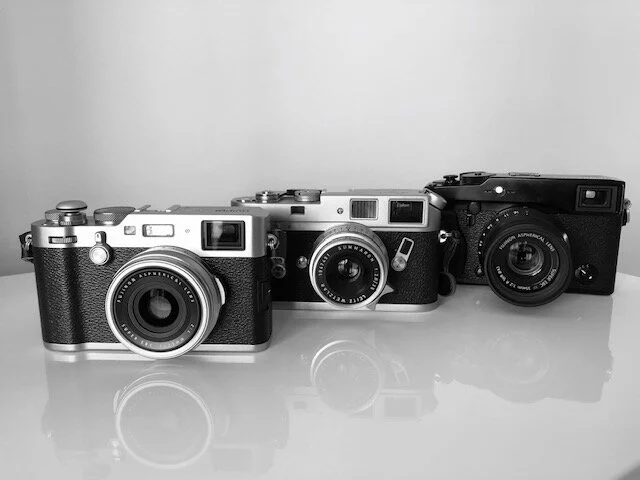
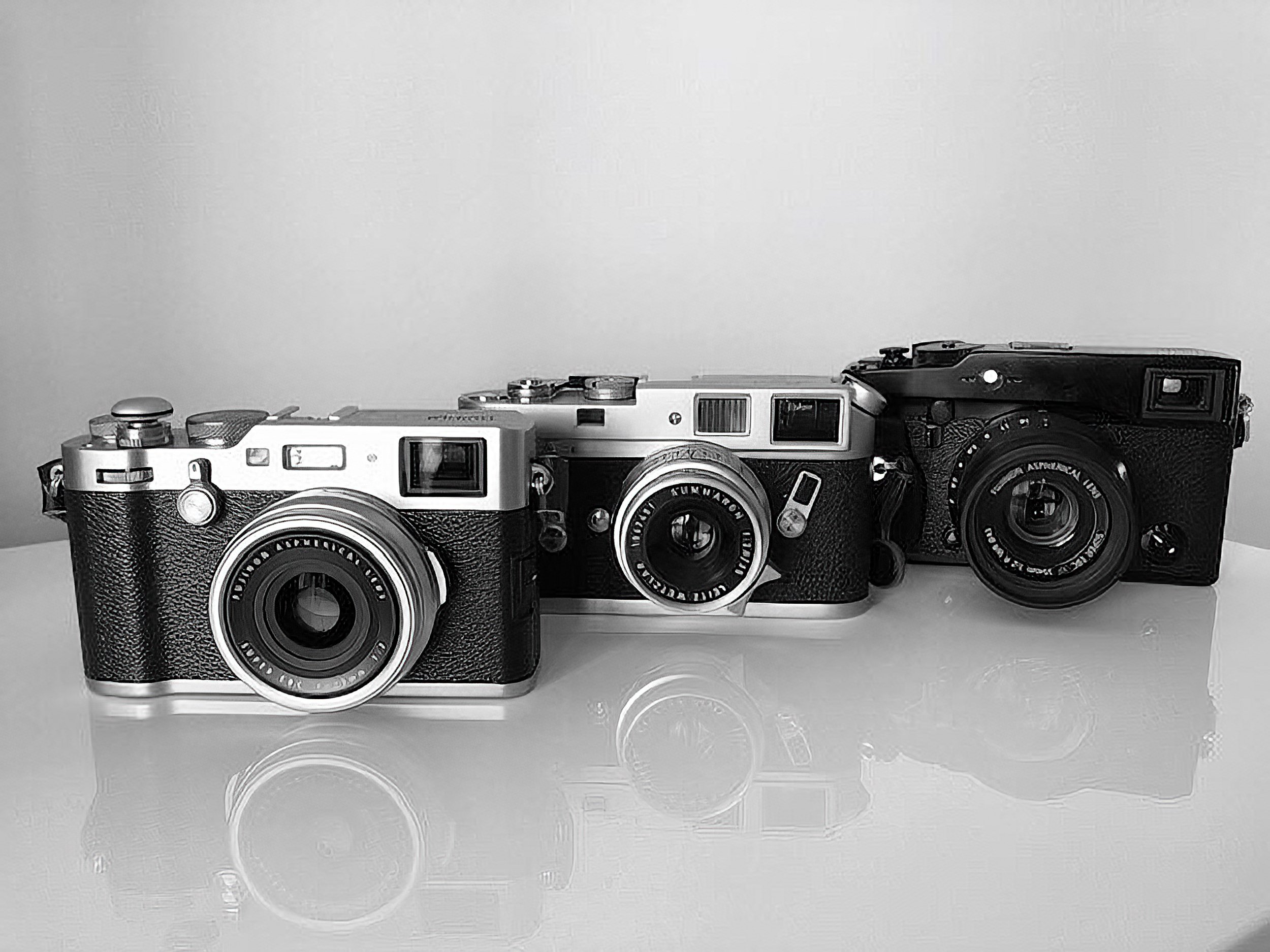
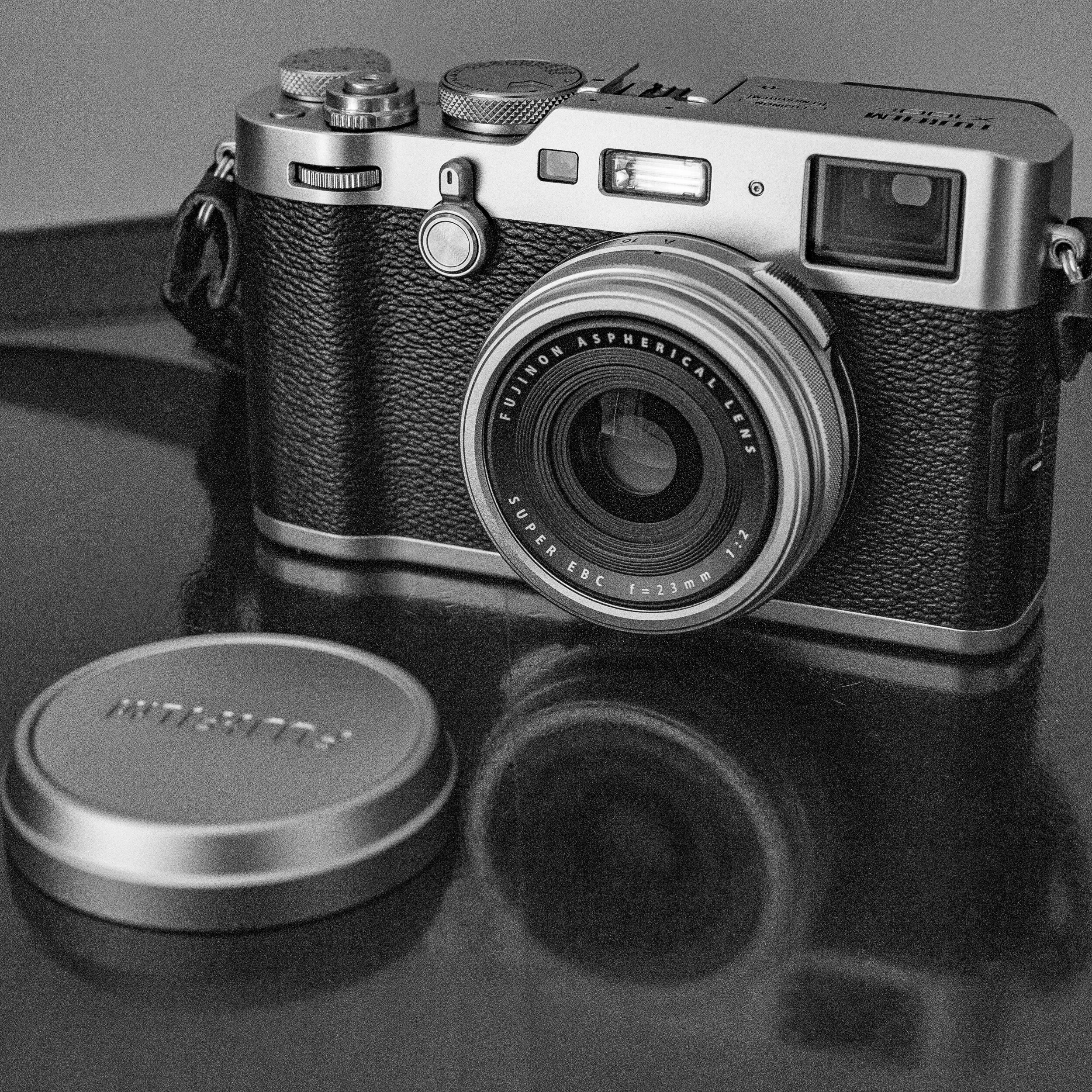
In 2019, I was fortunate to obtain two new cameras that were an excellent accompaniment to my Fujifilm X-Pro 1 and supplemented each other: a new Fujifilm X100F and a used Leica M4.
As I wrote, these three cameras became my Trinity.
One Camera Is Gone, And It Is Probably Not The One You Would Expect
In 2019, I was fortunate to obtain two new cameras that were an excellent accompaniment to my Fujifilm X-Pro 1 and supplemented each other: a new Fujifilm X100F and a used Leica M4.
As I wrote, these three cameras became my Trinity.
The X-Pro 1 was going to be my exchangeable-lens camera for when I wanted to create images with wide-angle (broader than 35mm full-frame equivalent) or longer lenses.
The X100F (with its 35mm full-frame equivalent lens) and the Leica M4 (with its 35mm Summaron) would be my daily go-to cameras, depending on whether I wanted to shoot digital or analogue.
This setup worked well; I created many street and social documentary-style images and essays with these three tools.
And now I broke the Trinity up.
What happened?
Did one of the cameras break? Did I not like any of them anymore?
Fortunately, none of those.
One of my daughters went to study abroad in September of this year and wanted to take a real camera with her. Although she has the ubiquitous iPhone, she wanted a real camera (insert dad doing a happy dance).
After researching several alternatives and the cost involved, I decided that I was going to give her the X100F.
Yup, I parted with this lovely camera to give my daughter an excellent tool and a fantastic shooting experience.
It is easy to set the Fujifilm X100F up as a 'point and shoot camera, and if she wants to go manual, that is still a possibility.
So there you have it: the X100F is no longer part of my daily toolkit.
While my daughter was thrilled with this decision - and she is making great memories with the X100F in Bonny Scotland - it gave me a challenge and an opportunity.
Without the X100F and its 23mm lens (35mm full-frame equivalent), I no longer had a direct digital match to the 35mm Summaron on the Leica M4. Because the only lenses I had for the X-Pro 1 were a Fujinon 18mm/1.2, a Fujinon 35mm/1.4, a Fujinon 35mm/1.2 XF, and a TTArtisan 50mm/1.2.
All great lenses, which I still use today, but none of them are a direct match to the 35mm angle of the Summaron.
Enter the TTArtisan 23mm/1.4
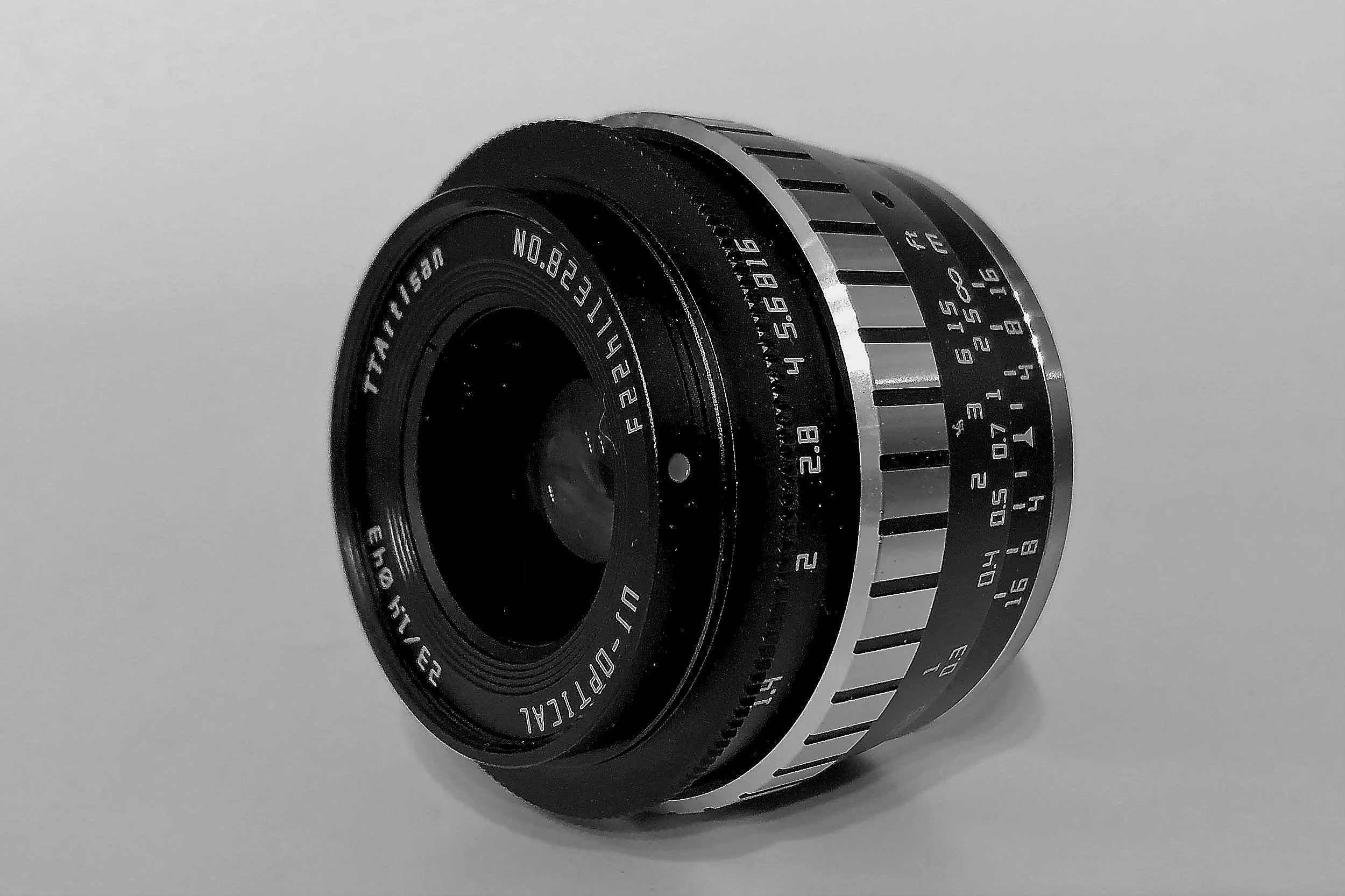
After some deliberation and research, I decided on this lens for several reasons.
It is extremely reasonably priced.
It is small.
It has a nice, solid feel to it.
It balances nicely on the X-Pro 1.
It looks cool.
And most importantly, it delivers excellent image results.
Considering this, I couldn't find a lens with a better price/quality ratio.
And there is another spec to this lens, which for me is essential: it has a distance/aperture scale which allows for zone and hyperfocal focusing! Unfortunately, the only Fujinon 23mm lens with this feature (the 23mm/1.4 R) is just over seven times more expensive.
[note: I have no affiliation with TTArtisan or Pergear, and I purchased this lens myself]
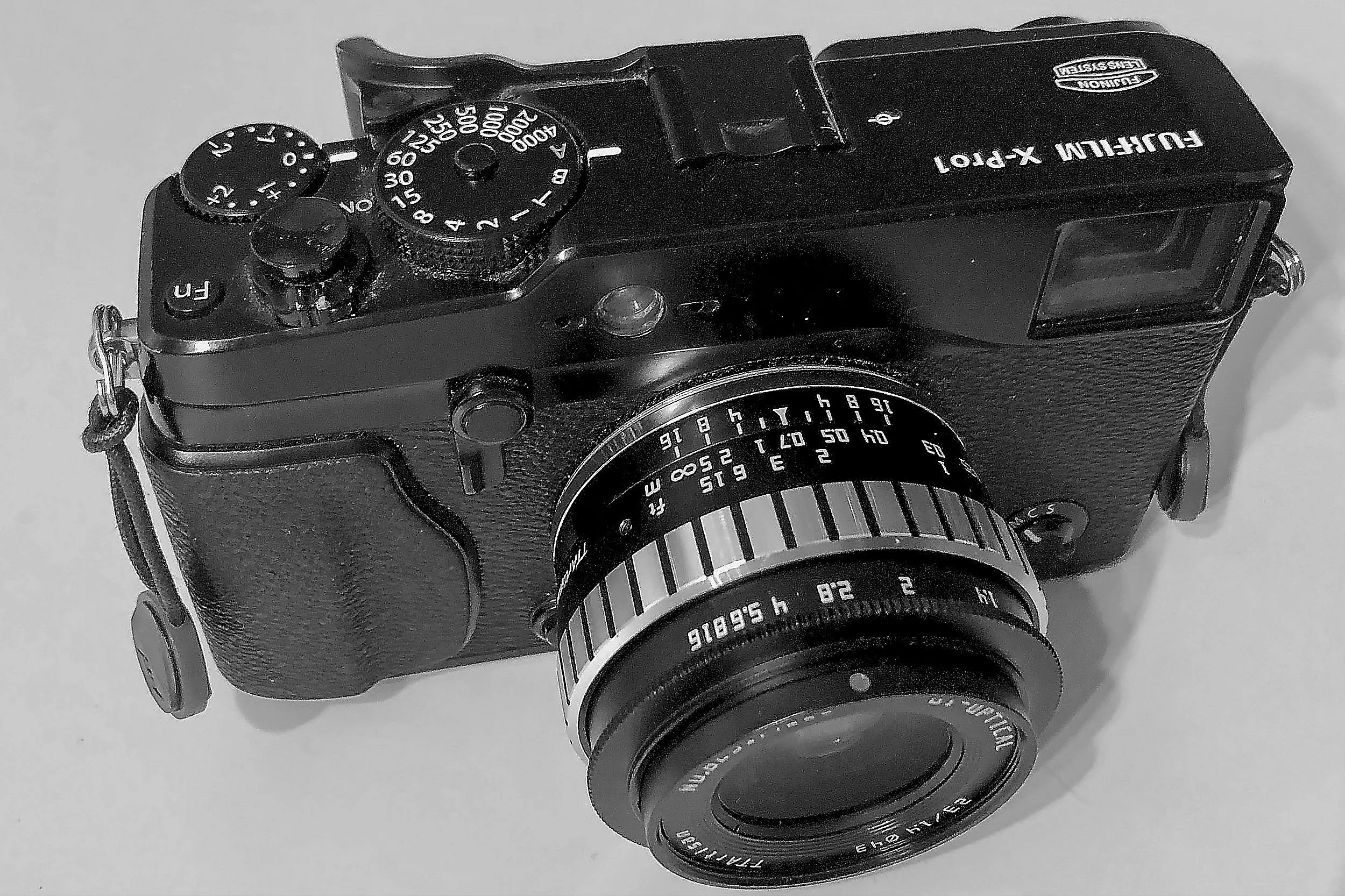
So now I am back to two daily cameras: the Leica M4 with the 35mm Summaron and the Fujifilm X-Pro 1 with the 23mm TTArtisan, which makes life also a bit easier because I don't have to choose between three cameras when going out on the street.
The images below are the first results of shooting with the TTArtisan 23mm (all are SOOC jpegs).
Admittedly, there is some learning curve since the lens is fully manual and does not communicate with the camera. I am finding, however, that the use of this lens is not much different from using the Summaron (all Leica devotees now probably are shaking their heads and un-friending me). And zone focusing even allows me to get great results using the X-Pro1's OVF.

In Focus: Food Envy
Pre-Pandemic Diners In The Hague
We all remember those carefree pre-pandemic afternoons and evenings when we could stroll the streets…
Pre-Pandemic Diners In The Hague
Background Story
We all remember those carefree pre-pandemic afternoons and evenings when we could stroll the streets without face masks and go to restaurants to enjoy a good meal without being restricted in how many friends to meet. Don’t we?
This image was created during a warm summer evening stroll in The Haag (Den Haag), The Netherlands, in August 2019.
I had spent a week in Madrid, Spain, with my wife and now enjoyed the additional time off with my youngest daughter who just moved for her studies to this lovely city in the Netherlands.
I stayed in the Park Centraal Hotel which is in a beautiful 160-year-old building. And in the Molenstraat and neighboring streets immediately outside the hotel are several small shops, restaurants, and eateries.
Tourists and locals alike enjoyed dining inside and on the terraces outside. The relaxed atmosphere, the darkening sky, and the light inside the restaurants created a tableau that depicted the typical Dutch “gezelligheid”. While this can be translated with “cosiness”, the Dutch word encompasses more: a general feeling of wellbeing and safety.
I find it always amusing to see how passersby look at people eating outside. In fact, they might not be as much interested in the diners as well as in the food on their plates. Are they deciding what they want to order themselves? Or are they going to an eatery which they anticipate has a less enjoyable menu; are they a bit envious maybe? Is food envy a concept?
Anyhow. The environment was right, the people were at the right place. And I made the photo.
How It Was Made
It was only in January of that year that I purchased the Fujifilm X100F, and I was still experimenting with its settings and discovering its capabilities.
I love black and white images (did you notice that all images on this website are monochrome?) and in this instance, I used the Acros standard camera preset.
Although I actually like that preset very much, when editing the image I selected the ON1 preset for Ilford Delta 400. I just love that film and I also wanted to check how the built-in preset would compare to scans from actual film images.
Why It Works
First of all, I like the subject matter.
A small city street with restaurants and outside diners. People passing by; what are they thinking?
Are the passers-by envious of the diners? Are the diners disturbed by the people walking in the street?
Then there are the leading lines that lead the viewer’s eye through the image.
The curb and the awnings are perfect examples of converging lines, anchored in the bottom right corner by the blackboard with snack offerings.
And, finally, the light. Ah, the light!
The combination of pre-sunset light and the soft incandescent light from the restaurants, creating that special atmospheric mood that is so typical of lazy summer evenings.
I can just not get enough of it.
How Can This Image Be Used
Images like this can well be used in a commercial setting.
Humphrey’s Restaurant might use it to connect their customers to the location (unfortunately their restaurant in the Molenstraat has been closed, but at the time of writing of this article they still operate a restaurant in Scheveningen, near The Hague), or to show them the great ambiance they have.
The Park Centraal Hotel can use this image to show their guests the nice area they are located at, and how close they are to restaurants and nightlife.
And the City of The Hague could use it to show prospective visitors how a big city can offer coziness and a safe environment to spend the evening.
With the current Covid-19 / Coronavirus-related restrictions in place, it might be a while until we can enjoy dining out in the Molenstraat again. But the time will come that we are allowed again! Until then, images like this will remind us how great having dinner outside with friends is.
Should You Buy A Fujifilm X100F?
Is the X100F still a camera to get, now that the X100V is available?
While I was transferring some images I took with my Fujifilm X100F to my laptop, I wondered if people are still interested in this…

Is the X100F still a camera to get, now that the X100V is available?
While I was transferring some images I took with my Fujifilm X100F to my laptop, I wondered if people are still interested in this camera. And if anyone would buy this camera now that a newer and updated version is available.
Although I didn't check any statistics regarding camera sales, a good indicator might be the traffic my X100F related posts are getting.
My posts about the Fujifilm X100F continue to be among the most popular on my blog; many people are still very interested in this camera and what it can do. And I have to admit: it is a versatile camera with a lot of punch, packed in a beautifully small package.
Check the articles out for yourself:
A NEW LOCATION, A NEW X
South Africa With The Fujifilm X100F
Although this fourth iteration of Fujifilm's X100 camera is already a couple of years on the market, it still is a great camera that still ticks all the boxes:
it has a reasonably compact body (slightly smaller than the X-Pro cameras, and the pancake-like lens makes a difference);
it has the OVF/EVF combo (and some more);
it has Fujifilm's magic sensor, with excellent film simulation modes (including the famous Acros black and white film simulation);
it is a tremendously unobtrusive camera for street and documentary photography.
FURTHER EXPLORING THE FUJIFILM X100F
Exploring The Film Simulation Modes Of The X100F
Although I am not a proponent of just copy-pasting presets, the results from the presets developed by Ritchie Roesch have me wanting to experiment more with presets. Maybe tweaking them a bit more, perhaps experimenting with some other film simulations.
TAKING THE FUJIFILM X100F TO NEW YORK
New York City And The X100F With Film Simulation Settings
My first real experience with the X100F came when I had to go to New York for a visa application, and my schedule left me with plenty of time to explore the city and put my Fujifilm X100F to work. Shooting the streets of NYC provided an excellent opportunity to use some of the presets I discussed in my previous article: Acros Push Processed, CineStill800T, Velvia, and Agfacolor.
FUJIFILM X100F PRESETS EXPERIMENTATION: IT'S A WRAP
What I Learned From Using Film Simulations And In-Camera Presets With The Fujifilm X100F
The main points I learned from using film simulation presets were:
Understanding how these settings impact the RAW file and produce the straight out of camera JPEGs
Understanding how other camera settings affect these settings and the final JPEGs
Knowledge how to tweak or built my film simulation settings
HOW TO ZONE-FOCUS WITH A FUJIFILM X-SERIES CAMERA
Zone Focusing With The Fujifilm X100F
This article explained how to set up the X100F for zone focusing.
By zone-focusing the camera prior to looking for images, I can save the time I otherwise would need to focus. I just bring my camera to my eye and press the shutter release button. I would not even need to look through the viewfinder: from my experience with the camera, I know what will be in the frame by looking just over de camera or even shooting from the hip.
TAKING THE X100F TO MADRID
Street Photography With The Fujifilm X100F In Madrid
During a trip to Madrid, Spain, I took the trinity with me with the intent to shoot some street photography.
The Fujifilm X100F was, according to plan, used during night time.
In Conclusion
I still love my X100F, and with the old and reliable X-Pro1 and the Leica M4, it forms my ideal camera trinity.
The traffic to my blog posts about this camera indicates that people still are interested in this version of the X100 series.
But of course, if the cost difference today between the X100F and X100V is only $100...
Should you get the X100V if this is your first X100 camera? Absolutely! Should you upgrade to the X100V from an X100F? I don't think the money you will lose selling the older camera is worth it.